
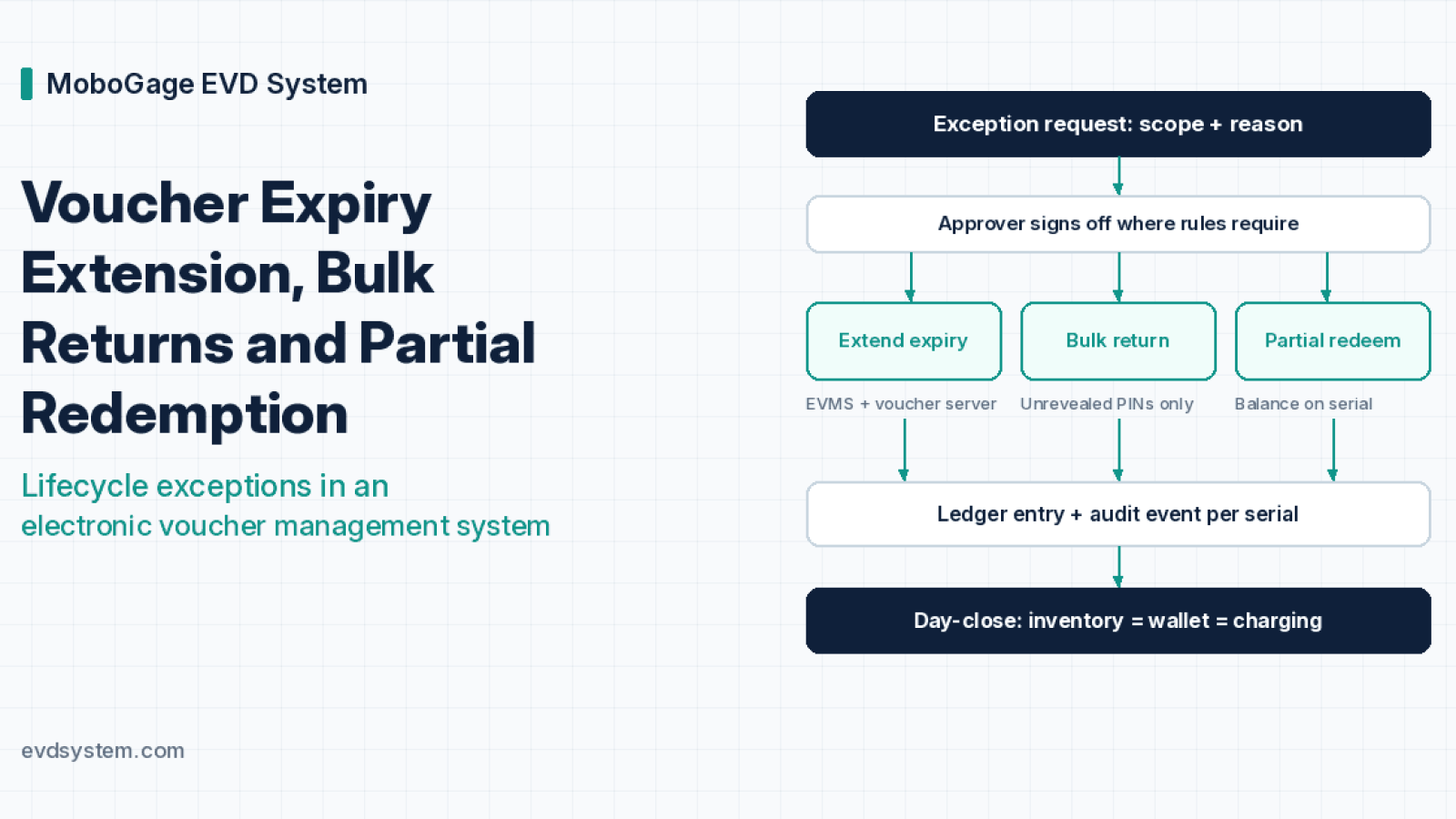
Short answer. Voucher expiry extension, bulk return of unsold stock and partial redemption are the lifecycle exceptions that most frequently break reconciliation in an electronic voucher management system (EVMS). All of them change the state or value of vouchers that already exist. So each one has to run as an approved, logged event with a named scope (batch, serial range or single serial), a matching entry in the dealer wallet ledger, and the same change applied on the operator’s voucher or charging platform.
- Expiry extension moves the expiry date of unsold or unredeemed vouchers. The date has to change on the system that validates redemption, not only in the distribution layer.
- Bulk return pulls unsold PINs back from a dealer node into inventory and credits the dealer. Only stock that was never revealed, printed or exported qualifies.
- Partial redemption lets one voucher be spent more than once until its value runs out. It belongs to gift cards and stored-value vouchers, while standard airtime PINs redeem in full.
We build MoboGage EVD System, an electronic voucher management system for telecom operators and VAS partners. Below is how we handle those exceptions, what the audit trail has to show for each, and what to ask a vendor before you sign. Figures in the worked examples are illustrative, not customer data.
Why the exceptions decide whether an EVMS holds up
Demos show the clean path. You generate a batch, allocate it to a master dealer, sell a PIN on a POS terminal and watch the subscriber’s balance go up, and money rarely goes missing there because each of those steps is a standard transaction the platform already records.
It goes missing on a Thursday afternoon. A regional distributor calls: a promotion ended early, a denomination is being retired, and he is sitting on stock that expires at the end of the month. He wants more time, or his money back, or permission to split the value across smaller top-ups. Fair enough. Whichever he asks for, the vouchers involved are already in the field, already counted in someone’s wallet and already loaded on the operator’s voucher server.
Handle that call with a database script and a phone call and finance finds out at month-end. Our glossary has a name for what they find: an unexplained variance. An electronic voucher management system earns its licence fee when requests like his turn into routine tickets that close cleanly.
The terms, defined
| Term | What it means | Typical requester | What it must never do |
|---|---|---|---|
| Voucher expiry extension | Moving the expiry date forward for vouchers that are not yet redeemed | Operator product team, master dealer | Revive a voucher that is already redeemed, blocked or cancelled |
| Bulk return | Taking unsold vouchers back from a dealer node into central inventory and crediting the dealer | Distributor, sub-dealer | Accept PINs that were revealed to a customer, printed or exported |
| Partial redemption | Redeeming part of a voucher’s value and keeping the remainder usable | Gift card or stored-value programme owner | Let the remaining balance exceed the original face value |
| Reinstatement | Returning a blocked or blacklisted voucher to sale after investigation | Fraud or revenue assurance team | Bypass the original block reason or approver |
| Forced expiry | Expiring vouchers early, usually after a leak or a withdrawn product | Operator, fraud team | Hit stock that a dealer has already paid for without a matching credit |
These sit on top of the normal lifecycle states (available, allocated, sold, redeemed, expired, cancelled) listed in our EVMS glossary. None of them adds a state. They move vouchers between existing states or change an attribute such as the expiry date or the remaining value, and the audit log has to record which of those happened.
Voucher expiry extension: change it where redemption checks it
Every voucher carries its expiry date in at least two places. The EVMS inventory uses it to decide whether the voucher can still be sold. The system that validates the PIN at redemption uses it too, whether that is the operator’s voucher server, the IN or OCS, or the EVMS itself when it owns redemption. On many IN platforms the voucher server keeps its own state for each serial and accepts or rejects the recharge request there.
Extend expiry in the EVMS alone and you get the worst kind of complaint: the dealer sells a PIN that our side says is valid, and the network refuses the subscriber’s recharge. Extend it only on the charging side and the EVMS stops selling stock that would redeem without trouble. The cure is a procedure. The extension request names a scope, is approved once, and is applied on both systems, with a confirmation back from each before the stock goes on sale again.
Worked example (illustrative figures). A master dealer holds 12,000 unsold 10-unit vouchers from batch B-2207, expiring on 30 November. The operator agrees to a 60-day extension for unsold stock only.
| Step | What happens | Record created |
|---|---|---|
| 1. Request | Product team raises an extension for batch B-2207, unsold serials only, new expiry 29 January | Request ID, scope, reason, requester |
| 2. Scope check | EVMS counts eligible serials: 12,000 allocated or available; 3,180 already sold are excluded | Eligible serial list with count and value |
| 3. Approval | Second approver signs off on the scope and the count | Approver, timestamp |
| 4. Apply in EVMS | Expiry attribute updated on 12,000 serials | One event per serial, linked to the request ID |
| 5. Apply at redemption | Same serial range updated on the voucher server, confirmation file returned | Charging-side confirmation, count matched |
| 6. Release | Stock becomes sellable again once both counts agree | Release event |
Watch the sold-but-unredeemed vouchers. A shop or a subscriber may be holding a PIN that now expires before the unsold stock next to it in the same batch. Decide up front whether the extension covers those serials, and write that answer into the request.
Promotions with a fixed end date are the other trap, because extending the voucher leaves the bonus end date where it was, so the redemption rule has to be checked along with the date.
Denomination changes raise expiry questions for GCC and wider MEA operators. In July 2020 Saudi Arabia raised VAT from 5% to 15%. Operators and distributors then had to decide what to do with stock priced under the old rate. A scoped extension or a controlled withdrawal handles that kind of change in a few approved requests instead of weeks of manual fixes. Our EVMS guide for GCC telecom covers the wider requirements by market.
Bulk return of unsold stock: prove the PIN was never seen
With physical scratch cards, a return is a box coming back through the warehouse, and the card is either intact or damaged. Electronic vouchers raise a harder question, which is whether anyone has seen the PIN.
Whoever saw a PIN can redeem it, whether it was shown on a POS screen, sent in an SMS, printed on a receipt or written to an export file. Take that serial back into inventory and resell it, and two people may hold the same value.
So the rule is short: a serial qualifies for return only if it was allocated to the dealer node and never revealed.
Applying it is harder. It depends on the platform keeping a reveal log per serial, and an EVMS that can only report that a voucher was “allocated to dealer D-0418” has no way to tell you whether the dealer’s terminal pulled the PIN down into an offline cache. Ask about this directly, since offline-tolerant POS terminals are built to do exactly that.
| Return check | Why it matters | Reject if |
|---|---|---|
| Serial belongs to the requesting node | Stops one dealer returning another’s stock | Serial allocated elsewhere or moved by transfer |
| No reveal, print or export event | A seen PIN can be redeemed by someone else | Any reveal event exists, including offline cache download |
| Not redeemed at the charging side | The EVMS may lag the voucher server | Charging platform shows a redemption |
| Inside the return window | Product rules and expiry limits | Return requested too close to expiry, per the agreed policy |
| Wallet credit matches purchase price | Dealer paid net of commission | Credit amount would include commission already earned |
Then the wallet. If the dealer bought stock at face value less a 3% commission (illustrative), the return credits the net amount, and any commission already posted up the hierarchy has to be reversed as well. In a multi-level chain one return can produce three or four ledger entries. Our post on multi-tier reseller voucher distribution explains how float and commission move through the hierarchy, and CreditSync covers distributor credit operations.
Accepted serials go back to central inventory as available, or into quarantine if the operator wants them held before reallocation. We usually suggest a day of quarantine, so that a late redemption reported by the charging side surfaces before the stock is sold to someone else.
Partial redemption: a balance, not a reissue
With partial redemption one voucher is spent in parts: a 100-unit gift voucher pays for a 40-unit purchase and keeps 60 for later. Gift card and stored-value programmes work this way, and so do bundles that carry several entitlements, such as a voucher that includes data plus a streaming subscription.
Airtime PINs don’t. Redemption credits the full face value to the subscriber’s account, and from that moment the balance belongs to the operator’s charging system. When a product team asks for “partial redemption” on airtime vouchers, they usually want something else: a voucher that can be split across several numbers, or a PINless top-up from dealer float where any amount can be sent. That second case is exactly the job eTopup was built to do.
Where partial redemption does apply, we hold the remaining value as a ledger balance attached to the serial. Each redemption posts as a debit with its own transaction reference, and the voucher stays redeemable until the balance reaches zero or the expiry date passes. Cancelling the original voucher and issuing a new one for the remainder looks simpler and causes damage: the audit trail breaks, the number of PINs in circulation doubles, and expiry rules become hard to reason about.
Retries need care. As with any redemption, a retried request carrying the same reference must not take the value twice. If the redemption call times out, nobody knows the remaining balance until a status query comes back. Our article on airtime top-up timeouts and unknown status walks through how that state is settled.
What the audit trail should show for each exception
An auditor reviewing any of these events wants to know who asked, who approved, exactly which serials were touched and how the books moved. The table below is the minimum we would accept.
| Event | Scope recorded | Approver | Wallet or ledger effect | Shows up at day-close as |
|---|---|---|---|---|
| Expiry extension | Batch ID, serial range, count, old and new date | Second approver, product or finance | None | Inventory attribute change, count reconciled with charging confirmation |
| Bulk return | Dealer node, serial list, count, value | Distributor manager plus operator finance | Credit to dealer wallet at net price, commission reversal up the chain | Inventory increase, wallet credit, commission reversal |
| Partial redemption | Serial, amount, remaining balance, channel | None (customer-initiated) | Debit on the voucher balance | Redemption volume and value, open balances report |
| Reinstatement | Serial or range, original block reason | Fraud or revenue assurance lead | None | State change from blocked to available |
| Forced expiry | Batch or range, reason | Operator plus fraud | Credit to affected dealers if stock was paid for | Inventory decrease, wallet credits |
In MoboGage EVD System, a person approves any mass cancel, forced expiry or balance correction, and that approval is logged, with the same discipline carried over to the exceptions above. At day close the platform matches its sales against the operator’s redemption records, and the voucher reconciliation and PIN security post shows how these events feed that match. The EVMS architecture guide shows which component owns each record.
Questions to put to any EVMS vendor
Ask these in the RFP. Then ask them again in the demo, and insist on seeing the actual screen and the audit record behind it rather than a slide that describes them.
- Can an expiry extension be scoped to unsold serials only, and how is the same change applied on the operator’s voucher server?
- Does the platform keep a per-serial reveal log, including PINs downloaded to offline POS caches?
- When a dealer returns stock, how are commissions already paid up the hierarchy reversed, and in which report do I see it?
- Which voucher products support partial redemption, and where is the remaining balance stored?
- Which of these actions need a second approver, and can that rule be configured per product?
- If an exception is applied in the EVMS but the charging-side update fails, what state are the vouchers left in?
For a broader comparison of platforms, our guide on how to choose an electronic voucher management system has the full checklist. If you are moving off an older system, map these exception rules before cutover; the EVMS migration playbook explains why unmapped states cause most cutover disputes.
If a batch has already expired, see how expired voucher reactivation and blocked batch reinstatement works.
Frequently asked questions
Can an expired voucher be reactivated?
Not by editing the voucher back into a redeemable state. In most charging platforms, putting expired unsold stock back on sale means extending or removing the batch expiry under approval and setting the batch back to Active, with stricter checks than an extension made in time. For a PIN a customer already holds, the usual route is new stock or an approved credit, which is why extensions should be applied before the expiry date.
What is a bulk return in voucher management?
A bulk return takes unsold vouchers back from a distributor or dealer into central inventory and credits the dealer’s wallet. In an electronic voucher management system, only vouchers that were never revealed, printed or exported should be accepted, because anyone who has seen a PIN can still redeem it.
Is partial redemption possible for telecom airtime vouchers?
Standard airtime PIN vouchers redeem their full face value into the subscriber’s balance in one step. Partial redemption is used for gift cards, stored-value vouchers and multi-entitlement bundles, where the remaining value is tracked as a balance on the voucher serial.
Who should approve a voucher expiry extension?
A second approver from product or finance should sign off on the scope (batch, serial range and count) before the change is applied. The request, the approval and each serial’s update should share one reference so the change can be traced at day-close.
Does a voucher expiry extension need to be applied in the charging system?
Yes, whenever the operator’s voucher server or charging platform checks expiry at redemption. If only the EVMS is updated, dealers can sell vouchers that the network then rejects. Both systems should confirm the same count before the stock is released.
How does MoboGage EVD System handle voucher lifecycle exceptions?
In MoboGage EVD System, expiry changes, returns, forced expiry and reinstatement are approved lifecycle events. Each one records its scope, approver and ledger effect, and each is carried into the daily reconciliation. Integration with each operator’s voucher or charging platform is scoped per project. Anonymised project write-ups are on our case studies page, with operator details removed.
Next step
If your team handles returns and extensions in a spreadsheet, list the last three exceptions you processed and where each one was recorded, and the gaps in your current process will show up in that list. To walk through how MoboGage EVD System would handle your exception rules, contact our team.
Add a Comment