
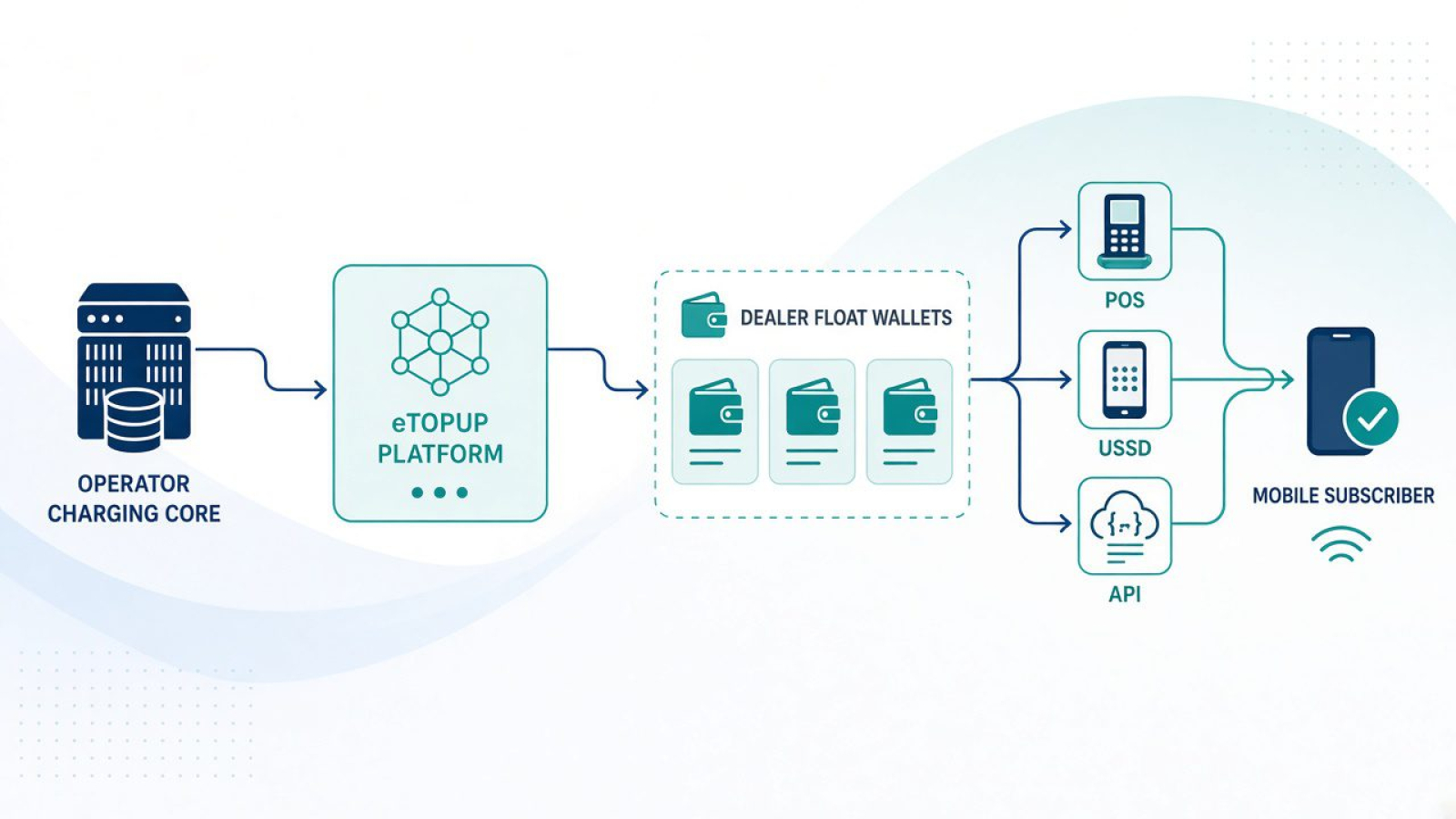
An electronic top up system (often called eTopup or etopup airtime distribution) lets telecom operators and their dealers credit prepaid subscribers directly—usually without handing over a printed scratch PIN. Value sits in dealer wallets or float; the sale posts to charging over USSD, POS, app, or API; the subscriber’s balance rises in near real time. Operators use it wheanding over a printed scratch PIN. Value sits in dealer wallets or float; the sale posts to charging over USSD, POS, app, or API; the subscriber’s balance rises in near real time. Operators use it when physical card logistics, denomination rigidity, or channel theft risk outweigh the comfort of cartons on the shelf.
TL;DR
- eTopup is PINless (or wallet-driven) airtime credit—not the same as printing EVD PIN stock for later scratch-style redemption.
- Dealer float replaces physical inventory exposure; credit limits and wallet visibility become the operating constraints.
- Channels typically include USSD, Android/Linux POS, portals, apps, and partner APIs against one float truth.
- Choose eTopup when you need fast denomination changes and lower card OpEx; keep a full electronic voucher management system when PIN lifecycle, hybrid stock, and deep reconcile still matter.
- GSMA research has long framed electronic airtime channels as a material cost lever versus scratch-card manufacturing and distribution (GSMA Mobile for Development).
What an electronic top up system actually does
In day-to-day ops language: a retailer or dealer takes cash (or wallet payment) from a subscriber, selects a denomination or bundle, and the platform debits the dealer’s float and instructs the operator’s IN / charging system to credit the MSISDN. No carton opens. No PIN sheet is photocopied in a back office. The transaction either commits with a unique id or fails cleanly with a retry path finance can understand.
That pattern is what industry writing usually means by electronic reloading or electronic top-up. Wikipedia’s overview of electronic reloading describes the shift away from physical prepaid cards toward retailer commercial load and digital credit—useful background when you brief product and channel teams that still think in “stock of cards.”
eTopup does not automatically mean you abandoned vouchers forever. Many markets run both: PINless top-up for high-velocity retail, and PIN or hybrid EVD where partners, regulations, or gift-style products still need serialised secrets. The decision is operating-model design, not a binary “digital good / cards bad” slogan.
How eTopup differs from physical scratch and EVD PIN print
| Dimension | Physical scratch cards | EVD PIN print / electronic PIN sale | Electronic top up (eTopup) |
|---|---|---|---|
| What the dealer holds | Printed cards with hidden PINs | Digital PIN inventory (revealed at sale) or print-on-demand | Wallet / float value—no PIN to the subscriber in the common PINless path |
| Theft / damage risk | High along logistics | Lower if secrets stay encrypted until sale | Lowest for PIN leakage; float misuse becomes the main risk |
| Denomination change | Reprint cycle | Catalog / batch policy update | Immediate policy and product catalog updates |
| Subscriber experience | Scratch + dial PIN | Receive / enter PIN | Instant credit to MSISDN |
| Reconciliation focus | Card batches vs sales | PIN status lifecycle vs charging | Float movements vs charging credits |
| Best fit | Legacy retail, remote print-heavy markets | When PIN products or hybrid stock remain required | High-velocity prepaid, micro-denoms, dense dealer networks |
Physical scratch remains familiar. It also carries manufacturing, warehousing, and leakage costs that electronic channels were built to reduce. EVD PIN paths still matter when you need serialised vouchers for certain partners or gift/OTT SKUs. eTopup shines when the commercial act is “credit this number now” and the dealer is effectively selling airtime value from a controlled wallet.
For the broader distribution vocabulary—EVD, VMS, and how they relate—see What is electronic voucher distribution (EVD)?.
Dealer float: the real inventory of eTopup
Once you remove cards from the story, float becomes the inventory. Operators and VAS partners typically:
- Onboard a hierarchy node (distributor, dealer, retailer).
- Fund that node’s wallet via bank transfer, cash deposit, or parent-wallet transfer.
- Enforce credit limits so a single compromised terminal cannot empty the sky.
- Debit float on successful top-up; credit float on approved reversals only.
- Expose near-real-time balances so field managers stop chasing WhatsApp screenshots.
If dealers distrust the float screen, they invent side ledgers. Side ledgers become disputes. Disputes become “the platform is wrong” tickets that bury real fraud. Float UX and day-close packs are product requirements, not nice-to-haves.
Credit limits should mirror commercial reality: a busy urban POS needs different headroom than a rural kiosk. Temporary limit lifts for festivals or salary-week peaks belong in policy—not in emergency DBA edits at midnight.
Channels that actually move airtime
A credible electronic top up system treats channels as faces of one float and fraud policy:
- USSD / SMS — Still dominant where feature phones and assisted retail are the norm. Keep menus short; log every attempt with MSISDN, dealer id, amount, and result code.
- Android / Linux POS — Handhelds and shop terminals for assisted sales. Offline-capable behaviour matters where coverage drops; define what can sell offline and how sync conflicts resolve.
- Dealer / retailer portals — Desktop replenishment, reporting, and sub-user management.
- Mobile apps — Agent apps for street sales and notifications on low float.
- APIs — Aggregators, banks, super-apps, and operator digital channels posting top-ups with the same velocity and duplicate controls as POS.
Omnichannel only counts if the same float ledger and duplicate/replay rules apply. A “web portal that sells without float debit” is a revenue leak dressed as a feature.
When operators need eTopup vs a full EVMS
Use this as a buyer checklist—not a marketing quiz.
Lean toward eTopup-first when:
- Most prepaid volume is PINless credit to MSISDN.
- Denomination and promo changes must ship weekly without print.
- Dealer complaints centre on card stockouts and logistics lag.
- You already trust (or will invest in) charging adapters and unique transaction ids.
Keep or prioritise a full electronic voucher management system when:
- You still run physical or hybrid PIN stock that needs lifecycle states.
- Gift cards, OTT entitlements, or partner PIN products sit beside airtime.
- Finance needs inventory-vs-sales reconcile across serialised secrets, not only float.
- Fraud teams care about batch blacklisting, PIN custody, and redemption audit as first-class objects.
In practice, many GCC and MEA operators land on a combined stack: EVMS as the lifecycle and inventory control plane, with eTopup as a primary sales mode off dealer wallets. That is how EVD System by MoboGage is usually positioned—float-backed channels under voucher and hierarchy discipline, not a disconnected “top-up gadget.”
If you are still comparing platform shapes, How to choose an electronic voucher management system walks the evaluation axes buyers actually argue about in steering committees.
Operational controls buyers should demand
Ask vendors to demonstrate—not slide-deck—the following:
- Idempotent top-up — Same client request id never double-credits the subscriber.
- Clear failure taxonomy — Timeout vs decline vs charging reject, with operator-facing codes.
- Reversal policy — Who can reverse, within what window, with what dual control.
- Velocity limits — Per dealer, per MSISDN, per terminal, per hour.
- Terminal hygiene — Disable lost devices; push config; know which POS version is live.
- Day-close pack — Float opening/closing, sales by channel, exceptions with owners.
- Charging alignment — Sales and IN/OCS credits share one truth or an explicit exception queue.
Without those, you have a fast way to move money and a slow way to explain where it went.
Implementation path that survives a normal Tuesday
- Map the pain — Where do cards disappear? Where do denomination changes stall? Where do channel sales disagree with charging?
- Pilot one hierarchy slice — One region, limited dealers, USSD or POS + portal. Prove float debit and charging credit on ordinary traffic.
- Encode commercial rules — Limits, commissions, and transfer approvals that match how distributors already work.
- Harden exceptions — Train L1 on reverse/decline paths before you open API partners.
- Expand by tier — Add apps, more POS families, and aggregator APIs once reconcile packs are trusted.
- Operate — Treat eTopup as prepaid critical infrastructure: monitoring, on-call, terminal lifecycle, fraud reviews.
Skip the demo that only shows a happy-path top-up with a pre-funded test wallet and no exception screen.
Soft next step
If your prepaid mix is still dominated by print logistics—or your “electronic” path is a patchwork of spreadsheets and partner portals—map one week of airtime sales by channel and float dispute volume. That short exercise usually clarifies whether you need eTopup discipline, full EVMS lifecycle, or both.
Operators and VAS partners evaluating EVD System can review the product overview on the electronic voucher management system page, learn more About MoboGage, or reach the team via the contact page · projects@mobogage.com · +91-9928 366 889.
FAQ
What is an electronic top up system?
It is software that lets dealers or digital channels credit prepaid subscribers from controlled float or wallets—typically without issuing a physical scratch PIN—while posting the credit to the operator’s charging system and logging the transaction for reconciliation.
Is eTopup the same as EVD?
Not exactly. EVD (electronic voucher distribution) emphasises moving voucher value through reseller channels. eTopup often means PINless airtime credit. Many platforms combine both: hierarchy and wallets from the EVD world, with eTopup as a primary sale mode. See What is EVD?.
Do dealers still need inventory?
They need float inventory—wallet balance and credit limits—not necessarily printed cards. PIN inventory still appears when you sell serialised vouchers alongside PINless top-up.
Which channels should we launch first?
Start with the channel that already carries your prepaid volume (often USSD or POS), prove float and charging alignment, then add APIs and apps. Launching every channel on day one without day-close discipline creates dispute factories.
When is a full EVMS still required?
When you manage PIN lifecycle, hybrid physical/electronic stock, multi-product catalogs (gift/OTT), or finance needs serialised inventory reconcile beyond float movements alone.
How does GSMA frame electronic airtime channels?
GSMA Mobile for Development writing on airtime distribution savings discusses how electronic top-up paths can reduce scratch-card manufacturing and channel discount costs relative to traditional card distribution—useful context for CFO-level business cases, not a substitute for your own market model.
Add a Comment