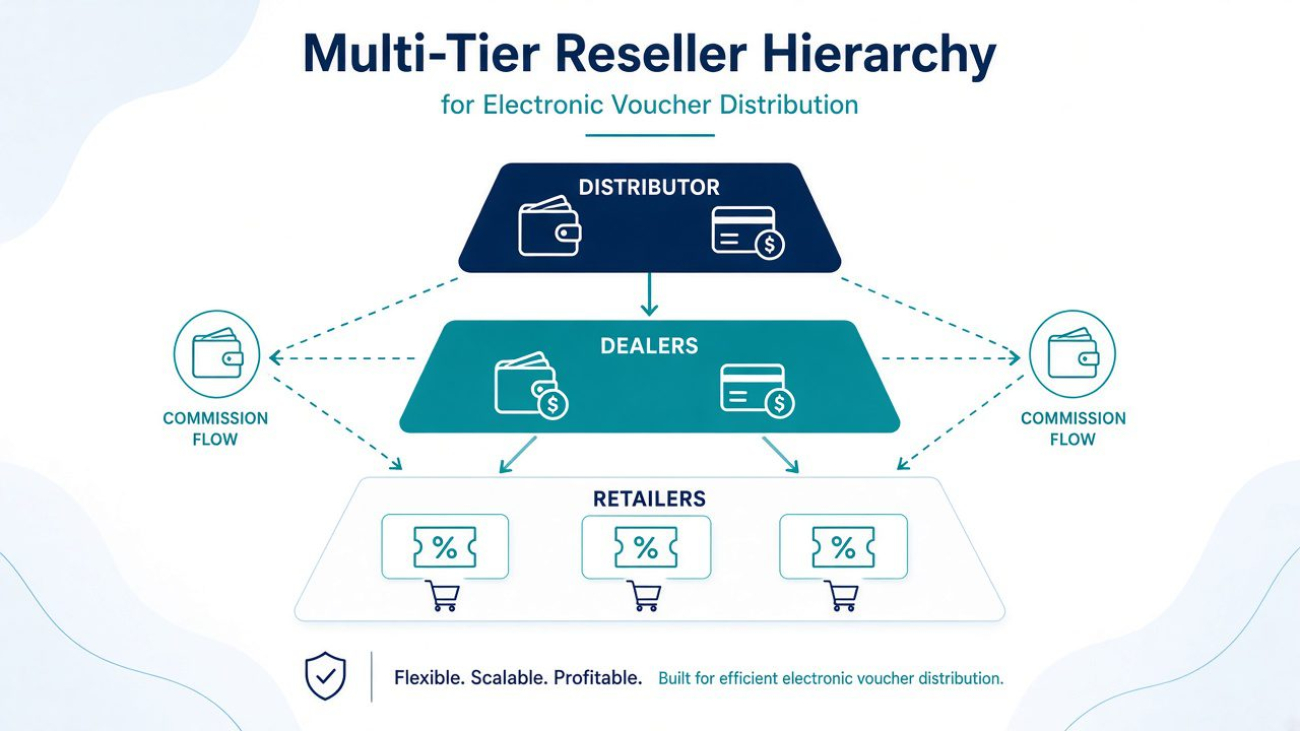
Multi-tier reseller voucher distribution hierarchy diagram from distributor to dealer to retailer for electronic vouchers

Multi-Tier Reseller Distribution for Electronic Vouchers

Multi-tier reseller voucher distribution is how most prepaid airtime and digital voucher value actually reaches the street: a distributor funds dealers, dealers fund retailers, retailers sell on POS, USSD, or appeach tier holding wallet balance, credit limits, and a slice of commission. An electronic voucher distribution hierarchy encodes that commercial reality in software so float, stock, and settlements stay auditable. Operators and VAS partners across GCC and MEA markets live this model daily; the platform either matches how the channel works, or the channel invents workarounds.

TL;DR

  • Hierarchy is not a UI treeit is wallets, limits, transfer rules, and commission logic that field managers will use under pressure.
  • Typical chain: operator / VAS admin distributor dealer retailer / agent, with optional regional splits.
  • Credit limits and offline POS sync are where programmes succeed or leak; treat them as first-class design.
  • Commissions should be configurable per tier and productnot hardcoded one discount for everyone.
  • For the lifecycle layer that sits above hierarchy, see the electronic voucher management system product page.

Why hierarchy exists (and why flat portals fail)

Prepaid distribution in many markets grew from physical logistics: master distributors held cartons, sub-dealers took boxes, retailers sold cards. When programmes went electronic, the people structure stayed. What changed was the objectwallets and digital stock instead of cardboard.

A flat everyone is a retailer portal looks clean in a demo. It collapses under real channel politics:

  • Master distributors expect sub-dealer creation rights and margin.
  • Regional managers need visibility without the ability to raid another regions float.
  • Retailers need fast sale flows, not admin screens built for HQ.
  • Finance needs one ledger truth across tiers at day-close.

GSMAs work on agent and airtime distribution networks has long noted that mobile operators already rely on multi-layer retail reach to put airtime within an arms reachand that those networks are assets when building adjacent digital services (GSMA agent networks handbook context). Electronic voucher programmes inherit that same structural truth.

For vocabulary on EVD itself, see What is electronic voucher distribution (EVD)?.

Anatomy of an electronic voucher distribution hierarchy

A practical multi-tier model usually includes:

Tier Commercial role Typical system objects
Operator / VAS admin Policy, catalog, root float, fraud rules Products, denominations, global limits, audit
Distributor / master Funds region or brand channel; creates dealers Parent wallet, transfer rights, reporting
Dealer / sub-distributor Funds retailers; may run own POS fleet Wallet, credit limit, commission share
Retailer / agent Sells to subscribers Sale rights, low-balance alerts, limited admin
Terminal / user Device or clerk under a retailer Auth, version, disablement

N-level trees are common. The point is not to maximise depth for sport. Every extra tier adds transfer latency, dispute surfaces, and training load. Design depth to match the markets existing commercial contractsthen enforce it in software so shadow hierarchies cannot form on WhatsApp.

Wallets and credit limits: the operating heart

In multi-tier reseller voucher distribution, each node typically holds:

  • Wallet balance Prepaid value available to transfer or sell.
  • Credit limit Ceiling on exposure (prepaid, postpaid-style credit, or hybrid).
  • Transfer permissions Who can push or pull float to children.
  • Product entitlements Which SKUs that node may sell (airtime, data, gift, OTT).

Credit limits are risk controls disguised as commercial terms. A distributor with uncapped children will eventually sponsor a fraud event. Temporary lifts for Eid peaks, salary weeks, or launch promotions belong in governed workflows with expirynot permanent just increase it tribal knowledge.

Low-balance notifications (SMS, app, email) keep the street selling. Without them, retailers claim stockouts while parent wallets sit idle upstairs.

Commissions without folklore

Commission design separates programmes that scale from programmes that argue monthly:

  • Per-tier rates Distributor, dealer, and retailer shares on the same sale.
  • Per-product rules Data bundles may differ from voice airtime; gift cards may differ again.
  • Timing Real-time wallet credit vs periodic settlement.
  • Clawbacks Clear policy when reversals happen.
  • Visibility Each tier sees its own earnings without leaking peer margins carelessly.

If commission math lives only in a side spreadsheet, the system of record is not the system. Encode rules, show statements, and reconcile commission totals into the same day-close culture you use for sales.

Offline POS sync in real channel conditions

Shop connectivity is uneven. GCC mall retail and dense urban MEA corridors may be fine; peri-urban and rural agents are not. Multi-tier distribution that assumes perpetual online POS will invent offline behaviour anywayusually badly.

Define explicitly:

  1. Which products may sell offline (if any).
  2. How local risk limits cap offline sales.
  3. How sync resolves conflicts when the server rejects a queued sale.
  4. How float is reserved or reconciled after reconnect.
  5. How long a terminal may remain offline before auto-disable.

Terminal managementversions, remote config, lost-device disablementbelongs in the same operating model. A hierarchy with orphaned POS still selling is not a hierarchy; it is a leak.

GCC / MEA operating context (without geo spam)

Channel reality in GCC and MEA prepaid markets often includes dense multi-brand retail, migrant-heavy prepaid bases, festival demand spikes, and partner-operated VAS distribution alongside opco-owned channels. Hierarchy software must tolerate:

  • Multi-currency or multi-denomination catalogs where programmes cross borders.
  • Partner white-label portals under opco policy.
  • Rapid onboarding of retailers without weeks of paper.
  • Reporting by region and partner that finance will actually open.

Mentioning the region once or twice is enough. Buyers know their markets; they need controls that fit, not slogan geography.

Comparison: flat vs multi-tier control

Dimension Flat retailer portal Multi-tier reseller hierarchy
Who creates sellers Central admin only Distributors/dealers under policy
Float path Admin retailer Cascaded wallets with limits
Commission Often single discount Configurable multi-level shares
Regional autonomy Weak Natural via subtree rights
Dispute surface Admin vs all Parentchild with audit
Fits existing contracts Rarely Usually
Risk if misconfigured Broad over-permission Deep trees without monitoring

Flat can work for a tiny pilot. Multi-tier matches how airtime already moves.

Buyer checklist for hierarchy platforms

Capability Prove in discovery
N-level tree Create distributor dealer retailer; show inheritance of policy
Wallet transfers Push/pull with approvals and audit
Credit limits Enforce hard stop mid-sale; temporary lift with expiry
Commissions Multi-level calc on one live sale; statement export
Channel parity Same float rules on POS, USSD, app, API
Offline sync Documented behaviour + conflict resolution demo
Reporting By tier, region, product; day-close pack
Disablement Kill a lost POS; revoke a dealer without nuking the tree
Onboarding Sub-user roles; KYC fields as your market requires

When comparing full platformsnot only hierarchyuse How to choose an electronic voucher management system.

How EVD System approaches hierarchy

EVD System by MoboGage treats dealer hierarchy and float as part of the prepaid control plane: allocation through master dealers and retailers, credit limits, multi-channel sale, and reconciliation. The goal is hierarchy dealers will trust on a busy afternoonnot an org-chart widget that finance cannot close.

Adjacent realitiesPINless eTopup off the same wallets, PIN lifecycle for hybrid stocksit beside hierarchy rather than replacing it. Channel design without lifecycle and security is incomplete; security without hierarchy that matches contracts will not get adopted.

Soft next step

Sketch your live commercial tree on one page: who funds whom, who sets limits, who earns what on a single airtime sale. Bring that page to vendor demos. If the platform cannot encode it without custom folklore, keep evaluating.

Learn more About MoboGage or start a scoped conversation via the contact page projects@mobogage.com +91-9928 366 889.

FAQ

What is multi-tier reseller voucher distribution?

It is the commercial and technical model where prepaid voucher or airtime value moves through nested partnerstypically distributor, dealer, and retailereach with wallets, limits, and commissions, down to a subscriber sale.

How many tiers should we configure?

Match existing contracts and management capacity. Start with the minimum depth that reflects who actually funds whom; add tiers only when a commercial role requires separate float and reporting.

What is the difference between hierarchy and EVMS?

Hierarchy is the channel and float structure. An electronic voucher management system covers lifecycle, security, channels, and reconciliationincluding hierarchy as a core module. Buyers usually need both connected.

How do commissions work across tiers?

On a successful sale, configured shares can credit parent and child wallets (or settle periodically). Rules should be product-aware and include reversal clawback policy.

Why does offline POS sync matter for hierarchy?

Retailers at the edge often have uneven connectivity. Without defined offline limits and sync conflict rules, parent wallets and child sales divergeand multi-tier trust collapses.

Can APIs sit inside the same hierarchy?

Yes. Aggregator or bank API nodes should consume the same float and fraud policy as POS retailers. Separate API float with weaker controls recreates leakage under a modern label.
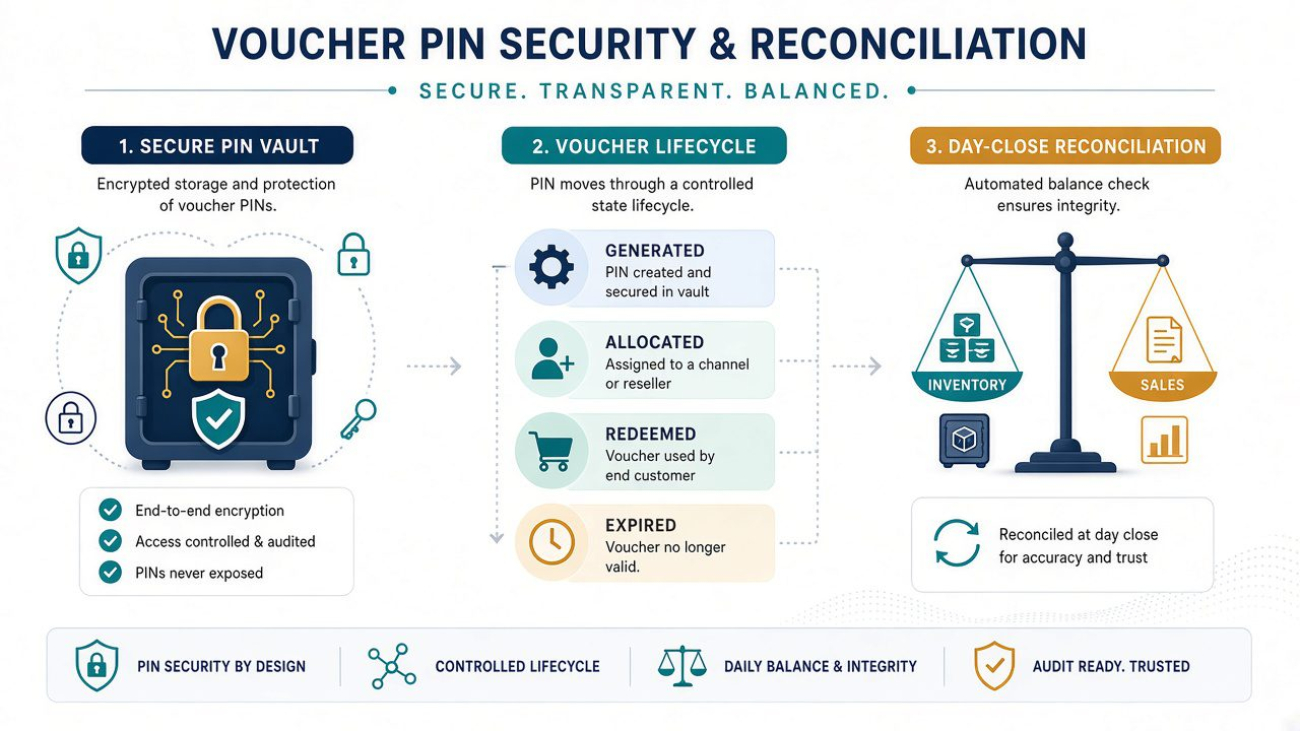
Voucher reconciliation and PIN security diagram showing lifecycle states and day-close controls in an electronic voucher management system

Voucher Reconciliation and PIN Security in an Electronic Voucher Management System

Voucher reconciliation is the day-close discipline that proves prepaid inventory, channel sales, and charging redemptions tell the same story. In an electronic voucher management system, that discipline sits beside PIN security: encryption of voucher secrets, controlled lifecycle states, custody rules, and audit trails that survive operator review. Buyers evaluating EVMS platforms should treat security and reconcile as one operating problemnot two slide decks.

TL;DR

  • PIN security without reconcile still leaves finance arguing with fraud; reconcile without PIN custody still leaks value at the edges.
  • Lifecycle states (generated allocated sold redeemed / expired / cancelled) are the spine of both inventory control and audit.
  • Physical theft and damage matter less when secrets never sit as plain text; float misuse and insider reveal become the primary risks.
  • Inventory-vs-sales and sales-vs-charging packs need named owners for exceptionsor disputes never close.
  • For platform scope beyond security alone, see the electronic voucher management system overview.

Why PIN security and reconciliation belong in the same brief

Telecom prepaid looks simple from the shop floor: sell value, credit a phone. Inside the stack, two failure modes dominate steering-committee conversations.

First, secrets leak. A batch file emailed unencrypted, a POS that caches clear PINs, a reprint without dual controleach becomes an unauthorised redemption somewhere else in the network.

Second, numbers disagree. Dealer wallets show one total; POS reports another; charging redemptions land somewhere in between. Without voucher reconciliation, every mismatch becomes a blame loop among channel ops, finance, and the vendor.

An electronic voucher management system earns its keep when it shrinks both failure modes with the same data model: serialised stock, status gates, encrypted secrets, and transaction ids that finance can follow end to end.

Industry and standards writing reinforce the pattern. Payment and voucher programmes commonly require unique end-to-end identifiers, encrypted storage of sensitive voucher data, and internal/external reconciliation across partiessee, for example, GovStacks voucher and payment orchestration requirements on voucher storage, audit, and reconciliation. Separately, GSMA work on airtime distribution economics shows why operators care about electronic channels in the first place: reducing scratch-card manufacturing and channel costs only sticks if the digital path is trustworthy (GSMA on airtime distribution savings).

PIN security: what encrypted until sale really means

Buyers hear PINs are encrypted in every demo. Ask what that covers.

At rest

Voucher secrets should not live as readable columns in a spreadsheet extract or an unprotected database dump. Encryption at rest, key custody separate from application admins where feasible, and segregation of duties for who can decrypt or export are the baseline questions. If a developer can pull a CSV of live PINs from production with one ticket, you do not have PIN securityyou have theatre.

In transit

Channels that reveal or transmit PINs (print-on-demand, SMS delivery, POS display) need TLS and channel authentication. Reveal should be tied to an authorised sale event, not a casual preview.

At reveal

The moment of sale is the highest-risk second. Controls that matter:

  • Role and device authentication before reveal.
  • One-time reveal logging (who, which terminal, which batch, which MSISDN if applicable).
  • Reprint / re-reveal policies with dual control and reason codes.
  • Velocity limits so a compromised retailer cannot drain a batch overnight.

Against guessing and replay

PIN and voucher number schemes should resist trivial prediction. Redemption paths need duplicate and replay protection so the same secret cannot credit twice. Timeout handling must be explicit: did charging accept, or do we leave the voucher in a pending-investigation state?

None of this requires inventing exotic cryptography for a blog post. It requires operational honesty about who can see secrets and how redemptions are proven.

Lifecycle states: the shared language of ops and audit

Thin EVD tools skip states. Serious EVMS designs make them unavoidable:

State Meaning Typical controls
Generated / intake Batch created or imported under policy Batch metadata, denomination, expiry, encryption plugin
Available Eligible for allocation Not yet assigned to a channel node
Allocated Assigned to distributor / dealer / wallet Hierarchy transfer rules, credit limits
Sold / issued Revealed or committed to a sale Float debit, reveal log, channel id
Redeemed Charging accepted credit Unique redemption id, duplicate block
Expired Past validity Reporting and write-off policy
Cancelled / blacklisted Removed from sale (theft, error, fraud) Batch or serial block, audit reason
Pending / exception Ambiguous after timeout or partial failure Human queue with owner

Every transition should leave an audit trail. If someone can silently move a serial from available to sold without a transaction, reconcile will never close.

For distribution context around how stock moves through resellers, see What is electronic voucher distribution (EVD)?.

Theft, damage, and the shift in risk profile

Physical scratch programmes lose value to damaged cards, wet cartons, and outright theft in transit. Electronic programmes reduce those modesthen invent new ones:

  • Insider reveal Staff or partners exporting batches.
  • Terminal compromise Lost POS still authorised to sell.
  • Social engineering Fake support asking for reprints.
  • Float gaming Collusion between hierarchy nodes and fake sales/reversals.
  • Charging mismatch exploits Selling when redemption is known flaky, then disputing.

Mitigations are operational: device disablement, short-lived sessions, dual control on sensitive actions, batch blacklist playbooks, and reconcile packs that surface anomalies early. We went digital is not a control. Digital without custody is just faster leakage.

Inventory vs sales vs charging: three ledgers, one close

Voucher reconciliation usually means matching three views:

  1. Inventory ledger What serials exist in which state, by batch and hierarchy node.
  2. Sales ledger What the channel claims it sold (POS, USSD, API, portal).
  3. Charging / redemption ledger What the IN/OCS or voucher redeem service accepted.

Healthy day-close asks:

  • Opening available + allocations sales cancels expiries = closing available?
  • Sales by dealer float debits for that dealer?
  • Sold PIN serials that should redeem successful redemptions (with timing lag understood)?
  • Exceptions queued with owners and age SLAs?

When sales and charging disagree, you do not adjust in Excel and move on. You open an exception with a reason class: timeout, double-submit, charging reject after local commit, channel clock skew, or suspected fraud. Platforms that cannot classify exceptions force humans to invent folklore.

Checklist: security + reconcile readiness

Use this in RFPs and discovery workshops:

Area Ask / prove
Secrets Encryption at rest; no clear PIN in routine exports
Keys Who holds keys; rotation; segregation from app admins
Reveal Sale-gated reveal; reprint dual control; full reveal log
Lifecycle Explicit states; illegal transitions blocked
Audit Immutable (or WORM-style) logs for privileged actions
Ids Unique end-to-end transaction ids across sale and redeem
Reconcile pack Daily inventory, sales, float, redemption, exceptions
Ownership Named queues for finance, fraud, and channel ops
Devices Loss/disable workflow; version inventory
Hybrid Physical + electronic under one status model if both exist

If a vendor can only demo generate PIN show on phone, keep looking. That line exists on the product page for a reason.

How EVD System frames the problem

EVD System by MoboGage is built as the prepaid control plane: generation or intake, hierarchy allocation, multi-channel sale, redemption path, and reconciliation finance can use. PIN custody and day-close are not add-on slogans; they are why operators and VAS partners adopt an EVMS instead of a thin top-up widget.

When you compare vendors, How to choose an electronic voucher management system outlines evaluation axesincluding security review posture and reconciliation packs that work on a normal day, not only in a scripted demo.

Soft next step

Pick one recent week of prepaid exceptions. Count how many were numbers dont match versus PIN may have leaked. That split usually tells you whether to prioritise reconcile tooling, custody hardening, or both before you argue about UI themes.

For a structured conversation about EVD System, see About MoboGage or the contact page projects@mobogage.com +91-9928 366 889.

FAQ

What is voucher reconciliation in telecom prepaid?

It is the process of matching inventory states, channel sales (and float movements), and charging redemptions so finance and fraud can close the day with known exceptionsnot unexplained gaps.

How does PIN security relate to an electronic voucher management system?

An EVMS governs voucher secrets across their lifecycle. PIN security is the set of encryption, access, reveal, and redemption controls that keep those secrets from becoming unauthorised credit.

Can we reconcile if we only run PINless eTopup?

Yesbut the objects change. You reconcile float and sales against charging credits more than serial PIN states. Many operators still want EVMS-grade audit when any PIN products remain in the catalog.

What should a day-close pack include?

Opening/closing inventory or float, sales by channel and dealer, redemptions, cancels/expiries, and an aged exception list with owners and reason codes.

How do we handle a compromised batch?

Blacklist or cancel affected serials, notify channel nodes, preserve audit evidence, and reconcile remaining inventory immediately. Document the playbook before you need it at 2 a.m.

Is encryption alone enough?

No. Encryption without role control, reveal policy, device hygiene, and reconcile ownership still fails in ordinary operations.

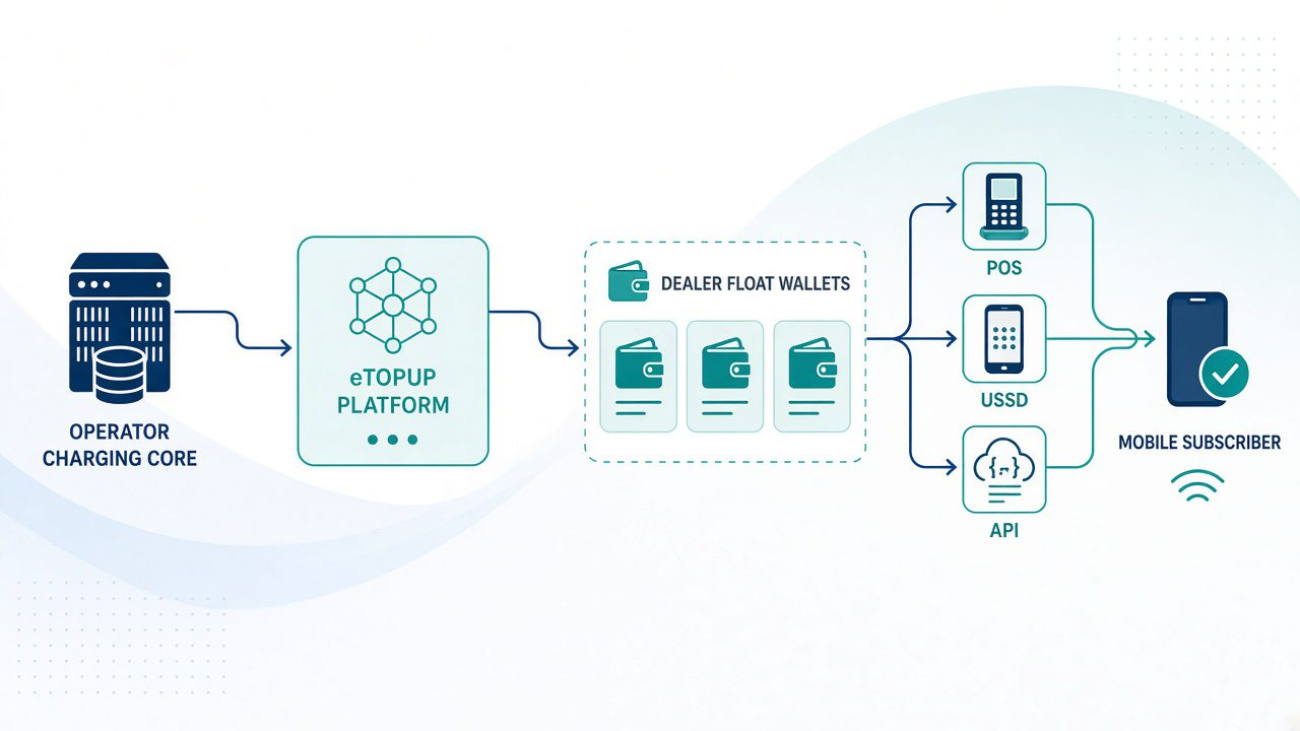
Diagram of an electronic top up system for telecom airtime

Electronic Top-Up System for Telecom Operators

An electronic top up system (often called eTopup or etopup airtime distribution) lets telecom operators and their dealers credit prepaid subscribers directly—usually without handing over a printed scratch PIN. Value sits in dealer wallets or float; the sale posts to charging over USSD, POS, app, or API; the subscriber’s balance rises in near real time. Operators use it wheanding over a printed scratch PIN. Value sits in dealer wallets or float; the sale posts to charging over USSD, POS, app, or API; the subscriber’s balance rises in near real time. Operators use it when physical card logistics, denomination rigidity, or channel theft risk outweigh the comfort of cartons on the shelf.

TL;DR

  • eTopup is PINless (or wallet-driven) airtime credit—not the same as printing EVD PIN stock for later scratch-style redemption.
  • Dealer float replaces physical inventory exposure; credit limits and wallet visibility become the operating constraints.
  • Channels typically include USSD, Android/Linux POS, portals, apps, and partner APIs against one float truth.
  • Choose eTopup when you need fast denomination changes and lower card OpEx; keep a full electronic voucher management system when PIN lifecycle, hybrid stock, and deep reconcile still matter.
  • GSMA research has long framed electronic airtime channels as a material cost lever versus scratch-card manufacturing and distribution (GSMA Mobile for Development).

What an electronic top up system actually does

In day-to-day ops language: a retailer or dealer takes cash (or wallet payment) from a subscriber, selects a denomination or bundle, and the platform debits the dealer’s float and instructs the operator’s IN / charging system to credit the MSISDN. No carton opens. No PIN sheet is photocopied in a back office. The transaction either commits with a unique id or fails cleanly with a retry path finance can understand.

That pattern is what industry writing usually means by electronic reloading or electronic top-up. Wikipedia’s overview of electronic reloading describes the shift away from physical prepaid cards toward retailer commercial load and digital credit—useful background when you brief product and channel teams that still think in “stock of cards.”

eTopup does not automatically mean you abandoned vouchers forever. Many markets run both: PINless top-up for high-velocity retail, and PIN or hybrid EVD where partners, regulations, or gift-style products still need serialised secrets. The decision is operating-model design, not a binary “digital good / cards bad” slogan.

How eTopup differs from physical scratch and EVD PIN print

Dimension Physical scratch cards EVD PIN print / electronic PIN sale Electronic top up (eTopup)
What the dealer holds Printed cards with hidden PINs Digital PIN inventory (revealed at sale) or print-on-demand Wallet / float value—no PIN to the subscriber in the common PINless path
Theft / damage risk High along logistics Lower if secrets stay encrypted until sale Lowest for PIN leakage; float misuse becomes the main risk
Denomination change Reprint cycle Catalog / batch policy update Immediate policy and product catalog updates
Subscriber experience Scratch + dial PIN Receive / enter PIN Instant credit to MSISDN
Reconciliation focus Card batches vs sales PIN status lifecycle vs charging Float movements vs charging credits
Best fit Legacy retail, remote print-heavy markets When PIN products or hybrid stock remain required High-velocity prepaid, micro-denoms, dense dealer networks

Physical scratch remains familiar. It also carries manufacturing, warehousing, and leakage costs that electronic channels were built to reduce. EVD PIN paths still matter when you need serialised vouchers for certain partners or gift/OTT SKUs. eTopup shines when the commercial act is “credit this number now” and the dealer is effectively selling airtime value from a controlled wallet.

For the broader distribution vocabulary—EVD, VMS, and how they relate—see What is electronic voucher distribution (EVD)?.

Dealer float: the real inventory of eTopup

Once you remove cards from the story, float becomes the inventory. Operators and VAS partners typically:

  1. Onboard a hierarchy node (distributor, dealer, retailer).
  2. Fund that node’s wallet via bank transfer, cash deposit, or parent-wallet transfer.
  3. Enforce credit limits so a single compromised terminal cannot empty the sky.
  4. Debit float on successful top-up; credit float on approved reversals only.
  5. Expose near-real-time balances so field managers stop chasing WhatsApp screenshots.

If dealers distrust the float screen, they invent side ledgers. Side ledgers become disputes. Disputes become “the platform is wrong” tickets that bury real fraud. Float UX and day-close packs are product requirements, not nice-to-haves.

Credit limits should mirror commercial reality: a busy urban POS needs different headroom than a rural kiosk. Temporary limit lifts for festivals or salary-week peaks belong in policy—not in emergency DBA edits at midnight.

Channels that actually move airtime

A credible electronic top up system treats channels as faces of one float and fraud policy:

  • USSD / SMS — Still dominant where feature phones and assisted retail are the norm. Keep menus short; log every attempt with MSISDN, dealer id, amount, and result code.
  • Android / Linux POS — Handhelds and shop terminals for assisted sales. Offline-capable behaviour matters where coverage drops; define what can sell offline and how sync conflicts resolve.
  • Dealer / retailer portals — Desktop replenishment, reporting, and sub-user management.
  • Mobile apps — Agent apps for street sales and notifications on low float.
  • APIs — Aggregators, banks, super-apps, and operator digital channels posting top-ups with the same velocity and duplicate controls as POS.

Omnichannel only counts if the same float ledger and duplicate/replay rules apply. A “web portal that sells without float debit” is a revenue leak dressed as a feature.

When operators need eTopup vs a full EVMS

Use this as a buyer checklist—not a marketing quiz.

Lean toward eTopup-first when:

  • Most prepaid volume is PINless credit to MSISDN.
  • Denomination and promo changes must ship weekly without print.
  • Dealer complaints centre on card stockouts and logistics lag.
  • You already trust (or will invest in) charging adapters and unique transaction ids.

Keep or prioritise a full electronic voucher management system when:

  • You still run physical or hybrid PIN stock that needs lifecycle states.
  • Gift cards, OTT entitlements, or partner PIN products sit beside airtime.
  • Finance needs inventory-vs-sales reconcile across serialised secrets, not only float.
  • Fraud teams care about batch blacklisting, PIN custody, and redemption audit as first-class objects.

In practice, many GCC and MEA operators land on a combined stack: EVMS as the lifecycle and inventory control plane, with eTopup as a primary sales mode off dealer wallets. That is how EVD System by MoboGage is usually positioned—float-backed channels under voucher and hierarchy discipline, not a disconnected “top-up gadget.”

If you are still comparing platform shapes, How to choose an electronic voucher management system walks the evaluation axes buyers actually argue about in steering committees.

Operational controls buyers should demand

Ask vendors to demonstrate—not slide-deck—the following:

  1. Idempotent top-up — Same client request id never double-credits the subscriber.
  2. Clear failure taxonomy — Timeout vs decline vs charging reject, with operator-facing codes.
  3. Reversal policy — Who can reverse, within what window, with what dual control.
  4. Velocity limits — Per dealer, per MSISDN, per terminal, per hour.
  5. Terminal hygiene — Disable lost devices; push config; know which POS version is live.
  6. Day-close pack — Float opening/closing, sales by channel, exceptions with owners.
  7. Charging alignment — Sales and IN/OCS credits share one truth or an explicit exception queue.

Without those, you have a fast way to move money and a slow way to explain where it went.

Implementation path that survives a normal Tuesday

  1. Map the pain — Where do cards disappear? Where do denomination changes stall? Where do channel sales disagree with charging?
  2. Pilot one hierarchy slice — One region, limited dealers, USSD or POS + portal. Prove float debit and charging credit on ordinary traffic.
  3. Encode commercial rules — Limits, commissions, and transfer approvals that match how distributors already work.
  4. Harden exceptions — Train L1 on reverse/decline paths before you open API partners.
  5. Expand by tier — Add apps, more POS families, and aggregator APIs once reconcile packs are trusted.
  6. Operate — Treat eTopup as prepaid critical infrastructure: monitoring, on-call, terminal lifecycle, fraud reviews.

Skip the demo that only shows a happy-path top-up with a pre-funded test wallet and no exception screen.

Soft next step

If your prepaid mix is still dominated by print logistics—or your “electronic” path is a patchwork of spreadsheets and partner portals—map one week of airtime sales by channel and float dispute volume. That short exercise usually clarifies whether you need eTopup discipline, full EVMS lifecycle, or both.

Operators and VAS partners evaluating EVD System can review the product overview on the electronic voucher management system page, learn more About MoboGage, or reach the team via the contact page · projects@mobogage.com · +91-9928 366 889.

FAQ

What is an electronic top up system?

It is software that lets dealers or digital channels credit prepaid subscribers from controlled float or wallets—typically without issuing a physical scratch PIN—while posting the credit to the operator’s charging system and logging the transaction for reconciliation.

Is eTopup the same as EVD?

Not exactly. EVD (electronic voucher distribution) emphasises moving voucher value through reseller channels. eTopup often means PINless airtime credit. Many platforms combine both: hierarchy and wallets from the EVD world, with eTopup as a primary sale mode. See What is EVD?.

Do dealers still need inventory?

They need float inventory—wallet balance and credit limits—not necessarily printed cards. PIN inventory still appears when you sell serialised vouchers alongside PINless top-up.

Which channels should we launch first?

Start with the channel that already carries your prepaid volume (often USSD or POS), prove float and charging alignment, then add APIs and apps. Launching every channel on day one without day-close discipline creates dispute factories.

When is a full EVMS still required?

When you manage PIN lifecycle, hybrid physical/electronic stock, multi-product catalogs (gift/OTT), or finance needs serialised inventory reconcile beyond float movements alone.

How does GSMA frame electronic airtime channels?

GSMA Mobile for Development writing on airtime distribution savings discusses how electronic top-up paths can reduce scratch-card manufacturing and channel discount costs relative to traditional card distribution—useful context for CFO-level business cases, not a substitute for your own market model.

pos_evd-system

Telecom voucher distribution opportunity in United Kingdom

  • The United Kingdom is a big market for telecom companies. The voucher management system in the telecom of the United Kingdom is still having great scope for business entrepreneurs. Telecom companies like O2, Vodafone are still using electronic voucher distribution for Airtime voice, Airtime Data and bundle recharges.

Major Telecom Companies in United Kingdom

  1. O2
  2. EE
  3. Vodafone
  4. Three

EE has the largest number of umbrella, including ASDA Mobile, BT Mobile, Plusnet, Virgin Mobile and HMD Mobile.

O2’s umbrella include Giffgaff, Tesco Mobile and Sky Mobile.

Three’s include iD Mobile and SMARTY, while Vodafone’s include Talk Mobile and VOXI.


How Electronic Voucher Management System deliver value to telecom subscribers in United Kingdom?

Voucher distiribution system by MoboGage is considered among top 5 voucher management system in the world. The innovative approach of MoboGage makes this platform unique and highly robust over high value of transactions.
MoboGage EVD System is used for following services
  • Digital Wallet
  • Airtime Recharge
  • Pay-TV Recharge
  • Data Recharge
  • OTT Subscriptions