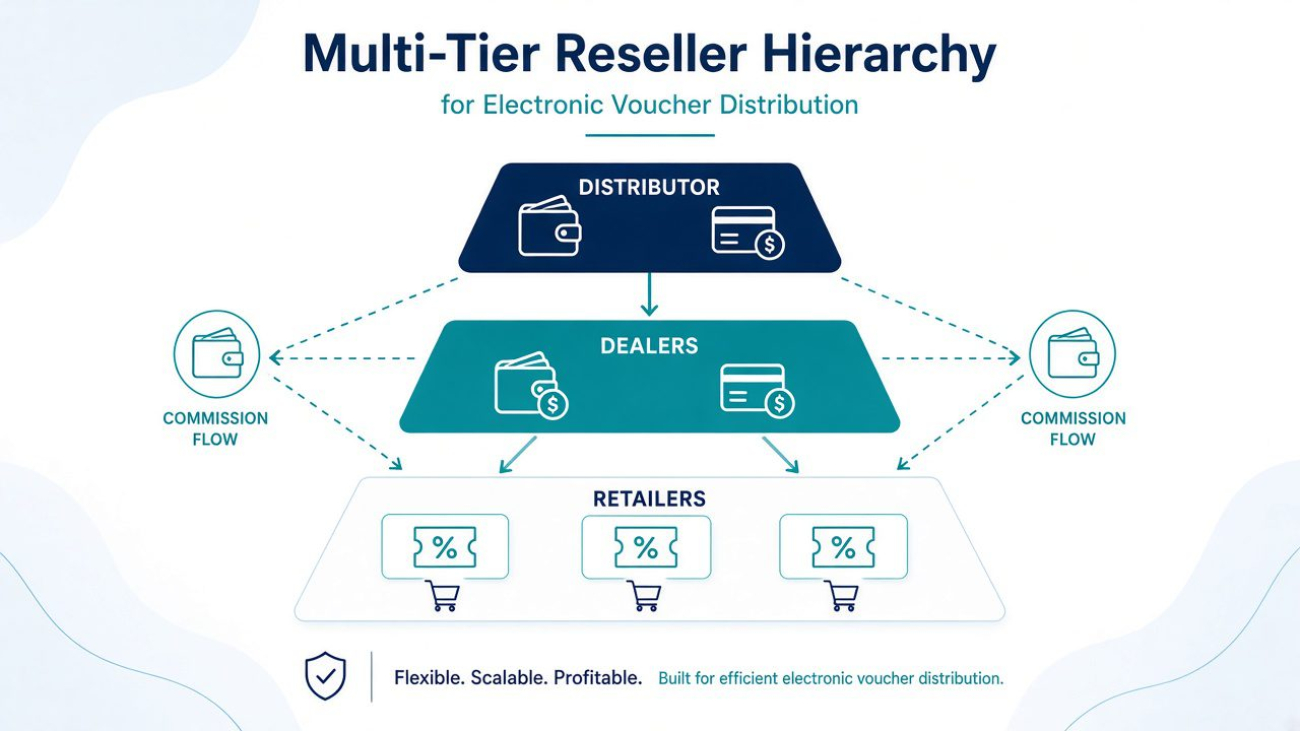
Multi-tier reseller voucher distribution hierarchy diagram from distributor to dealer to retailer for electronic vouchers

Multi-Tier Reseller Distribution for Electronic Vouchers

Multi-tier reseller voucher distribution is how most prepaid airtime and digital voucher value actually reaches the street: a distributor funds dealers, dealers fund retailers, retailers sell on POS, USSD, or appeach tier holding wallet balance, credit limits, and a slice of commission. An electronic voucher distribution hierarchy encodes that commercial reality in software so float, stock, and settlements stay auditable. Operators and VAS partners across GCC and MEA markets live this model daily; the platform either matches how the channel works, or the channel invents workarounds.

TL;DR

  • Hierarchy is not a UI treeit is wallets, limits, transfer rules, and commission logic that field managers will use under pressure.
  • Typical chain: operator / VAS admin distributor dealer retailer / agent, with optional regional splits.
  • Credit limits and offline POS sync are where programmes succeed or leak; treat them as first-class design.
  • Commissions should be configurable per tier and productnot hardcoded one discount for everyone.
  • For the lifecycle layer that sits above hierarchy, see the electronic voucher management system product page.

Why hierarchy exists (and why flat portals fail)

Prepaid distribution in many markets grew from physical logistics: master distributors held cartons, sub-dealers took boxes, retailers sold cards. When programmes went electronic, the people structure stayed. What changed was the objectwallets and digital stock instead of cardboard.

A flat everyone is a retailer portal looks clean in a demo. It collapses under real channel politics:

  • Master distributors expect sub-dealer creation rights and margin.
  • Regional managers need visibility without the ability to raid another regions float.
  • Retailers need fast sale flows, not admin screens built for HQ.
  • Finance needs one ledger truth across tiers at day-close.

GSMAs work on agent and airtime distribution networks has long noted that mobile operators already rely on multi-layer retail reach to put airtime within an arms reachand that those networks are assets when building adjacent digital services (GSMA agent networks handbook context). Electronic voucher programmes inherit that same structural truth.

For vocabulary on EVD itself, see What is electronic voucher distribution (EVD)?.

Anatomy of an electronic voucher distribution hierarchy

A practical multi-tier model usually includes:

TierCommercial roleTypical system objects
Operator / VAS adminPolicy, catalog, root float, fraud rulesProducts, denominations, global limits, audit
Distributor / masterFunds region or brand channel; creates dealersParent wallet, transfer rights, reporting
Dealer / sub-distributorFunds retailers; may run own POS fleetWallet, credit limit, commission share
Retailer / agentSells to subscribersSale rights, low-balance alerts, limited admin
Terminal / userDevice or clerk under a retailerAuth, version, disablement

N-level trees are common. The point is not to maximise depth for sport. Every extra tier adds transfer latency, dispute surfaces, and training load. Design depth to match the markets existing commercial contractsthen enforce it in software so shadow hierarchies cannot form on WhatsApp.

Wallets and credit limits: the operating heart

In multi-tier reseller voucher distribution, each node typically holds:

  • Wallet balance Prepaid value available to transfer or sell.
  • Credit limit Ceiling on exposure (prepaid, postpaid-style credit, or hybrid).
  • Transfer permissions Who can push or pull float to children.
  • Product entitlements Which SKUs that node may sell (airtime, data, gift, OTT).

Credit limits are risk controls disguised as commercial terms. A distributor with uncapped children will eventually sponsor a fraud event. Temporary lifts for Eid peaks, salary weeks, or launch promotions belong in governed workflows with expirynot permanent just increase it tribal knowledge.

Low-balance notifications (SMS, app, email) keep the street selling. Without them, retailers claim stockouts while parent wallets sit idle upstairs.

Commissions without folklore

Commission design separates programmes that scale from programmes that argue monthly:

  • Per-tier rates Distributor, dealer, and retailer shares on the same sale.
  • Per-product rules Data bundles may differ from voice airtime; gift cards may differ again.
  • Timing Real-time wallet credit vs periodic settlement.
  • Clawbacks Clear policy when reversals happen.
  • Visibility Each tier sees its own earnings without leaking peer margins carelessly.

If commission math lives only in a side spreadsheet, the system of record is not the system. Encode rules, show statements, and reconcile commission totals into the same day-close culture you use for sales.

Offline POS sync in real channel conditions

Shop connectivity is uneven. GCC mall retail and dense urban MEA corridors may be fine; peri-urban and rural agents are not. Multi-tier distribution that assumes perpetual online POS will invent offline behaviour anywayusually badly.

Define explicitly:

  1. Which products may sell offline (if any).
  2. How local risk limits cap offline sales.
  3. How sync resolves conflicts when the server rejects a queued sale.
  4. How float is reserved or reconciled after reconnect.
  5. How long a terminal may remain offline before auto-disable.

Terminal managementversions, remote config, lost-device disablementbelongs in the same operating model. A hierarchy with orphaned POS still selling is not a hierarchy; it is a leak.

GCC / MEA operating context (without geo spam)

Channel reality in GCC and MEA prepaid markets often includes dense multi-brand retail, migrant-heavy prepaid bases, festival demand spikes, and partner-operated VAS distribution alongside opco-owned channels. Hierarchy software must tolerate:

  • Multi-currency or multi-denomination catalogs where programmes cross borders.
  • Partner white-label portals under opco policy.
  • Rapid onboarding of retailers without weeks of paper.
  • Reporting by region and partner that finance will actually open.

Mentioning the region once or twice is enough. Buyers know their markets; they need controls that fit, not slogan geography.

Comparison: flat vs multi-tier control

DimensionFlat retailer portalMulti-tier reseller hierarchy
Who creates sellersCentral admin onlyDistributors/dealers under policy
Float pathAdmin retailerCascaded wallets with limits
CommissionOften single discountConfigurable multi-level shares
Regional autonomyWeakNatural via subtree rights
Dispute surfaceAdmin vs allParentchild with audit
Fits existing contractsRarelyUsually
Risk if misconfiguredBroad over-permissionDeep trees without monitoring

Flat can work for a tiny pilot. Multi-tier matches how airtime already moves.

Buyer checklist for hierarchy platforms

CapabilityProve in discovery
N-level treeCreate distributor dealer retailer; show inheritance of policy
Wallet transfersPush/pull with approvals and audit
Credit limitsEnforce hard stop mid-sale; temporary lift with expiry
CommissionsMulti-level calc on one live sale; statement export
Channel paritySame float rules on POS, USSD, app, API
Offline syncDocumented behaviour + conflict resolution demo
ReportingBy tier, region, product; day-close pack
DisablementKill a lost POS; revoke a dealer without nuking the tree
OnboardingSub-user roles; KYC fields as your market requires

When comparing full platformsnot only hierarchyuse How to choose an electronic voucher management system.

How EVD System approaches hierarchy

EVD System by MoboGage treats dealer hierarchy and float as part of the prepaid control plane: allocation through master dealers and retailers, credit limits, multi-channel sale, and reconciliation. The goal is hierarchy dealers will trust on a busy afternoonnot an org-chart widget that finance cannot close.

Adjacent realitiesPINless eTopup off the same wallets, PIN lifecycle for hybrid stocksit beside hierarchy rather than replacing it. Channel design without lifecycle and security is incomplete; security without hierarchy that matches contracts will not get adopted.

Soft next step

Sketch your live commercial tree on one page: who funds whom, who sets limits, who earns what on a single airtime sale. Bring that page to vendor demos. If the platform cannot encode it without custom folklore, keep evaluating.

Learn more About MoboGage or start a scoped conversation via the contact page projects@mobogage.com +91-9928 366 889.

FAQ

What is multi-tier reseller voucher distribution?

It is the commercial and technical model where prepaid voucher or airtime value moves through nested partnerstypically distributor, dealer, and retailereach with wallets, limits, and commissions, down to a subscriber sale.

How many tiers should we configure?

Match existing contracts and management capacity. Start with the minimum depth that reflects who actually funds whom; add tiers only when a commercial role requires separate float and reporting.

What is the difference between hierarchy and EVMS?

Hierarchy is the channel and float structure. An electronic voucher management system covers lifecycle, security, channels, and reconciliationincluding hierarchy as a core module. Buyers usually need both connected.

How do commissions work across tiers?

On a successful sale, configured shares can credit parent and child wallets (or settle periodically). Rules should be product-aware and include reversal clawback policy.

Why does offline POS sync matter for hierarchy?

Retailers at the edge often have uneven connectivity. Without defined offline limits and sync conflict rules, parent wallets and child sales divergeand multi-tier trust collapses.

Can APIs sit inside the same hierarchy?

Yes. Aggregator or bank API nodes should consume the same float and fraud policy as POS retailers. Separate API float with weaker controls recreates leakage under a modern label.

Related operator reading: Pair this reseller model with electronic top-up for telecom airtime and voucher reconciliation and PIN security; see the EVMS product overview for the lifecycle control plane.

See the reseller hierarchy glossary entry.
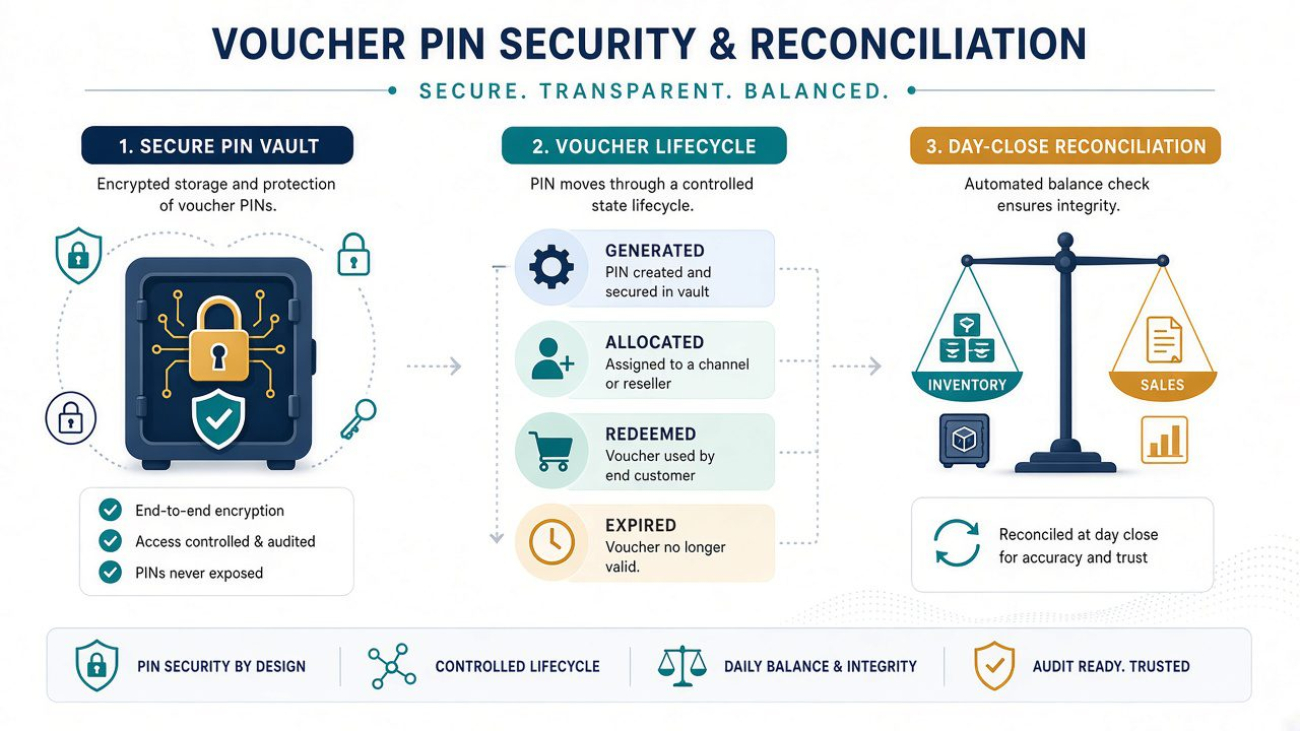
Voucher reconciliation and PIN security diagram showing lifecycle states and day-close controls in an electronic voucher management system

Voucher Reconciliation and PIN Security in an Electronic Voucher Management System

Voucher reconciliation is the day-close job of proving that the stock your platform holds, the sales your channel reports and the credits your charging system applied all describe the same vouchers. In an electronic voucher management system it sits right next to PIN security, because most of the gaps found at close come from one of two places: a counting fault somewhere in the pipeline, or a secret that left the building. This post walks through the mechanics: which records get matched, on which keys, with which time window, and what the leftovers look like.

For the wider platform scope, see the electronic voucher management system overview.

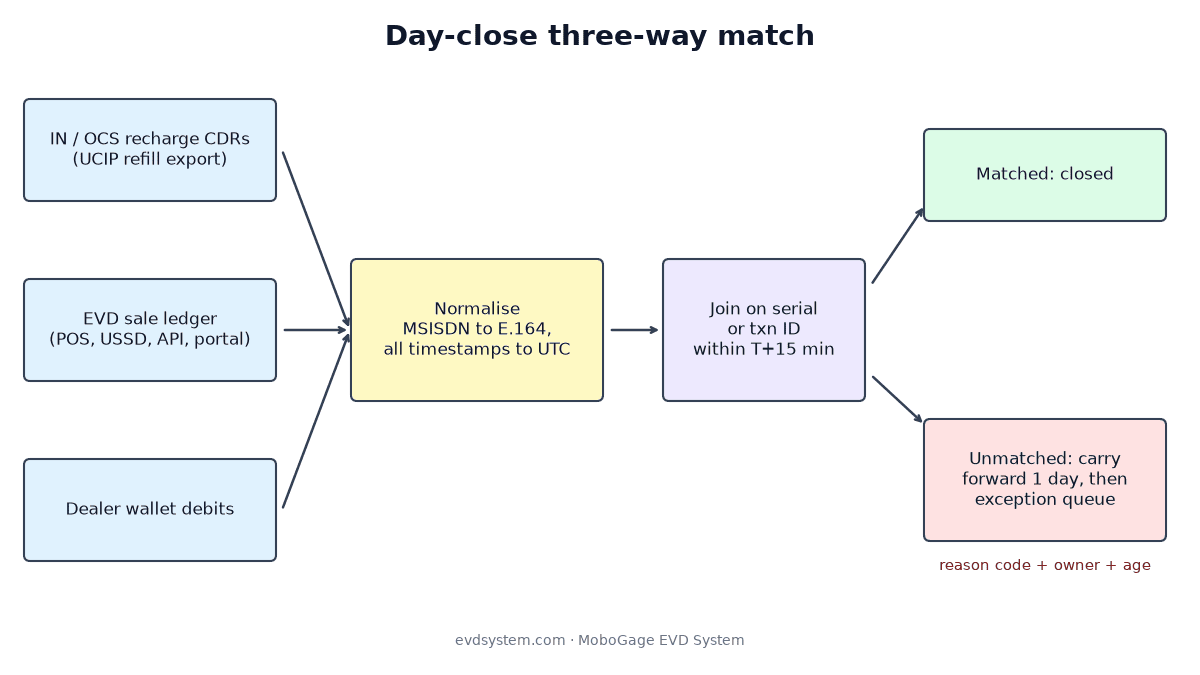
Voucher reconciliation starts with three ledgers

Every prepaid voucher programme produces three independent records of the same day. The IN or OCS writes a recharge CDR whenever a voucher or PINless top-up credits a subscriber. The EVD platform writes a sale ledger entry when a dealer sells. And the dealer wallet writes a debit for the value of that sale. Reconciliation is the join between them.

The charging side usually arrives as a file export rather than a live feed. On Ericsson-style charging the refill request goes over UCIP (an XML-RPC interface), and the fields worth keeping are the ones the request itself carries: subscriberNumber, originTransactionID, originTimeStamp, transactionAmount and transactionCurrency, plus the voucher serial when the refill was voucher-based. Other vendors name things differently, and the CDR export format can change between charging releases, so pin the field mapping in the interface document rather than in someone’s script. Diameter credit control (Gy/Ro, 3GPP TS 32.299) matters here mostly as context. It governs usage charging, not recharge, but the same OCS writes both kinds of record and the export often mixes them.

Standards writing points the same way. GovStack’s voucher and payment orchestration requirements ask for unique end-to-end identifiers, encrypted storage of sensitive voucher data, and reconciliation inside and across parties (voucher storage, audit, and reconciliation). GSMA’s analysis of airtime distribution costs explains why operators moved to electronic channels at all (GSMA on airtime distribution savings).

Day-close three-way match: IN/OCS recharge CDRs, EVD sale ledger and dealer wallet debits are normalised (E.164 MSISDN, UTC timestamps) and joined on transaction ID or serial within a 15-minute window; matched rows close, leftovers go to an exception queue with a reason code and owner.
The day-close three-way match.

Before you join anything, normalise

Most false mismatches we chase at close are formatting, not fraud. The commonest is the MSISDN. A POS in Riyadh may send 0551234567, the USSD gateway may send 966551234567 and the charging export may hold +966551234567. Convert all three to E.164 before matching: strip the plus sign or a leading 00, drop the national trunk prefix (the leading zero) and prepend the country code. E.164 numbers are at most 15 digits, which also makes a cheap sanity check for garbage input.

Time is the second trap. Charging nodes usually log in UTC, POS terminals log in local time, and a terminal whose clock has drifted can be minutes out. Convert everything to UTC first. Then match within a window instead of on exact timestamps: we use T+15 minutes after the sale timestamp as a default, widened for channels known to batch-submit (some offline POS fleets upload hours later). A sale near midnight UTC whose credit lands after the cut-off belongs in tomorrow’s charging file, so carry unmatched rows forward one day before calling them exceptions.

A worked day-close (illustrative figures)

The table below shows one dealer, one denomination, one day. All figures are illustrative; they are not from any operator.

CheckIN recharge CDRsEVD sale ledgerDealer wallet debitsResult
Count, SAR 10 vouchers4124154163 sales with no credit; 1 debit with no sale
ValueSAR 4,120SAR 4,150SAR 4,160SAR 30 and SAR 10 to explain
Matched on serial / txn ID within T+15 min410410410Closed
Matched after carry-forward to next file222Closed next day (credit after cut-off)
Sale, no credit033Exception: charging reject after local commit, or redemption pending
Debit, no sale001Exception: double-submit from terminal; refund dealer

Read it right to left. The wallet has one more debit than the ledger has sales, which almost always means the terminal retried a sale after a timeout and the wallet service did not dedupe on the original transaction ID. The three sales with no credit need a look at the UCIP responses: a non-zero responseCode on the refill means charging refused it and the voucher should go back to available (or to the exception state if the PIN was already shown to a customer). See how unknown top-ups should be held and settled.

The unmatched-transaction query

A pseudo-SQL version of the report finance gets every morning. Table and column names are placeholders.

-- sales with no matching charging credit
SELECT s.txn_id, s.serial, s.dealer_id, s.msisdn_e164, s.sold_at_utc, s.amount
FROM evd_sale s
LEFT JOIN in_refill_cdr c
  ON (c.voucher_serial = s.serial OR c.origin_txn_id = s.txn_id)
 AND c.msisdn_e164 = s.msisdn_e164
 AND c.event_time_utc BETWEEN s.sold_at_utc
                          AND s.sold_at_utc + INTERVAL '15 minutes'
WHERE s.business_date = :close_date
  AND c.cdr_id IS NULL
UNION ALL
-- wallet debits with no sale
SELECT w.ref_txn_id, NULL, w.dealer_id, NULL, w.debited_at_utc, w.amount
FROM dealer_wallet_debit w
LEFT JOIN evd_sale s ON s.txn_id = w.ref_txn_id
WHERE w.business_date = :close_date
  AND s.txn_id IS NULL;

Each row it returns gets a reason code (timeout, double-submit, charging reject after local commit, clock skew, suspected fraud) and an owner. An unexplained row older than two business days should page someone.

What does a duplicate-PIN redemption look like in the logs?

Two redemption attempts on one serial, usually from different MSISDNs, close together. The first succeeds; the voucher server marks the serial used. The second comes back from charging with a “voucher already used” style response (the exact code depends on the voucher server; on Ericsson-style VS the voucher state is no longer available). In the EVD log it looks like this:

2026-09-30T18:02:11Z REDEEM serial=7741003921 msisdn=966551234567 result=OK   origin_txn=R-88120
2026-09-30T18:02:49Z REDEEM serial=7741003921 msisdn=966559876543 result=USED origin_txn=R-88131

One such pair is usually a customer who shared a photo of the receipt. Twenty pairs on one batch within an hour is a leaked batch file. Alert on the rate per batch, not on single events.

When that alert fires, blacklist the batch’s unredeemed serials straight away and tell the channel nodes holding it. After that, freeze reprints on the affected terminals, run an ad-hoc reconcile of the remaining inventory so the exposure is a number rather than a guess, and preserve the reveal and export logs.

Key handling

Voucher PINs are not card data, so PCI DSS does not formally apply to them. Its key-management requirements (in v4.0, requirements 3.6 and 3.7: documented key custodians, split knowledge, dual control, defined cryptoperiods and key retirement) are still the most practical template we know for PIN custody. Store PINs encrypted with AES under a data-encryption key, wrap that key with a key-encryption key held in an HSM (AES key wrap per NIST SP 800-38F / RFC 3394), and keep HSM administration away from application admins. ISO/IEC 27001 gives the management-system frame; Annex A control 8.24 covers the use of cryptography. None of this implies EVD System holds any particular certification, and you should ask any vendor, us included, for evidence rather than a logo.

Reveal is the other half. Log every reveal once (user, terminal, batch, timestamp and MSISDN where relevant) and require a second approver plus a reason code for any reprint.

Lifecycle states, and one transition we would remove

StateMeaningTypical controls
Generated / intakeBatch created or imported under policyBatch metadata, denomination, expiry, encryption plugin
AvailableEligible for allocationNot yet assigned to a channel node
AllocatedAssigned to distributor / dealer / walletHierarchy transfer rules, credit limits
Sold / issuedRevealed or committed to a saleFloat debit, reveal log, channel id
RedeemedCharging accepted creditUnique redemption id, duplicate block
ExpiredPast validityReporting and write-off policy
Cancelled / blacklistedRemoved from sale (theft, error, fraud)Batch or serial block, audit reason
Pending / exceptionAmbiguous after timeout or partial failureHuman queue with owner

Every transition should leave an audit record, ideally in append-only (WORM-style) storage. Our opinion, which some vendors will dispute: there should be no path from Redeemed back to Sold or Available at all. Once charging has confirmed a credit, the fix for any error is a compensating adjustment on the subscriber balance, raised in charging, never an edit to the voucher’s state. Platforms that allow the reverse transition make every redemption deniable. Some vendors market flexible status changes as a feature (Comviva’s PreTUPS VMS page, for instance, describes changing voucher status “just in time” for stolen and damaged stock); for stock that has not been redeemed that is useful, so the question to ask is which transitions are allowed after redemption, and who approves them.

For how stock moves through resellers, see What is electronic voucher distribution (EVD)?.

Questions for a vendor demo

Ask them to run the unmatched report above on their own demo data, with a deliberately skewed terminal clock, and to push a reprint request through dual control while you watch. And ask who, by role, can export clear PINs from production; the right answer is nobody, and if the vendor needs to check, note that down.

If a vendor can only demo “generate PIN, show on phone”, that tells you most of what you need. How to choose an electronic voucher management system has the full evaluation grid.

EVD System

EVD System by MoboGage covers generation or intake, hierarchy allocation, multi-channel sale, the redemption path and the day-close pack described above. Talk to us via About MoboGage or the contact page (projects@mobogage.com, +91-9928 366 889). If you can, bring last week’s exception list.

Related reading: how the three ledgers fit together in an EVMS architecture; electronic top-up for telecom airtime covers the PINless side of the same close, and multi-tier reseller voucher distribution covers how dealer wallets are funded. Moving off a legacy platform? The EVMS migration playbook shows how lifecycle states and dealer balances carry across, and the EVMS glossary defines the terms used on this page.

FAQ

What is voucher reconciliation in telecom prepaid?

It is the daily match between voucher inventory states, channel sales with their wallet debits, and charging redemptions, so finance and fraud teams can close the day with every difference explained and owned.

How does PIN security relate to an electronic voucher management system?

An EVMS holds voucher secrets for their whole life. PIN security is the set of encryption, key custody, access, reveal and redemption controls that stop those secrets turning into unauthorised credit.

Can we reconcile if we only run PINless eTopup?

Yes, but the objects change. You match float debits and sales against charging credits by transaction ID and MSISDN rather than by voucher serial. Operators that still sell any PIN products usually keep EVMS-grade audit for those.

What should a day-close pack include?

Opening and closing inventory or float, sales by channel and dealer, redemptions, cancels and expiries, and an aged exception list with an owner and a reason code on every row.

How do we handle a compromised batch?

Blacklist the unredeemed serials in the batch, notify the channel nodes holding it, preserve reveal and export logs, and reconcile the remaining inventory immediately. Write the playbook before you need it.

Is encryption alone enough?

No. Encryption without role control, reveal policy, device hygiene and named reconcile owners still fails in ordinary operations.

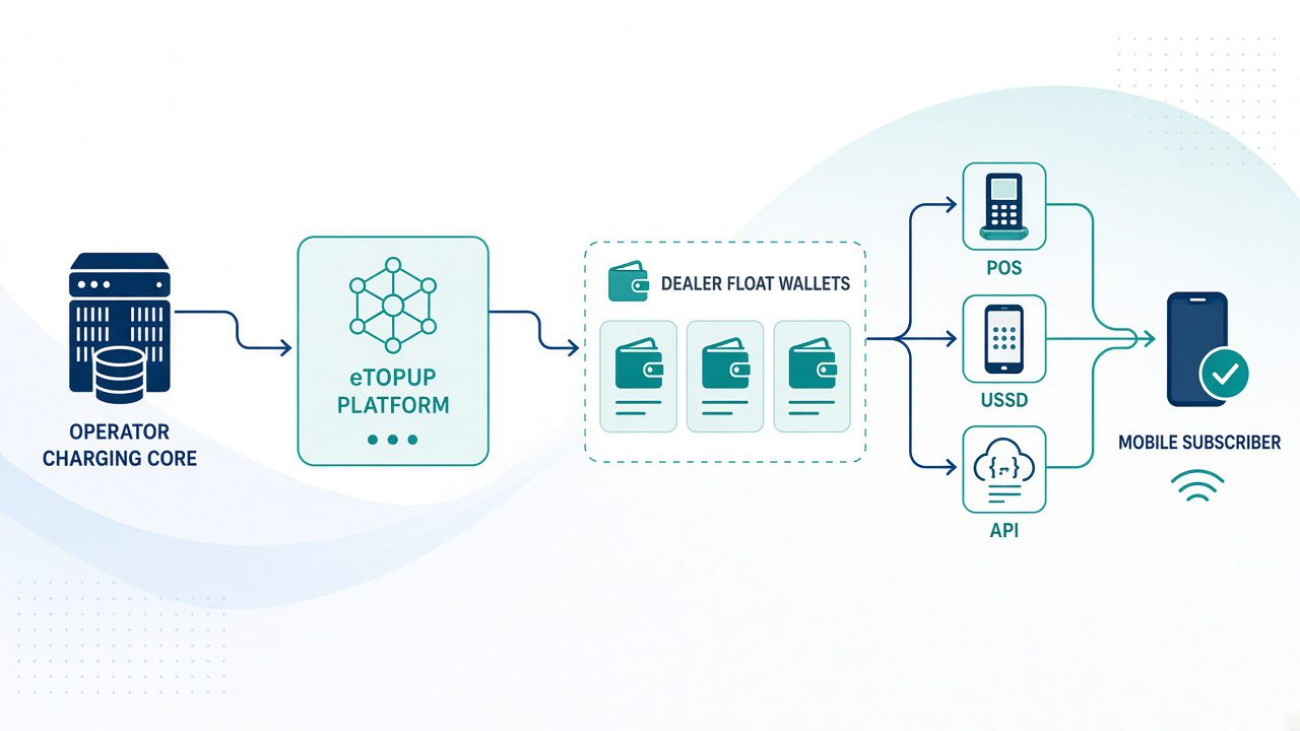
Diagram of an electronic top up system for telecom airtime

Electronic Top-Up System for Telecom Operators

An electronic top up system (also called eTopup or PINless airtime distribution) lets mobile operators and their reseller hierarchies credit prepaid subscribers directly without handing over a printed scratch PIN. Value sits in dealer wallets as pre-funded float or an approved credit limit, the recharge request travels to the operator’s charging platform over USSD, POS, mobile app, or partner API, and the subscriber’s balance updates in seconds. Operators adopt it when physical card printing costs and denomination rigidity alongside warehouse leakage outweigh the familiarity of scratch cartons on a retail shelf.

TL;DR: eTopup vs PIN voucher distribution

Model What the dealer holds How the subscriber gets credit Primary operational control
eTopup (PINless recharge) Pre-funded wallet float or credit limit Direct recharge call (e.g. UCIP Refill or UpdateBalanceAndDate) to the MSISDN at sale time Float reservation, idempotent retry keys, and timeout reconciliation against charging CDRs
PIN voucher (EVD / scratch) Allocated serial batches or print-on-demand PIN entitlements Subscriber dials or enters a secret PIN after purchase to redeem value HSM-backed PIN custody, batch activation gates, and serial state tracking from generated to redeemed

In practice, dealer float replaces physical inventory exposure, so wallet reservations and velocity caps alongside day-close exception queues become the core operating controls across USSD, Android or Linux POS, dealer web portals or mobile agent apps and partner APIs. Operators choose eTopup when they need rapid bundle changes and lower card operating costs, while keeping a full electronic voucher management system whenever serialised PIN lifecycles or hybrid stock with batch-level reconciliation remain part of the commercial mix. Research from GSMA Mobile for Development has long examined how shifting prepaid volume from scratch cards to electronic channels reduces manufacturing and distribution overhead.

What an electronic top up system actually does

In daily retail operations, a shopkeeper takes cash or a digital payment from a subscriber, keys the MSISDN (normalised to E.164 format) and selects a denomination or data bundle, after which the platform reserves the dealer’s float and instructs the operator’s IN or OCS to credit the account. No carton is opened in a warehouse, and no PIN sheet is photocopied in a back office. Every transaction either closes with a confirmed charging correlation ID or enters a tracked pending state that finance can reconcile at day-close.

Industry literature refers to this flow as electronic reloading or direct top-up. Wikipedia’s overview of electronic reloading traces the transition away from physical prepaid cards toward commercial retailer load and digital credit, which provides helpful context when briefing channel teams that still plan around physical card stock.

Deploying eTopup does not force an operator to retire vouchers everywhere at once. Multi-country operators run both side by side, using PINless eTopup for everyday prepaid refills while keeping serialised PIN stock for rural wholesalers or gift and OTT products.

Comparing eTopup, EVD PIN print and physical scratch cards

Dimension Physical scratch cards EVD PIN print / electronic PIN sale Electronic top up (eTopup)
What the dealer holds Printed cards with concealed PINs Digital PIN inventory released at sale or print-on-demand Wallet float value with no PIN issued to the subscriber
Theft and leakage risk High across warehousing and transport Contained when PINs stay encrypted in a vault until sale No PIN leakage; duplicate recharges and float misuse are the main risks
Denomination or bundle update Requires a print and distribution cycle Catalogue or batch policy update Immediate product catalogue and charging profile update
Subscriber experience Scratch coating and dial USSD string Receive printed or SMS PIN and redeem Direct balance or bundle credit to MSISDN
Reconciliation focus Physical batch manifests vs activated sales Serial lifecycle states vs charging redemptions Dealer wallet debits and holds vs charging CDR credits
Best commercial fit Offline or remote print-heavy retail Markets needing gift vouchers, partner PINs, or hybrid stock High-velocity prepaid refills, micro-denominations, dense agent networks

Physical scratch cards remain familiar to cash-based retailers, yet they carry printing and warehousing overhead plus stock shrinkage that digital channels eliminate. Electronic PIN printing still fits wherever a bearer secret is required for gift cards or utility tokens, whereas eTopup fits wherever the commercial act is crediting a subscriber’s phone number immediately from a controlled dealer wallet. For the broader terminology across these models, see our guide to electronic voucher distribution (EVD) for full definitions across both models.

Dealer float: the real inventory of eTopup

Removing physical cards makes dealer float the working inventory of the distribution network. Operating an eTopup hierarchy requires five linked ledger steps:

  1. Onboard each hierarchy tier (master distributor, sub-distributor, dealer, and retail POS agent) with explicit parent-child rules.
  2. Fund distributor and dealer wallets against verified bank transfers, cash deposits, or maker-checker credit allocations.
  3. Enforce per-tier credit limits and velocity caps so a compromised terminal cannot drain upstream float.
  4. Convert wallet reservations into debits only on confirmed charging success, and credit float back only through audited reversals.
  5. Expose live balance and hold views so field supervisors do not rely on chat screenshots to verify stock.

A core ledger rule is separating reservation from debit inside the dealer ledger. When a retailer submits a top-up, the platform places an atomic hold on the dealer’s available float (tracked in ISO 4217 integer minor units, including three-decimal Gulf currencies such as the Kuwaiti dinar, Bahraini dinar, and Omani rial) before the charging adapter sends the request to the IN or OCS. If charging returns a confirmed success (responseCode = 0 on UCIP), the hold converts into a final debit and posts commission. If the request receives an explicit reject, the hold releases immediately. When a recharge call times out without a reply, the reservation stays locked under a pending-unknown state until a status query or the T+1 charging CDR file proves whether the subscriber received the credit.

When dealers cannot see their reserved versus available float clearly, they maintain side ledgers on paper or spreadsheets, which turns ordinary timing differences into support disputes. Credit limits also need policy-driven temporary lifts for salary weeks or festival peaks rather than manual database edits at midnight.

eTopup channels that move prepaid airtime

A production eTopup platform routes every retail and digital channel through one channel gateway, one float ledger, and one duplicate-detection policy.

USSD and SMS remain the primary interface where feature phones and assisted street retail dominate. Menus have to stay shallow to avoid session timeouts, and every request must log the target MSISDN, the dealer ID, the transaction amount, and the upstream result code. Android and Linux POS terminals serve high-throughput counters with receipt printing and device binding, alongside dealer web portals for bulk wallet transfers and sub-agent management. Mobile agent apps cover field sales and low-balance alerts, while partner APIs connect banks, super-apps, and payment aggregators using the same composite idempotency keys and velocity limits enforced on retail terminals.

Choosing between eTopup-first and a full EVMS

Most steering-committee debates come down to whether an operator needs a standalone PINless recharge switch or a combined voucher and eTopup control plane.

When an eTopup-first rollout fits

An eTopup-first scope makes sense when almost all prepaid volume is direct PINless credit to MSISDNs, commercial teams ship weekly bundle or promotional price changes that cannot wait for print runs, and dealer complaints centre on card stockouts across rural branches. It assumes your engineering team will invest in resilient charging adapters, client-generated idempotency keys, and automated timeout resolution.

When to keep a full electronic voucher management system

A full electronic voucher management system remains necessary when you run physical or hybrid PIN stock that needs serial-level lifecycle states, distribute gift cards or OTT entitlements alongside airtime, or require batch blacklisting and HSM-backed PIN custody for revenue assurance.

In GCC and MEA deployments, operators commonly combine both models by running MoboGage’s EVD System as the inventory and hierarchy control plane with PINless eTopup operating directly off the dealer wallet ledger. If your team is comparing vendor architectures for a tender, our guide on how to choose an electronic voucher management system covers the evaluation criteria across voucher vault security, IN charging integration, and day-close reconciliation.

Operational controls buyers should demand

During technical due diligence, ask shortlisted vendors to demonstrate seven controls on a live test bed rather than on slides:

  1. Idempotent top-up: The same client request ID never double-credits the subscriber or double-debits the dealer. (How that works when charging does not answer: airtime top-up timeouts and unknown status.)
  2. Explicit failure taxonomy: Clear separation between a network timeout (pending-unknown), a gateway validation error, and an upstream charging reject, with distinct operator reason codes.
  3. Reversal and refund governance: Automated correlation-ID reversals for incomplete legs kept separate from maker-checker financial refunds after settlement.
  4. Multi-level velocity limits: Configurable caps per dealer, per terminal, and per target MSISDN over rolling hourly and daily windows.
  5. Terminal binding and revocation: Ability to revoke a stolen POS session token at the gateway immediately and track active app versions across the fleet.
  6. Three-way day-close pack: Automated comparison of channel sales, dealer wallet movements, and charging CDR/EDR files with named owners for exceptions.
  7. Charging interface discipline: Documented UCIP, Diameter, or OCS API mappings scoped and tested against forced timeouts per project.

Without those seven controls in place, a high-throughput recharge switch simply creates reconciliation breaks faster than finance can investigate them.

Implementation path for an operator rollout

  1. Baseline current leakage and disputes: Measure where physical stock disappears, where promo launches stall, and how many daily support tickets stem from unconfirmed recharges.
  2. Pilot a single hierarchy slice: Start with one region and a controlled group of distributors on USSD or POS plus the dealer portal to prove wallet reservations and charging CDR alignment on live traffic.
  3. Encode commercial hierarchy rules: Configure multi-tier commission splits, credit limits, and maker-checker transfer approvals to match existing distributor contracts.
  4. Harden timeout and exception playbooks: Train operations and support teams on pending-unknown holds and T+1 CDR settlement before onboarding external aggregator APIs.
  5. Expand channels incrementally: Roll out mobile apps, additional POS hardware families, and bank or super-app APIs once the daily reconciliation pack closes cleanly.
  6. Run continuous revenue assurance: Monitor adapter latency, duplicate-block counts, and late-success refund exceptions as routine operational metrics.

Next steps for operators and VAS partners

If your prepaid distribution still depends on physical print logistics, or if your electronic channels leave finance reconciling wallet debits against charging CDRs in spreadsheets, audit one week of recharge traffic by channel and exception code. That baseline shows immediately where reservation holds, idempotency constraints, or voucher lifecycle controls are missing.

Operators and VAS partners evaluating MoboGage (founded in 2007 as company-reported, headquartered in Jaipur, India as its sole office, with company-reported reach across more than 1 million retailers and 17 countries via channel partners) can review the product overview on the electronic voucher management system page, see how a UCIP / IN charging integration handles recharge calls, read more About MoboGage, or reach the engineering team via the contact page (projects@mobogage.com, +91-9928 366 889).

FAQ

What is an electronic top up system?

It is software that lets dealers or digital channels credit prepaid subscribers from controlled float or wallets without issuing a physical scratch PIN, while posting the credit to the operator’s charging system and logging the transaction for day-close reconciliation.

Is eTopup the same as EVD?

Not quite. EVD (electronic voucher distribution) covers moving voucher value through reseller channels, whereas eTopup refers specifically to PINless airtime credit posted straight to the subscriber’s balance. Most operator deployments combine both models by running PINless eTopup as a primary sales mode on top of an EVD hierarchy and wallet ledger.

Do dealers still need inventory?

Dealers hold float inventory in the form of wallet balances and credit limits rather than cartons of printed cards. Serialised PIN inventory is still used alongside float whenever an operator sells voucher batches or third-party entitlements on the same terminals.

Which channels should we launch first?

Start with the channel that already carries your core prepaid volume, such as USSD or Android POS, and prove that dealer float debits and charging credits reconcile cleanly before adding partner APIs and mobile apps. Opening every channel on day one without a working day-close exception queue creates avoidable balance disputes.

When is a full EVMS still required?

A full EVMS is required whenever you manage serialised PIN lifecycles or hybrid voucher stock alongside multi-product catalogues for gift and OTT entitlements, or when finance requires batch-level inventory reconciliation beyond wallet float movements.

How does GSMA frame electronic airtime channels?

GSMA Mobile for Development research on airtime distribution savings examines how electronic top-up paths reduce scratch-card printing and warehousing expenses alongside channel discount costs compared with physical card distribution, providing a useful benchmark when building an operator business case.

Related operator reading: For the connected prepaid stack, compare voucher reconciliation and PIN security with multi-tier reseller voucher distribution, review our electronic voucher distribution (EVD) explainer, or see the EVMS product overview for full lifecycle controls across the prepaid stack.

For formal PIN voucher and eTopup definitions used across the prepaid stack, consult the EVMS glossary.

If your team is operating or bidding in the Gulf, read our regional guide to electronic voucher management for GCC telecom.

Electronic voucher management system checklist for telecom operators

How to Choose an Electronic Voucher Management System (Telecom Buyer Checklist)

An electronic voucher management system is the software that keeps prepaid value under control, from generation or intake, through the dealer hierarchy and every sales channel, to redemption in charging and a day-close finance will sign off on. For MNOs, MVNOs and VAS partners, getting the shortlist wrong costs real money. It shows up later as disputed float, PINs exposed without anyone noticing, and reprints you thought you’d left behind with scratch cards.

EVD System by MoboGage is built to be that control plane for telecom and gift-card distribution. But this page isn’t a brochure. It’s the checklist we’d want a buyer to bring to our own discovery call, so your RFP tests what actually matters once you’re live.

The short version: buy for a lifecycle that runs all the way through reconciliation, not for a slick “generate PIN” demo. Settle your operating model (opco-owned, VAS-operated or hybrid) before anyone argues about screens. Insist on a concrete charging/BSS path, POS and offline behaviour that has been proven somewhere, and day-close packs an auditor would accept. Treat security as PIN custody plus velocity and replay controls, not a logo on a slide. And treat vendor rankings with caution; a reference who can walk you through an ordinary week of exceptions tells you more.

Opco, VAS partner or hybrid: decide this first

An opco, MNO or MVNO should own stock and fraud policy, with the EVMS plugging cleanly into charging and a hierarchy that mirrors national distribution. A VAS or distribution partner needs something more productised for running several opcos: white-label portals and POS, commissions, partner float and APIs, without rebuilding the lifecycle for each brand. A hybrid arrangement only works when it’s crystal clear who holds the keys, who runs L1 support, who owns blacklist and expiry, and how disputes escalate.

If your team can’t answer those ownership questions yet, pause the software comparison and settle the operating model. A common sticking point is who owns a compromised batch: who can blacklist it, who tells the dealers, and who signs off the write-off.

What an electronic voucher management system must cover, gate by gate

Take each product on your shortlist and walk it through six gates. Generation or intake comes first: controlled serialisation, denomination rules, batch metadata and expiry, with secrets never stored as plain text. Inventory next, with statuses you can believe (available, allocated, sold, redeemed, expired, cancelled). Then allocation across multi-level dealers, with float, credit limits and transfer rules your ops team will actually follow. Sale, over portal, Android/Linux POS, app, USSD/SMS and API, all under one fraud policy. Redemption, where credit reaches charging with duplicate and replay controls. And finally reconciliation: daily packs covering volumes, wallets and exceptions, with a named owner for every mismatch.

A gap at any gate becomes leakage later. The EVMS architecture guide maps each gate to a component you can ask vendors about. Hybrid physical and electronic programmes are fine, as long as print logistics are an option rather than the default cost of selling prepaid.

Two gates deserve a concrete test. For redemption on Ericsson-style charging, ask the vendor to show the UCIP refill request and response for one sale, including the originTransactionID they send and how a non-zero responseCode appears on the retailer’s screen. For offline POS, ask how the terminal sells without a connection: typically a small encrypted pool of pre-allocated PINs or an offline value cap per terminal, a sync that uploads sales with their local timestamps, and a rule for what happens when the server has already cancelled a voucher the terminal sold offline.

A 1 to 5 scoring grid for vendor demos

AreaQuestions to ask in discoveryWeak answer sounds like…
Security & trustHow are PINs encrypted at rest and in transit? Who can reveal a PIN? Velocity, duplicate, and replay controls? Audit logs for operator review?“We use HTTPS” (and nothing else).
Hierarchy & floatMulti-level trees, credit limits, commissions, operator stock vs partner float separation?Flat “admin / agent” only; float explained with a spreadsheet.
POS & field opsWhich Android/Linux families are in production (e.g. Sunmi-class)? Online/offline sale and sync rules? Remote disablement?“Any Android phone” with no offline story.
APIs & chargingDocumented sale/inquiry/reversal (where allowed)? Concrete charging/BSS integration path?Slide that only says “API ready.”
Reporting & reconcileNear real-time by region/dealer/product/channel? Day-close packs finance will use? Exception queues with owners?Marketing dashboards; no mismatch workflow.
CatalogAirtime, data, gift, OTT without fracturing inventory? PIN sale and PINless eTopup on the same wallet where required?One denomination demo; gift cards “phase 2 forever.”
Commercial & hostingLicensing, hosting (on-prem/private cloud), transaction economics, upgrade and support SLAs?Opaque pricing until late; support undefined.

Weight the rows before the demos, not after. A vendor who scores high on UI polish but low on reconciliation and charging is offering a sales screen rather than an EVMS.

When to walk away

Some answers should end the conversation, or at least put heavy conditions on it. The demo stops at “PIN appears on screen” and there’s no day-close pack. The vendor can’t tell the EVMS lifecycle apart from EVD channels, or worse, describes them in ways that contradict each other. You’re shown vanity metrics (“best in world,” ratings you can’t verify, inflated client counts) instead of reconcile references. Offline works “verbally,” with nothing written about sync conflicts or disabling a terminal. Reversals and duplicate controls are pushed to “custom, later.” Or your dealers would end up running a shadow system for float, because they already don’t trust the screen.

Six questions to bring to the kickoff

Who owns voucher secrets and the HSM/key ceremony, the opco or the partner? What’s the pilot slice (region, dealer tier, POS count), and what are its exit criteria? Where do sales and charging disagree today, and which report will prove they agree after go-live? What’s the end-to-end procedure for blacklisting a compromised batch? How are terminals versioned, configured and disabled when they’re lost or compromised? And what’s the training and L1 model for master dealers in the first 90 days?

A vendor with live rollouts should answer most of these from memory and show the matching screen or document for the rest.

Reading competitor brochures

The established suppliers publish feature lists that overlap heavily. Comviva describes PreTUPS VMS as covering the voucher lifecycle from product management to consumption, with expiry-date modification and status changes, and cites uptime figures for the platform. Seamless positions ERS 360 around dealer management, campaigns and third-party products on the POS. Telepin and Emida describe eTopUp, eVoucher, PINless and QR top-up. These are real capabilities. What brochures rarely show is the exception path: the unmatched report, the timeout handling, the dual-control reprint. Score that part from the demo, for every vendor including us.

EVMS vs EVD vs eTopup (so RFPs stay coherent)

TermMeaning in practice
EVMS / VMSLifecycle & inventory core: generate/receive, serialise, allocate, expire, cancel, reconcile.
EVDDistribution/channel layer: how digital vouchers reach resellers and customers via POS, apps, USSD, APIs.
eTopupOften PINless recharge: credit via dealer float or API without handing over a scratch PIN.

When buyers say “we need EVD software,” they usually mean this whole prepaid stack. Deep dive: What is electronic voucher distribution (EVD)?.

How MoboGage EVD System maps to this checklist

We position EVD System as the electronic voucher management system control plane for operators and VAS partners: hierarchy and float you can audit, Android/Linux POS (Sunmi-class included) next to portals and APIs, and a BSS-adjacent path to charging scoped per contract. The exact device fleets, offline behaviour and charging adapters belong in discovery. A one-size public matrix would mislead you.

Product overview: Electronic voucher management system for telecom. Contact: voucher-management-system-mobogage · projects@mobogage.com · +91-9928 366 889.

FAQ

What is an electronic voucher management system?

Software that controls prepaid voucher value end to end: generate or intake stock, inventory and hierarchy allocation, multi-channel sale, redemption into charging, and reconciliation, typically for telecom airtime, data, gift cards, and related digital products.

How do I choose an electronic voucher management system for telecom?

Score vendors on security and PIN custody, hierarchy and float, POS and offline realism, charging or BSS path, day-close reconciliation, catalog breadth, and commercial clarity. Prefer references that describe exception handling.

Is EVMS the same as EVD software?

Not exactly. EVMS or VMS is the lifecycle core; EVD is the channel and distribution layer. Strong platforms connect both under one inventory and fraud policy.

What should VAS partners prioritise?

Prioritise multi-opco operating efficiency: white-label portals and POS, commissions, partner float separation, APIs, and reconciliation packs for each opco without rebuilding the core.

Can an EVMS run hybrid physical and electronic stock?

Yes. Require one control framework for batches, status, expiry, and audit so print logistics are optional.

Does offline POS matter?

In many GCC, MEA, and emerging retail networks, yes. Ask how offline sales sync, how conflicts resolve, and how lost terminals are disabled.

What is the fastest way to fail an EVMS project?

Skipping operating-model ownership, launching without a charging truth, and ignoring day-close exceptions until finance escalates.

What to do this week

Run the scoring grid against your shortlist. If you’d like a discovery-style walkthrough of how EVD System handles hierarchy, POS and reconcile for your operating model, talk to MoboGage. Before you score anyone, though, agree shared definitions inside your own team.

GCC buyers can use the GCC EVMS RFP requirements table. Moving off a legacy platform? Read the EVMS migration playbook. For wider industry context, see GSMA mobile money industry research and this electronic reloading overview.

Product: https://evdsystem.com/electronic-voucher-management-system-evd-telecom/ · Guide: https://evdsystem.com/evd-software/what-is-electronic-voucher-distribution-evd/ · Contact: https://evdsystem.com/voucher-management-system-mobogage/ · Email: projects@mobogage.com · Phone: +91-9928 366 889

Entity: MoboGage · EVD System · Jaipur, India Last updated: 21 Sep 2026 (IST)