
ucip-in-emergency-credit-charging

UCIP / IN Emergency Credit and Charging Integration

UCIP / IN charging and emergency credit integration connects eligibility, redemption and credit rules to an operator’s charging environment through UCIP and intelligent-network interfaces, so emergency credit grants and voucher redemptions behave the way the network expects rather than the way a retail screen promised.

The usual dispute goes like this. A shop’s terminal printed “recharge successful”, the subscriber’s balance didn’t move, and care has two systems telling two different stories. Most of these come down to what the distribution platform did when the charging node answered slowly or not at all. That is why we treat charging integration as part of distribution control, scoped before POS go-live and not patched in afterwards.

MoboGage lists charging and emergency credit as an Established telecom capability. Selected company-reported experience includes telecom charging work involving emergency credit and voucher redemption through UCIP/IN environments; scope and references are shared through due diligence. Heritage since 2007 (IWT Group, company-reported); MoboGage Private Limited was incorporated in February 2017 and its only office is the Jaipur HQ.

What a UCIP request actually carries

UCIP (User Communication Integration Protocol) is the Ericsson charging interface that external systems use to reach the AIR node. Requests are XML-RPC over HTTP POST. A refill or balance call carries an envelope of fields that matter later at reconciliation: originNodeType and originHostName (who is asking), originTransactionID (your reference, unique per request), originTimeStamp (ISO 8601 with offset) and subscriberNumber. A refill adds transactionAmount, transactionCurrency and a refillProfileID, or a voucher activation code when the refill is voucher-based. The answer comes back with a responseCode; 0 means success, and every other value needs a mapped meaning in your interface document.

Methods you will meet on most projects are GetAccountDetails and GetBalanceAndDate for eligibility and status, Refill for value, and UpdateBalanceAndDate for adjustments on the main or a dedicated account. Other IN platforms expose the same ideas under different names, and some operators sit a mediation layer in front of AIR. The integration pattern is the same either way. Our job is to carry the operator’s policy into retail and self-care channels without creating a second copy of the balance.

Emergency credit: eligibility, grant, recovery

Emergency credit is a temporary grant under operator rules, offered when a subscriber can’t top up right now. On Ericsson-style charging, one common pattern is a check against account state and history (age on network, recent recharges, any outstanding advance), a grant through a dedicated refill profile or an adjustment on a dedicated account, and recovery of the advance plus any fee on the next refill. All of those rules belong to the operator’s charging team. That includes stacking with bonuses or loans. The integration layer passes the parameters it was given and refuses to improvise when charging rejects something.

Voucher redemption is the sibling flow: a PIN or entitlement that was sold turns into network credit through the charging path. The two can share interface families and still differ in eligibility, amount, validity and repayment, so keep separate rule owners on the project plan. A change to one product’s refill profile should never silently break the other. Upstream PIN security and lifecycle controls still apply; see voucher reconciliation and PIN security.

Timeouts: the outcome nobody designs for

A request that times out may have credited, may not have, or may still be queued. (Where the charging adapter sits in the wider stack is covered in our EVMS architecture guide.) The sequence we design for: hold the retail transaction in a pending state, do not tell the shop it failed, query the account (balance and date, or refill history where your AIR release exposes it) after a short delay, and only then decide. If a retry is needed, send it with a new originTransactionID that links back to the first in your own ledger, so finance can see both attempts. A second blind refill is how a subscriber ends up credited twice and the dealer debited once. Full walkthrough: airtime top-up timeouts and unknown status.

The shop and the care agent need words for each of those states. A message tied to a real response code (“charging declined: account barred”) lets them explain what happened; “pending, do not resell, check in five minutes” is a defined next step for a timeout.

Who owns which part of a disputed credit

The charging and prepaid team owns policy. That’s central to the EVMS for telecom product story and to the GCC programmes on the EVMS GCC page. A distribution or VAS partner cares about money: for products that need it, sale confirmation waits for charging confirmation, which cuts down refund arguments with agents. Finance, fraud and revenue assurance need every retail transaction matched to a charging event by reference, with explicit states and a record of each retry. Revenue-assurance AI tools that appear as Proposed in the wider portfolio are not claimed here as available.

Name the charging owner, prepaid product owner, EVD or channel owner, care owner and finance reconciliation owner before coding starts. The escalation path for “customer says credited, charging says not” fits on one page; write it and rehearse it in the pilot.

Where this meets EVD channels and PINless top-up

POS, apps, USSD, SMS and API channels that sell vouchers or trigger PINless top-up all depend on charging for the balance the customer sees. The electronic top-up system post covers PINless recharge; this one covers the charging side that makes emergency credit and redemption believable. For platform selection, see how to choose an EVMS and the homepage electronic voucher management system overview.

If a migration moves redemption onto new charging interfaces, run the charging cutover as its own workstream with its own test SIMs and rollback plan. See also EVMS migration.

What to ask any vendor

Large recharge platforms (Comviva PreTUPS, Seamless ERS 360, Telepin eTopUp among them) all say they integrate with the major charging systems, and they do. Their public pages say much less about what happens on a timeout or a mapped error. So ask every shortlisted vendor, us included, to show you three things on a lab AIR or simulator: the retail screen for each non-zero response code, the pending-then-query sequence after a forced timeout, and the reconciliation row that ties a retried request back to the original reference.

Security review should cover privileged access to credit-rule configuration, how UCIP/IN credentials are stored and rotated, and how long charging request logs are retained. Continuity planning should state what retail channels display when charging is unreachable.

Start with one interface and one use case

The company profile suggests first pilots built around one operator interface and one use case. For charging integration that means one bounded emergency-credit or redemption path, judged on observed behaviour: correct eligibility rejects, correct grants, correct failure messages, clean matching of retail references to charging references, and a rehearsed path for indeterminate cases. Put those criteria in the pilot charter rather than throughput claims. Delivery follows Discover → Design → Pilot → Roll out → Operate and expand.

Label: Established. In-development items such as CNAP, and Proposed fraud-API or revenue-assurance packages, are not presented as available charging features.

Bring the charging interface owners, the use case, and whatever exception process you run today, even if it’s a spreadsheet. Contact us through the voucher management system enquiry page, projects@mobogage.com, or +91-9928 366 889. Founder & CEO: Sohan Lal Soni, Jaipur, India.

Frequently asked questions

What is UCIP / IN emergency credit charging integration?

It is the connection of eligibility, redemption and credit rules to an operator’s charging environment through UCIP and intelligent-network (IN) interfaces, so emergency credit and voucher redemption follow operator-defined charging behaviour.

Why do operators integrate EVD with UCIP or IN?

Because retail sale and network charging must agree. Integration lets eligibility checks, credit grants and voucher redemptions execute against the live charging stack rather than as disconnected offline promises.

What rules are typically configured?

Eligibility conditions, credit amounts or denominations, validity, redemption paths, failure handling and which channel or product may trigger a charging request. Exact rule sets are operator-specific.

Does this replace the operator’s charging system?

No. The charging and IN environments remain operator-owned. MoboGage integrates eligibility, redemption and credit workflows to those environments under agreed interfaces and controls.

How does this relate to voucher distribution?

Voucher sale and inventory can live in EVD; redemption and emergency credit grant consume charging interfaces. Keeping both sides reconciled is core to prepaid integrity.

How should an operator pilot charging integration?

Bound one interface and use case, often emergency credit or a single redemption path, agree success and exception measures, then expand. Contact projects@mobogage.com or the enquiry page.
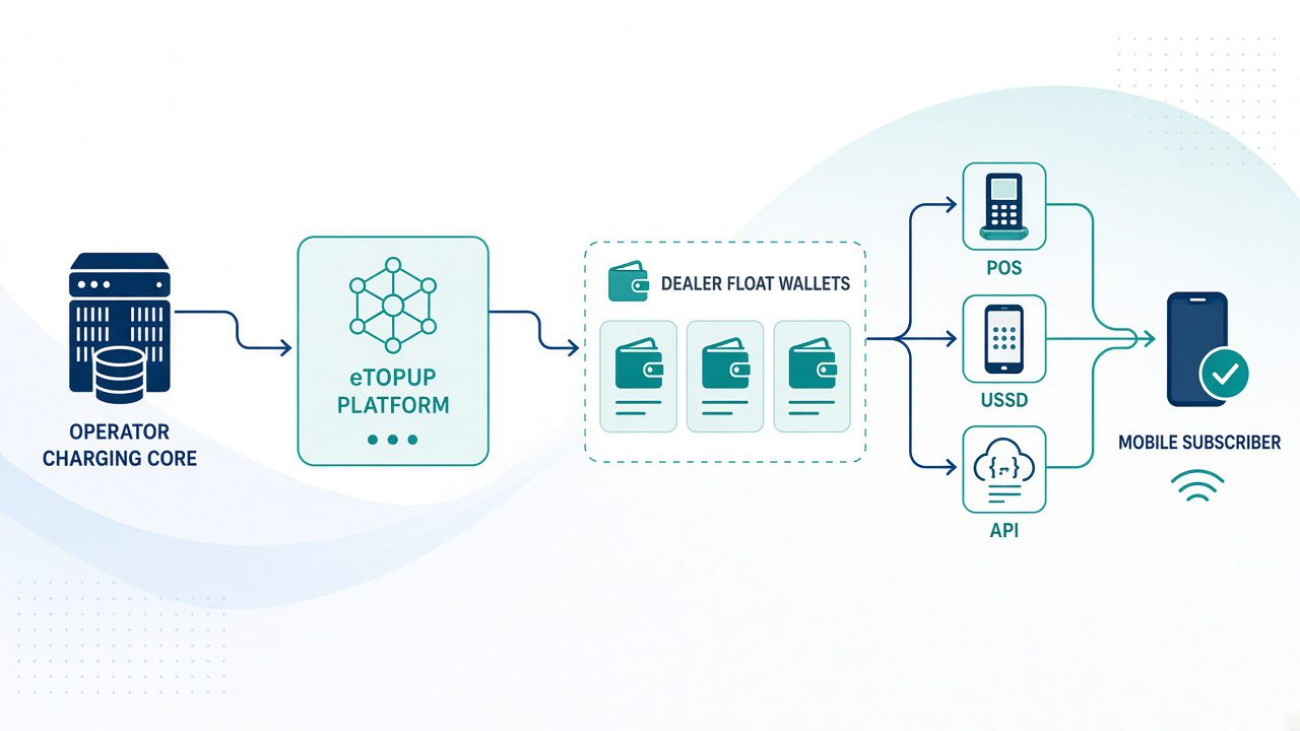
Diagram of an electronic top up system for telecom airtime

Electronic Top-Up System for Telecom Operators

An electronic top up system (also called eTopup or PINless airtime distribution) lets mobile operators and their reseller hierarchies credit prepaid subscribers directly without handing over a printed scratch PIN. Value sits in dealer wallets as pre-funded float or an approved credit limit, the recharge request travels to the operator’s charging platform over USSD, POS, mobile app, or partner API, and the subscriber’s balance updates in seconds. Operators adopt it when physical card printing costs and denomination rigidity alongside warehouse leakage outweigh the familiarity of scratch cartons on a retail shelf.

TL;DR: eTopup vs PIN voucher distribution

Model What the dealer holds How the subscriber gets credit Primary operational control
eTopup (PINless recharge) Pre-funded wallet float or credit limit Direct recharge call (e.g. UCIP Refill or UpdateBalanceAndDate) to the MSISDN at sale time Float reservation, idempotent retry keys, and timeout reconciliation against charging CDRs
PIN voucher (EVD / scratch) Allocated serial batches or print-on-demand PIN entitlements Subscriber dials or enters a secret PIN after purchase to redeem value HSM-backed PIN custody, batch activation gates, and serial state tracking from generated to redeemed

In practice, dealer float replaces physical inventory exposure, so wallet reservations and velocity caps alongside day-close exception queues become the core operating controls across USSD, Android or Linux POS, dealer web portals or mobile agent apps and partner APIs. Operators choose eTopup when they need rapid bundle changes and lower card operating costs, while keeping a full electronic voucher management system whenever serialised PIN lifecycles or hybrid stock with batch-level reconciliation remain part of the commercial mix. Research from GSMA Mobile for Development has long examined how shifting prepaid volume from scratch cards to electronic channels reduces manufacturing and distribution overhead.

What an electronic top up system actually does

In daily retail operations, a shopkeeper takes cash or a digital payment from a subscriber, keys the MSISDN (normalised to E.164 format) and selects a denomination or data bundle, after which the platform reserves the dealer’s float and instructs the operator’s IN or OCS to credit the account. No carton is opened in a warehouse, and no PIN sheet is photocopied in a back office. Every transaction either closes with a confirmed charging correlation ID or enters a tracked pending state that finance can reconcile at day-close.

Industry literature refers to this flow as electronic reloading or direct top-up. Wikipedia’s overview of electronic reloading traces the transition away from physical prepaid cards toward commercial retailer load and digital credit, which provides helpful context when briefing channel teams that still plan around physical card stock.

Deploying eTopup does not force an operator to retire vouchers everywhere at once. Multi-country operators run both side by side, using PINless eTopup for everyday prepaid refills while keeping serialised PIN stock for rural wholesalers or gift and OTT products.

Comparing eTopup, EVD PIN print and physical scratch cards

Dimension Physical scratch cards EVD PIN print / electronic PIN sale Electronic top up (eTopup)
What the dealer holds Printed cards with concealed PINs Digital PIN inventory released at sale or print-on-demand Wallet float value with no PIN issued to the subscriber
Theft and leakage risk High across warehousing and transport Contained when PINs stay encrypted in a vault until sale No PIN leakage; duplicate recharges and float misuse are the main risks
Denomination or bundle update Requires a print and distribution cycle Catalogue or batch policy update Immediate product catalogue and charging profile update
Subscriber experience Scratch coating and dial USSD string Receive printed or SMS PIN and redeem Direct balance or bundle credit to MSISDN
Reconciliation focus Physical batch manifests vs activated sales Serial lifecycle states vs charging redemptions Dealer wallet debits and holds vs charging CDR credits
Best commercial fit Offline or remote print-heavy retail Markets needing gift vouchers, partner PINs, or hybrid stock High-velocity prepaid refills, micro-denominations, dense agent networks

Physical scratch cards remain familiar to cash-based retailers, yet they carry printing and warehousing overhead plus stock shrinkage that digital channels eliminate. Electronic PIN printing still fits wherever a bearer secret is required for gift cards or utility tokens, whereas eTopup fits wherever the commercial act is crediting a subscriber’s phone number immediately from a controlled dealer wallet. For the broader terminology across these models, see our guide to electronic voucher distribution (EVD) for full definitions across both models.

Dealer float: the real inventory of eTopup

Removing physical cards makes dealer float the working inventory of the distribution network. Operating an eTopup hierarchy requires five linked ledger steps:

  1. Onboard each hierarchy tier (master distributor, sub-distributor, dealer, and retail POS agent) with explicit parent-child rules.
  2. Fund distributor and dealer wallets against verified bank transfers, cash deposits, or maker-checker credit allocations.
  3. Enforce per-tier credit limits and velocity caps so a compromised terminal cannot drain upstream float.
  4. Convert wallet reservations into debits only on confirmed charging success, and credit float back only through audited reversals.
  5. Expose live balance and hold views so field supervisors do not rely on chat screenshots to verify stock.

A core ledger rule is separating reservation from debit inside the dealer ledger. When a retailer submits a top-up, the platform places an atomic hold on the dealer’s available float (tracked in ISO 4217 integer minor units, including three-decimal Gulf currencies such as the Kuwaiti dinar, Bahraini dinar, and Omani rial) before the charging adapter sends the request to the IN or OCS. If charging returns a confirmed success (responseCode = 0 on UCIP), the hold converts into a final debit and posts commission. If the request receives an explicit reject, the hold releases immediately. When a recharge call times out without a reply, the reservation stays locked under a pending-unknown state until a status query or the T+1 charging CDR file proves whether the subscriber received the credit.

When dealers cannot see their reserved versus available float clearly, they maintain side ledgers on paper or spreadsheets, which turns ordinary timing differences into support disputes. Credit limits also need policy-driven temporary lifts for salary weeks or festival peaks rather than manual database edits at midnight.

eTopup channels that move prepaid airtime

A production eTopup platform routes every retail and digital channel through one channel gateway, one float ledger, and one duplicate-detection policy.

USSD and SMS remain the primary interface where feature phones and assisted street retail dominate. Menus have to stay shallow to avoid session timeouts, and every request must log the target MSISDN, the dealer ID, the transaction amount, and the upstream result code. Android and Linux POS terminals serve high-throughput counters with receipt printing and device binding, alongside dealer web portals for bulk wallet transfers and sub-agent management. Mobile agent apps cover field sales and low-balance alerts, while partner APIs connect banks, super-apps, and payment aggregators using the same composite idempotency keys and velocity limits enforced on retail terminals.

Choosing between eTopup-first and a full EVMS

Most steering-committee debates come down to whether an operator needs a standalone PINless recharge switch or a combined voucher and eTopup control plane.

When an eTopup-first rollout fits

An eTopup-first scope makes sense when almost all prepaid volume is direct PINless credit to MSISDNs, commercial teams ship weekly bundle or promotional price changes that cannot wait for print runs, and dealer complaints centre on card stockouts across rural branches. It assumes your engineering team will invest in resilient charging adapters, client-generated idempotency keys, and automated timeout resolution.

When to keep a full electronic voucher management system

A full electronic voucher management system remains necessary when you run physical or hybrid PIN stock that needs serial-level lifecycle states, distribute gift cards or OTT entitlements alongside airtime, or require batch blacklisting and HSM-backed PIN custody for revenue assurance.

In GCC and MEA deployments, operators commonly combine both models by running MoboGage’s EVD System as the inventory and hierarchy control plane with PINless eTopup operating directly off the dealer wallet ledger. If your team is comparing vendor architectures for a tender, our guide on how to choose an electronic voucher management system covers the evaluation criteria across voucher vault security, IN charging integration, and day-close reconciliation.

Operational controls buyers should demand

During technical due diligence, ask shortlisted vendors to demonstrate seven controls on a live test bed rather than on slides:

  1. Idempotent top-up: The same client request ID never double-credits the subscriber or double-debits the dealer. (How that works when charging does not answer: airtime top-up timeouts and unknown status.)
  2. Explicit failure taxonomy: Clear separation between a network timeout (pending-unknown), a gateway validation error, and an upstream charging reject, with distinct operator reason codes.
  3. Reversal and refund governance: Automated correlation-ID reversals for incomplete legs kept separate from maker-checker financial refunds after settlement.
  4. Multi-level velocity limits: Configurable caps per dealer, per terminal, and per target MSISDN over rolling hourly and daily windows.
  5. Terminal binding and revocation: Ability to revoke a stolen POS session token at the gateway immediately and track active app versions across the fleet.
  6. Three-way day-close pack: Automated comparison of channel sales, dealer wallet movements, and charging CDR/EDR files with named owners for exceptions.
  7. Charging interface discipline: Documented UCIP, Diameter, or OCS API mappings scoped and tested against forced timeouts per project.

Without those seven controls in place, a high-throughput recharge switch simply creates reconciliation breaks faster than finance can investigate them.

Implementation path for an operator rollout

  1. Baseline current leakage and disputes: Measure where physical stock disappears, where promo launches stall, and how many daily support tickets stem from unconfirmed recharges.
  2. Pilot a single hierarchy slice: Start with one region and a controlled group of distributors on USSD or POS plus the dealer portal to prove wallet reservations and charging CDR alignment on live traffic.
  3. Encode commercial hierarchy rules: Configure multi-tier commission splits, credit limits, and maker-checker transfer approvals to match existing distributor contracts.
  4. Harden timeout and exception playbooks: Train operations and support teams on pending-unknown holds and T+1 CDR settlement before onboarding external aggregator APIs.
  5. Expand channels incrementally: Roll out mobile apps, additional POS hardware families, and bank or super-app APIs once the daily reconciliation pack closes cleanly.
  6. Run continuous revenue assurance: Monitor adapter latency, duplicate-block counts, and late-success refund exceptions as routine operational metrics.

Next steps for operators and VAS partners

If your prepaid distribution still depends on physical print logistics, or if your electronic channels leave finance reconciling wallet debits against charging CDRs in spreadsheets, audit one week of recharge traffic by channel and exception code. That baseline shows immediately where reservation holds, idempotency constraints, or voucher lifecycle controls are missing.

Operators and VAS partners evaluating MoboGage (founded in 2007 as company-reported, headquartered in Jaipur, India as its sole office, with company-reported reach across more than 1 million retailers and 17 countries via channel partners) can review the product overview on the electronic voucher management system page, see how a UCIP / IN charging integration handles recharge calls, read more About MoboGage, or reach the engineering team via the contact page (projects@mobogage.com, +91-9928 366 889).

FAQ

What is an electronic top up system?

It is software that lets dealers or digital channels credit prepaid subscribers from controlled float or wallets without issuing a physical scratch PIN, while posting the credit to the operator’s charging system and logging the transaction for day-close reconciliation.

Is eTopup the same as EVD?

Not quite. EVD (electronic voucher distribution) covers moving voucher value through reseller channels, whereas eTopup refers specifically to PINless airtime credit posted straight to the subscriber’s balance. Most operator deployments combine both models by running PINless eTopup as a primary sales mode on top of an EVD hierarchy and wallet ledger.

Do dealers still need inventory?

Dealers hold float inventory in the form of wallet balances and credit limits rather than cartons of printed cards. Serialised PIN inventory is still used alongside float whenever an operator sells voucher batches or third-party entitlements on the same terminals.

Which channels should we launch first?

Start with the channel that already carries your core prepaid volume, such as USSD or Android POS, and prove that dealer float debits and charging credits reconcile cleanly before adding partner APIs and mobile apps. Opening every channel on day one without a working day-close exception queue creates avoidable balance disputes.

When is a full EVMS still required?

A full EVMS is required whenever you manage serialised PIN lifecycles or hybrid voucher stock alongside multi-product catalogues for gift and OTT entitlements, or when finance requires batch-level inventory reconciliation beyond wallet float movements.

How does GSMA frame electronic airtime channels?

GSMA Mobile for Development research on airtime distribution savings examines how electronic top-up paths reduce scratch-card printing and warehousing expenses alongside channel discount costs compared with physical card distribution, providing a useful benchmark when building an operator business case.

Related operator reading: For the connected prepaid stack, compare voucher reconciliation and PIN security with multi-tier reseller voucher distribution, review our electronic voucher distribution (EVD) explainer, or see the EVMS product overview for full lifecycle controls across the prepaid stack.

For formal PIN voucher and eTopup definitions used across the prepaid stack, consult the EVMS glossary.

If your team is operating or bidding in the Gulf, read our regional guide to electronic voucher management for GCC telecom.