
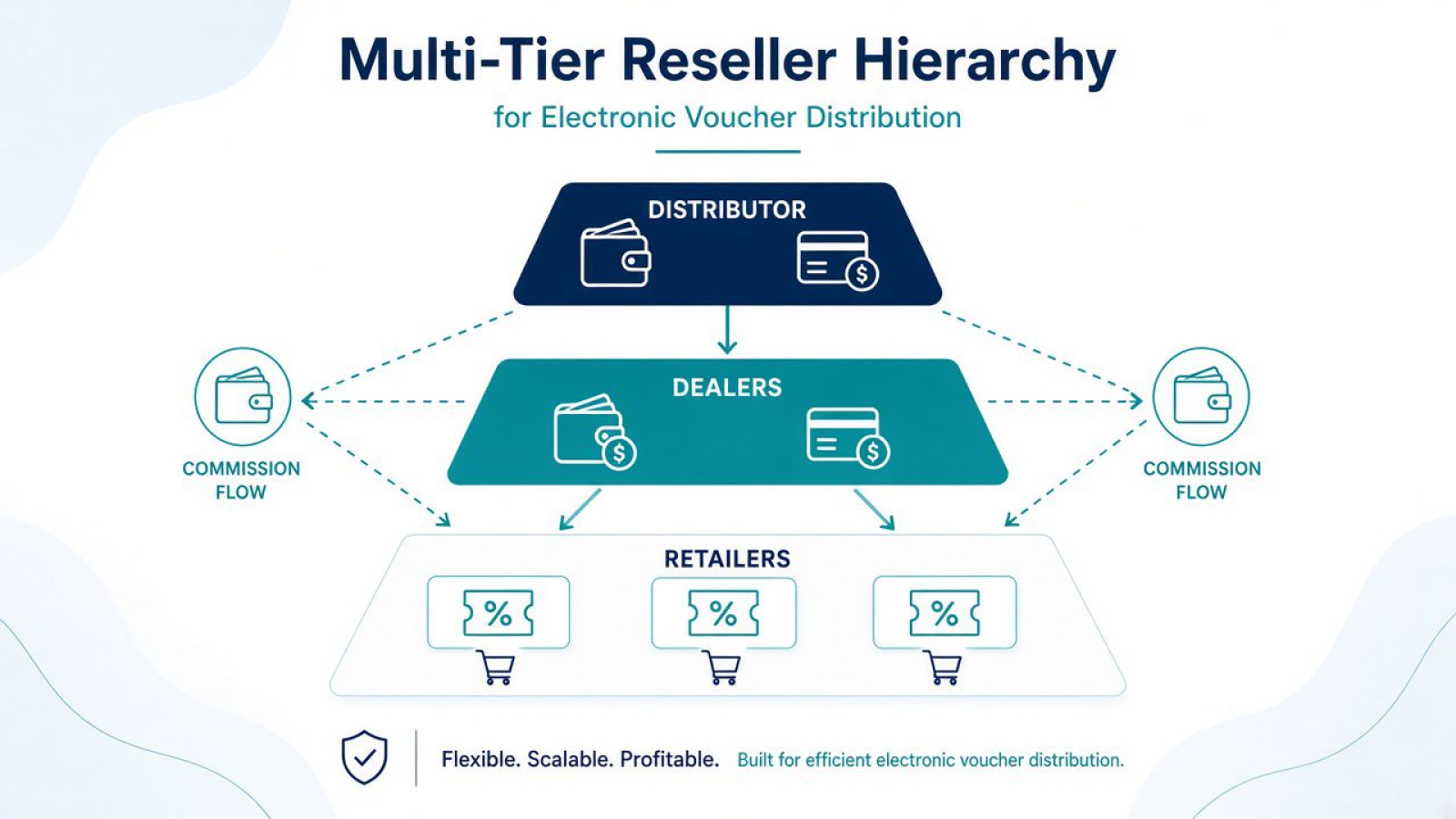
Multi-tier reseller voucher distribution is how most prepaid airtime and digital voucher value actually reaches the street: a distributor funds dealers, dealers fund retailers, retailers sell on POS, USSD, or appeach tier holding wallet balance, credit limits, and a slice of commission. An electronic voucher distribution hierarchy encodes that commercial reality in software so float, stock, and settlements stay auditable. Operators and VAS partners across GCC and MEA markets live this model daily; the platform either matches how the channel works, or the channel invents workarounds.
TL;DR
- Hierarchy is not a UI treeit is wallets, limits, transfer rules, and commission logic that field managers will use under pressure.
- Typical chain: operator / VAS admin distributor dealer retailer / agent, with optional regional splits.
- Credit limits and offline POS sync are where programmes succeed or leak; treat them as first-class design.
- Commissions should be configurable per tier and productnot hardcoded one discount for everyone.
- For the lifecycle layer that sits above hierarchy, see the electronic voucher management system product page.
Why hierarchy exists (and why flat portals fail)
Prepaid distribution in many markets grew from physical logistics: master distributors held cartons, sub-dealers took boxes, retailers sold cards. When programmes went electronic, the people structure stayed. What changed was the objectwallets and digital stock instead of cardboard.
A flat everyone is a retailer portal looks clean in a demo. It collapses under real channel politics:
- Master distributors expect sub-dealer creation rights and margin.
- Regional managers need visibility without the ability to raid another regions float.
- Retailers need fast sale flows, not admin screens built for HQ.
- Finance needs one ledger truth across tiers at day-close.
GSMAs work on agent and airtime distribution networks has long noted that mobile operators already rely on multi-layer retail reach to put airtime within an arms reachand that those networks are assets when building adjacent digital services (GSMA agent networks handbook context). Electronic voucher programmes inherit that same structural truth.
For vocabulary on EVD itself, see What is electronic voucher distribution (EVD)?.
Anatomy of an electronic voucher distribution hierarchy
A practical multi-tier model usually includes:
| Tier | Commercial role | Typical system objects |
|---|---|---|
| Operator / VAS admin | Policy, catalog, root float, fraud rules | Products, denominations, global limits, audit |
| Distributor / master | Funds region or brand channel; creates dealers | Parent wallet, transfer rights, reporting |
| Dealer / sub-distributor | Funds retailers; may run own POS fleet | Wallet, credit limit, commission share |
| Retailer / agent | Sells to subscribers | Sale rights, low-balance alerts, limited admin |
| Terminal / user | Device or clerk under a retailer | Auth, version, disablement |
N-level trees are common. The point is not to maximise depth for sport. Every extra tier adds transfer latency, dispute surfaces, and training load. Design depth to match the markets existing commercial contractsthen enforce it in software so shadow hierarchies cannot form on WhatsApp.
Wallets and credit limits: the operating heart
In multi-tier reseller voucher distribution, each node typically holds:
- Wallet balance Prepaid value available to transfer or sell.
- Credit limit Ceiling on exposure (prepaid, postpaid-style credit, or hybrid).
- Transfer permissions Who can push or pull float to children.
- Product entitlements Which SKUs that node may sell (airtime, data, gift, OTT).
Credit limits are risk controls disguised as commercial terms. A distributor with uncapped children will eventually sponsor a fraud event. Temporary lifts for Eid peaks, salary weeks, or launch promotions belong in governed workflows with expirynot permanent just increase it tribal knowledge.
Low-balance notifications (SMS, app, email) keep the street selling. Without them, retailers claim stockouts while parent wallets sit idle upstairs.
Commissions without folklore
Commission design separates programmes that scale from programmes that argue monthly:
- Per-tier rates Distributor, dealer, and retailer shares on the same sale.
- Per-product rules Data bundles may differ from voice airtime; gift cards may differ again.
- Timing Real-time wallet credit vs periodic settlement.
- Clawbacks Clear policy when reversals happen.
- Visibility Each tier sees its own earnings without leaking peer margins carelessly.
If commission math lives only in a side spreadsheet, the system of record is not the system. Encode rules, show statements, and reconcile commission totals into the same day-close culture you use for sales.
Offline POS sync in real channel conditions
Shop connectivity is uneven. GCC mall retail and dense urban MEA corridors may be fine; peri-urban and rural agents are not. Multi-tier distribution that assumes perpetual online POS will invent offline behaviour anywayusually badly.
Define explicitly:
- Which products may sell offline (if any).
- How local risk limits cap offline sales.
- How sync resolves conflicts when the server rejects a queued sale.
- How float is reserved or reconciled after reconnect.
- How long a terminal may remain offline before auto-disable.
Terminal managementversions, remote config, lost-device disablementbelongs in the same operating model. A hierarchy with orphaned POS still selling is not a hierarchy; it is a leak.
GCC / MEA operating context (without geo spam)
Channel reality in GCC and MEA prepaid markets often includes dense multi-brand retail, migrant-heavy prepaid bases, festival demand spikes, and partner-operated VAS distribution alongside opco-owned channels. Hierarchy software must tolerate:
- Multi-currency or multi-denomination catalogs where programmes cross borders.
- Partner white-label portals under opco policy.
- Rapid onboarding of retailers without weeks of paper.
- Reporting by region and partner that finance will actually open.
Mentioning the region once or twice is enough. Buyers know their markets; they need controls that fit, not slogan geography.
Comparison: flat vs multi-tier control
| Dimension | Flat retailer portal | Multi-tier reseller hierarchy |
|---|---|---|
| Who creates sellers | Central admin only | Distributors/dealers under policy |
| Float path | Admin retailer | Cascaded wallets with limits |
| Commission | Often single discount | Configurable multi-level shares |
| Regional autonomy | Weak | Natural via subtree rights |
| Dispute surface | Admin vs all | Parentchild with audit |
| Fits existing contracts | Rarely | Usually |
| Risk if misconfigured | Broad over-permission | Deep trees without monitoring |
Flat can work for a tiny pilot. Multi-tier matches how airtime already moves.
Buyer checklist for hierarchy platforms
| Capability | Prove in discovery |
|---|---|
| N-level tree | Create distributor dealer retailer; show inheritance of policy |
| Wallet transfers | Push/pull with approvals and audit |
| Credit limits | Enforce hard stop mid-sale; temporary lift with expiry |
| Commissions | Multi-level calc on one live sale; statement export |
| Channel parity | Same float rules on POS, USSD, app, API |
| Offline sync | Documented behaviour + conflict resolution demo |
| Reporting | By tier, region, product; day-close pack |
| Disablement | Kill a lost POS; revoke a dealer without nuking the tree |
| Onboarding | Sub-user roles; KYC fields as your market requires |
When comparing full platformsnot only hierarchyuse How to choose an electronic voucher management system.
How EVD System approaches hierarchy
EVD System by MoboGage treats dealer hierarchy and float as part of the prepaid control plane: allocation through master dealers and retailers, credit limits, multi-channel sale, and reconciliation. The goal is hierarchy dealers will trust on a busy afternoonnot an org-chart widget that finance cannot close.
Adjacent realitiesPINless eTopup off the same wallets, PIN lifecycle for hybrid stocksit beside hierarchy rather than replacing it. Channel design without lifecycle and security is incomplete; security without hierarchy that matches contracts will not get adopted.
Soft next step
Sketch your live commercial tree on one page: who funds whom, who sets limits, who earns what on a single airtime sale. Bring that page to vendor demos. If the platform cannot encode it without custom folklore, keep evaluating.
Learn more About MoboGage or start a scoped conversation via the contact page projects@mobogage.com +91-9928 366 889.
FAQ
What is multi-tier reseller voucher distribution?
It is the commercial and technical model where prepaid voucher or airtime value moves through nested partnerstypically distributor, dealer, and retailereach with wallets, limits, and commissions, down to a subscriber sale.
How many tiers should we configure?
Match existing contracts and management capacity. Start with the minimum depth that reflects who actually funds whom; add tiers only when a commercial role requires separate float and reporting.
What is the difference between hierarchy and EVMS?
Hierarchy is the channel and float structure. An electronic voucher management system covers lifecycle, security, channels, and reconciliationincluding hierarchy as a core module. Buyers usually need both connected.
How do commissions work across tiers?
On a successful sale, configured shares can credit parent and child wallets (or settle periodically). Rules should be product-aware and include reversal clawback policy.
Why does offline POS sync matter for hierarchy?
Retailers at the edge often have uneven connectivity. Without defined offline limits and sync conflict rules, parent wallets and child sales divergeand multi-tier trust collapses.
Can APIs sit inside the same hierarchy?
Yes. Aggregator or bank API nodes should consume the same float and fraud policy as POS retailers. Separate API float with weaker controls recreates leakage under a modern label.
Add a Comment