
merchant-agency-onboarding-commissions-qr

Merchant and Agency Channel Onboarding, Commissions and QR

Merchant and agency channels connect merchant onboarding, agent hierarchies, commissions, QR acceptance and cash workflows through agreed financial integrations, so banks, wallet providers and distribution groups can grow acceptance without losing track of who may sell, collect or settle.

MoboGage labels this an Established foundation with extensions in its banking portfolio. It is the channel layer that usually sits next to mobile money, CreditSync and EVD retail sale, and the company profile frames the buyer value as service access, controlled credit operations, and clearer visibility of transactions and balances.

Company context, as reported by MoboGage: experience since 2007 (IWT Group heritage), more than one million retailers using its POS and airtime services, and business or project reach across 17 countries. MoboGage Private Limited was incorporated in February 2017; its only office is the Jaipur HQ, and other countries are served through partners.

Merchant and agency channel management is more than a sign-up form

A registration form gets you a list of names. Running the channel means onboarding merchants and agents under the institution’s own compliance rules, placing each one in the hierarchy (master agent, sub-agent or merchant outlet), granting permissions per product, channel and cash activity, attaching a commission scheme, enabling QR where the payment integration allows it, and reconciling cash back to wallet or bank positions. New payment schemes or device types beyond that foundation are scoped by agreement.

Onboarding states and who sees them

Onboarding captures the identity and commercial fields the institution requires, routes the application to an approver, places the party in the hierarchy and activates only the products it has authorised. The record keeps the approver’s ID and timestamp. Field supervisors see each application as submitted, in review, approved, rejected or suspended, so a sales rep can’t tell a shop it is live while compliance is still checking documents. Product activation waits until those checks are done; the KYC rules themselves belong to the regulated client.

Device and channel binding matter as much as the approval. An agent approved to sell through the app should not acquire cash-out rights that nobody granted, and QR acceptance should switch on only after the acquiring or wallet scheme confirms the merchant. Edges like these prevent the “the system let me” argument later.

Hierarchy changes are money events

The tree defines reporting lines, float relationships and how commission cascades. Moving an agent to a new parent looks like an admin edit, but it rewires money and support paths. We treat it as a dated event: open commissions stay with the old parent up to the effective date, new transactions accrue to the new one, and the move itself is approved and logged. Suspension stops new activity immediately while keeping history intact for settlement, and exit terms (data rights, documentation, training) belong in the commercial schedule.

Airtime networks already think in trees, which gives distribution and VAS groups a head start when they extend into wallet cash-in/out and merchant acceptance. That only works if the discipline from multi-tier reseller voucher distribution carries over, including who may sell to whom and at what limit.

Commission you can trace to a rule version

Commission can differ by product (airtime, bill pay, QR), by channel and by level in the tree. Each commission line we post stores the transaction reference, the rule ID and the rule version that produced it, so “what rate was live on Tuesday?” has a database answer. Master and sub-agent splits are calculated once from the same transaction event. Promotions get explicit start and end dates. Recalculating history is rare, needs authorisation and is audited, because each retroactive change opens a fresh dispute.

Agents on the same street compare rates. Where policy allows, print the applied rate on the receipt or statement line, and write the commission logic in words a field team can explain at the counter.

QR acceptance: what the code actually contains

Most national QR schemes follow the EMVCo merchant-presented QR specification. The payload is a string of tag-length-value fields: tag 00 for the payload format, tag 01 for static (11) or dynamic (12) codes, tags 26 to 51 for the merchant account information the scheme assigns, 52 for the merchant category code, 53 for the ISO 4217 currency, 54 for an amount on dynamic codes, 58 and 59 and 60 for country, merchant name and city, and tag 63 for a CRC checksum. A printed sticker at a till is usually static, so the customer types the amount; a code shown on a POS screen is usually dynamic and carries the amount and a reference.

That reference is what lets a QR payment reconcile against the outlet’s ledger. QR acceptance depends on the agreed financial integration and on acquiring or wallet scheme rules, so we present it as a scoped capability per market, not a universal claim.

Cash and the till

In many markets cash and QR will run side by side for years. Cash ties back to wallet balances through cash-in, cash-out and till reconciliation at the end of each shift, and QR failures need scheme-specific messages the shopkeeper can read. A 200 response from an API is no help to a shopkeeper whose drawer is short, so receipts and training are part of the design.

Who needs what from the channel

A bank or licensed wallet provider needs accountable merchants: onboarding evidence, clear hierarchy ownership and commission transparency, which help growth and help during regulatory review. Regulated responsibilities stay with the licensed institution. Merchants and agents need to see their activation status, product rights and commission statements. Finance and operations need commission accruals, cash variances and dormant outlets reported with unique transaction references and explicit states, in line with voucher reconciliation and the reversal design in the wallet cash-in/out deep-dive.

Fit with EVD System and mobile money

Retailers already selling from an electronic voucher management system are natural candidates for agency roles once wallet products expand. Keep one merchant master record across EVD and wallets so catalogue airtime, utilities and cash-in share the same outlet identity, and no orphan accounts appear. CreditSync may fund agent float, while the channel modules decide what that agent is allowed to do.

For the bigger picture, read the mobile money platform with merchant payment overview, the telecom product page EVMS for telecom, and about MoboGage. The buyer checklist is at how to choose an EVMS.

Questions to put to any channel vendor

Large recharge and distribution suites such as Comviva PreTUPS and Seamless ERS 360 market multi-level hierarchies, segment-based commission and dealer management. Those are reasonable baselines. In a demo, ask each vendor to move an agent between parents mid-month and show where the open commission lands, to show the rule version on a commission line, and to reconcile one dynamic-QR payment against the outlet ledger. Ask us the same.

A pilot sized to the field

Delivery follows the same five stages as our other work (Discover → Design → Pilot → Roll out → Operate and expand). For channels we pilot on one city or one hierarchy branch, with one product set (cash-in plus airtime, or QR plus bill pay) and a training cohort that stays the same throughout. Measure the quality of completed onboarding rather than the application count, how clear agents find their commission statements (ask them in feedback sessions), and how old cash variances get. Label: Established foundation with extensions. Proposed banking exception hubs and settlement-exception products are not included as available features and stay out of the pilot charter unless discovery adds them.

Useful links for evaluators: telecom EVD systems for context, electronic top-up for PINless sale at the same outlets, and the CreditSync post for the float funding behind the hierarchy.

For a first call, bring your compliance owner, your hierarchy model and the product set you want live first. Contact us through the voucher management system enquiry page, projects@mobogage.com, or +91-9928 366 889. Founder & CEO: Sohan Lal Soni, Jaipur, India.

Frequently asked questions

What are merchant and agency channels in this context?

They are the operating structures that onboard merchants and agents, organise hierarchies, calculate commissions, accept QR payments and run cash workflows through agreed financial integrations, an Established foundation with extensions in MoboGage’s banking portfolio.

How does onboarding usually work?

Onboarding collects identity and commercial data required by the institution, applies approval workflows, assigns hierarchy placement and activates channel permissions (POS, app, QR, cash). Exact KYC rules belong to the regulated client.

Why do agent hierarchies matter?

Commissions, float, limits and support ownership usually follow the tree. Without a clear hierarchy, settlement and dispute routing become informal and slow.

What is QR acceptance used for?

QR acceptance lets merchants take wallet or payment-scheme payments at the point of sale under agreed financial integrations. It sits beside cash workflows rather than replacing them overnight.

How do commissions stay trustworthy?

Commission rules should be versioned, attributable to transaction types, and visible to finance. Silent rule changes create channel conflict.

How do we pilot merchant and agency channels?

Bound one city or hierarchy branch, agree onboarding completion and commission clarity measures, then expand. Contact projects@mobogage.com or the enquiry page.
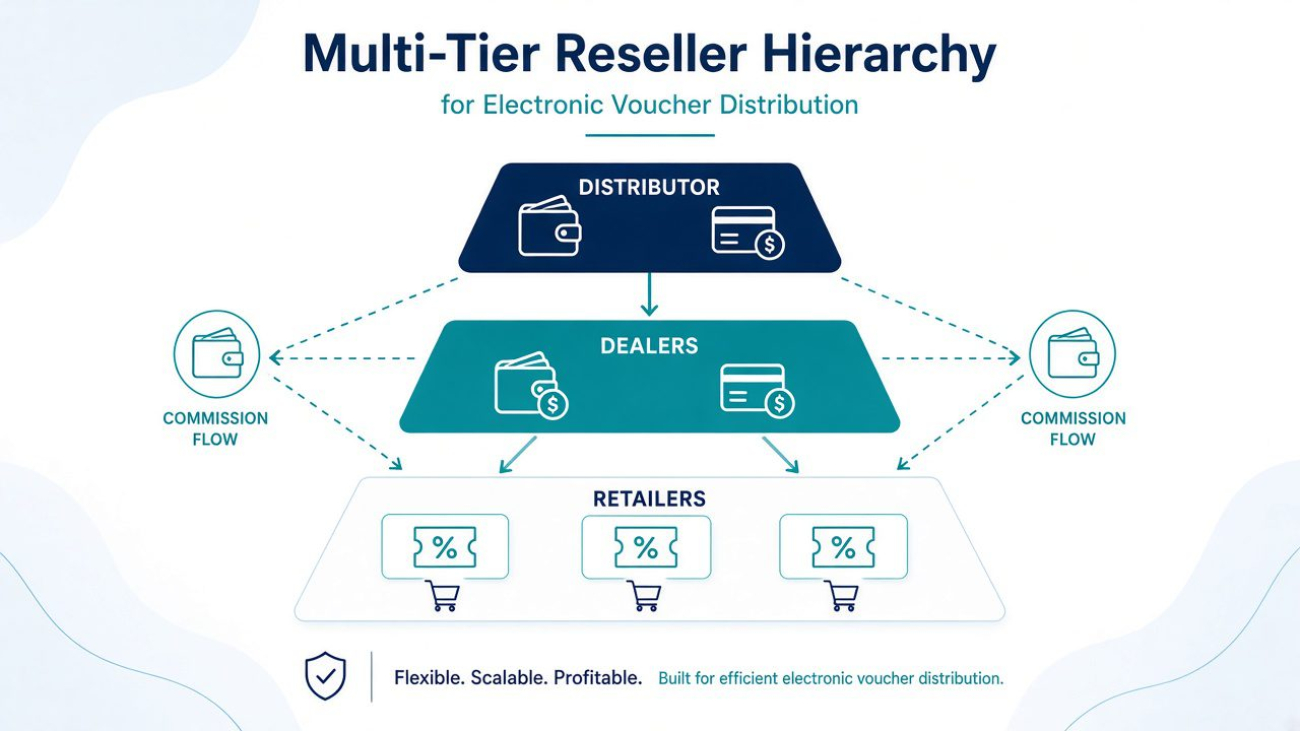
Multi-tier reseller voucher distribution hierarchy diagram from distributor to dealer to retailer for electronic vouchers

Multi-Tier Reseller Distribution for Electronic Vouchers

Multi-tier reseller voucher distribution is how most prepaid airtime and digital voucher value actually reaches the street: a distributor funds dealers, dealers fund retailers, retailers sell on POS, USSD, or appeach tier holding wallet balance, credit limits, and a slice of commission. An electronic voucher distribution hierarchy encodes that commercial reality in software so float, stock, and settlements stay auditable. Operators and VAS partners across GCC and MEA markets live this model daily; the platform either matches how the channel works, or the channel invents workarounds.

TL;DR

  • Hierarchy is not a UI treeit is wallets, limits, transfer rules, and commission logic that field managers will use under pressure.
  • Typical chain: operator / VAS admin distributor dealer retailer / agent, with optional regional splits.
  • Credit limits and offline POS sync are where programmes succeed or leak; treat them as first-class design.
  • Commissions should be configurable per tier and productnot hardcoded one discount for everyone.
  • For the lifecycle layer that sits above hierarchy, see the electronic voucher management system product page.

Why hierarchy exists (and why flat portals fail)

Prepaid distribution in many markets grew from physical logistics: master distributors held cartons, sub-dealers took boxes, retailers sold cards. When programmes went electronic, the people structure stayed. What changed was the objectwallets and digital stock instead of cardboard.

A flat everyone is a retailer portal looks clean in a demo. It collapses under real channel politics:

  • Master distributors expect sub-dealer creation rights and margin.
  • Regional managers need visibility without the ability to raid another regions float.
  • Retailers need fast sale flows, not admin screens built for HQ.
  • Finance needs one ledger truth across tiers at day-close.

GSMAs work on agent and airtime distribution networks has long noted that mobile operators already rely on multi-layer retail reach to put airtime within an arms reachand that those networks are assets when building adjacent digital services (GSMA agent networks handbook context). Electronic voucher programmes inherit that same structural truth.

For vocabulary on EVD itself, see What is electronic voucher distribution (EVD)?.

Anatomy of an electronic voucher distribution hierarchy

A practical multi-tier model usually includes:

TierCommercial roleTypical system objects
Operator / VAS adminPolicy, catalog, root float, fraud rulesProducts, denominations, global limits, audit
Distributor / masterFunds region or brand channel; creates dealersParent wallet, transfer rights, reporting
Dealer / sub-distributorFunds retailers; may run own POS fleetWallet, credit limit, commission share
Retailer / agentSells to subscribersSale rights, low-balance alerts, limited admin
Terminal / userDevice or clerk under a retailerAuth, version, disablement

N-level trees are common. The point is not to maximise depth for sport. Every extra tier adds transfer latency, dispute surfaces, and training load. Design depth to match the markets existing commercial contractsthen enforce it in software so shadow hierarchies cannot form on WhatsApp.

Wallets and credit limits: the operating heart

In multi-tier reseller voucher distribution, each node typically holds:

  • Wallet balance Prepaid value available to transfer or sell.
  • Credit limit Ceiling on exposure (prepaid, postpaid-style credit, or hybrid).
  • Transfer permissions Who can push or pull float to children.
  • Product entitlements Which SKUs that node may sell (airtime, data, gift, OTT).

Credit limits are risk controls disguised as commercial terms. A distributor with uncapped children will eventually sponsor a fraud event. Temporary lifts for Eid peaks, salary weeks, or launch promotions belong in governed workflows with expirynot permanent just increase it tribal knowledge.

Low-balance notifications (SMS, app, email) keep the street selling. Without them, retailers claim stockouts while parent wallets sit idle upstairs.

Commissions without folklore

Commission design separates programmes that scale from programmes that argue monthly:

  • Per-tier rates Distributor, dealer, and retailer shares on the same sale.
  • Per-product rules Data bundles may differ from voice airtime; gift cards may differ again.
  • Timing Real-time wallet credit vs periodic settlement.
  • Clawbacks Clear policy when reversals happen.
  • Visibility Each tier sees its own earnings without leaking peer margins carelessly.

If commission math lives only in a side spreadsheet, the system of record is not the system. Encode rules, show statements, and reconcile commission totals into the same day-close culture you use for sales.

Offline POS sync in real channel conditions

Shop connectivity is uneven. GCC mall retail and dense urban MEA corridors may be fine; peri-urban and rural agents are not. Multi-tier distribution that assumes perpetual online POS will invent offline behaviour anywayusually badly.

Define explicitly:

  1. Which products may sell offline (if any).
  2. How local risk limits cap offline sales.
  3. How sync resolves conflicts when the server rejects a queued sale.
  4. How float is reserved or reconciled after reconnect.
  5. How long a terminal may remain offline before auto-disable.

Terminal managementversions, remote config, lost-device disablementbelongs in the same operating model. A hierarchy with orphaned POS still selling is not a hierarchy; it is a leak.

GCC / MEA operating context (without geo spam)

Channel reality in GCC and MEA prepaid markets often includes dense multi-brand retail, migrant-heavy prepaid bases, festival demand spikes, and partner-operated VAS distribution alongside opco-owned channels. Hierarchy software must tolerate:

  • Multi-currency or multi-denomination catalogs where programmes cross borders.
  • Partner white-label portals under opco policy.
  • Rapid onboarding of retailers without weeks of paper.
  • Reporting by region and partner that finance will actually open.

Mentioning the region once or twice is enough. Buyers know their markets; they need controls that fit, not slogan geography.

Comparison: flat vs multi-tier control

DimensionFlat retailer portalMulti-tier reseller hierarchy
Who creates sellersCentral admin onlyDistributors/dealers under policy
Float pathAdmin retailerCascaded wallets with limits
CommissionOften single discountConfigurable multi-level shares
Regional autonomyWeakNatural via subtree rights
Dispute surfaceAdmin vs allParentchild with audit
Fits existing contractsRarelyUsually
Risk if misconfiguredBroad over-permissionDeep trees without monitoring

Flat can work for a tiny pilot. Multi-tier matches how airtime already moves.

Buyer checklist for hierarchy platforms

CapabilityProve in discovery
N-level treeCreate distributor dealer retailer; show inheritance of policy
Wallet transfersPush/pull with approvals and audit
Credit limitsEnforce hard stop mid-sale; temporary lift with expiry
CommissionsMulti-level calc on one live sale; statement export
Channel paritySame float rules on POS, USSD, app, API
Offline syncDocumented behaviour + conflict resolution demo
ReportingBy tier, region, product; day-close pack
DisablementKill a lost POS; revoke a dealer without nuking the tree
OnboardingSub-user roles; KYC fields as your market requires

When comparing full platformsnot only hierarchyuse How to choose an electronic voucher management system.

How EVD System approaches hierarchy

EVD System by MoboGage treats dealer hierarchy and float as part of the prepaid control plane: allocation through master dealers and retailers, credit limits, multi-channel sale, and reconciliation. The goal is hierarchy dealers will trust on a busy afternoonnot an org-chart widget that finance cannot close.

Adjacent realitiesPINless eTopup off the same wallets, PIN lifecycle for hybrid stocksit beside hierarchy rather than replacing it. Channel design without lifecycle and security is incomplete; security without hierarchy that matches contracts will not get adopted.

Soft next step

Sketch your live commercial tree on one page: who funds whom, who sets limits, who earns what on a single airtime sale. Bring that page to vendor demos. If the platform cannot encode it without custom folklore, keep evaluating.

Learn more About MoboGage or start a scoped conversation via the contact page projects@mobogage.com +91-9928 366 889.

FAQ

What is multi-tier reseller voucher distribution?

It is the commercial and technical model where prepaid voucher or airtime value moves through nested partnerstypically distributor, dealer, and retailereach with wallets, limits, and commissions, down to a subscriber sale.

How many tiers should we configure?

Match existing contracts and management capacity. Start with the minimum depth that reflects who actually funds whom; add tiers only when a commercial role requires separate float and reporting.

What is the difference between hierarchy and EVMS?

Hierarchy is the channel and float structure. An electronic voucher management system covers lifecycle, security, channels, and reconciliationincluding hierarchy as a core module. Buyers usually need both connected.

How do commissions work across tiers?

On a successful sale, configured shares can credit parent and child wallets (or settle periodically). Rules should be product-aware and include reversal clawback policy.

Why does offline POS sync matter for hierarchy?

Retailers at the edge often have uneven connectivity. Without defined offline limits and sync conflict rules, parent wallets and child sales divergeand multi-tier trust collapses.

Can APIs sit inside the same hierarchy?

Yes. Aggregator or bank API nodes should consume the same float and fraud policy as POS retailers. Separate API float with weaker controls recreates leakage under a modern label.

Related operator reading: Pair this reseller model with electronic top-up for telecom airtime and voucher reconciliation and PIN security; see the EVMS product overview for the lifecycle control plane.

See the reseller hierarchy glossary entry.