
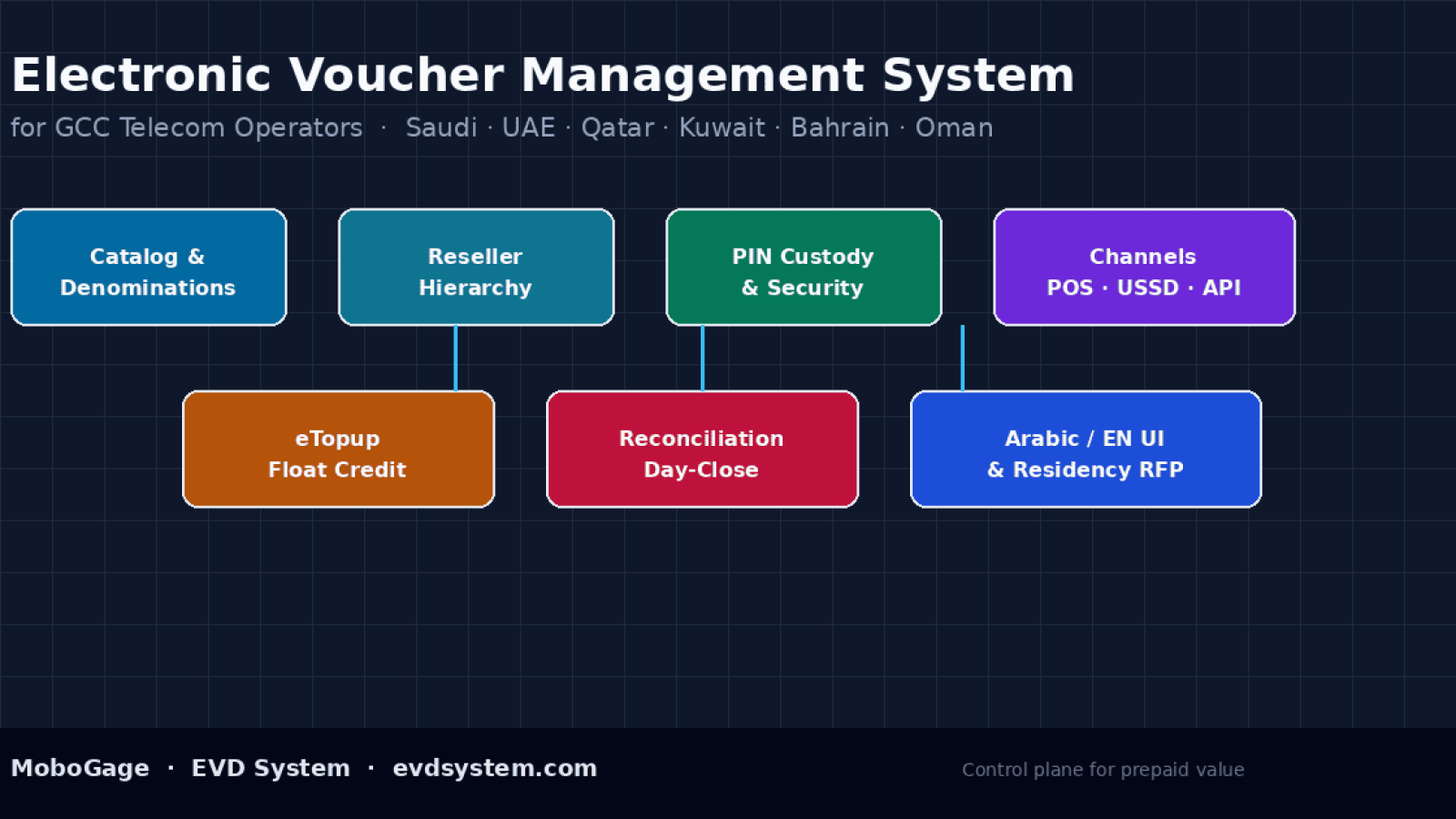
Electronic Voucher Management System for GCC Telecom Operators
An electronic voucher management system is the control plane for prepaid value: it generates and inventories serialised vouchers or float, allocates them through reseller hierarchies, sells via POS, USSD, portal, or API, and reconciles inventory, sales, and charging. For telecom operators and VAS partners in the GCC—Saudi Arabia, UAE, Qatar, Kuwait, Bahrain, and Oman—that control plane has to absorb multi-currency catalogs, dense distributor trees, bilingual field teams, and partner delivery models without turning every festival peak into a finance ticket storm.
Definition
| Term | Plain meaning |
|---|---|
| Electronic voucher management system (EVMS / VMS) | Software that owns voucher or prepaid-value lifecycle: create → secure → distribute → sell/redeem → report/reconcile |
| EVD | Electronic voucher distribution — moving prepaid value through channel nodes (often with wallets and POS) |
| eTopup | Typically PINless airtime credit from dealer float to subscriber MSISDN |
| Control plane | The system of record for stock, hierarchy policy, PIN custody, and day-close truth |
TL;DR
- GCC prepaid programmes usually need an electronic voucher management system that handles catalogs, reseller tiers, PIN custody, and reconcile—not a single-channel top-up gadget.
- Operating realities that show up in RFPs: multi-denomination / multi-currency product catalogs, multi-tier distributors, hybrid PIN + eTopup sales, Arabic/English UI expectations, and data-residency requirements language for IT and risk teams.
- eTopup adjacency matters: many Saudi and UAE retail paths want PINless credit while partners still sell serialised vouchers—see electronic top-up for telecom airtime.
- Buy on lifecycle and day-close proof, not slide decks. Use the EVMS buyer checklist when steering committees compare vendors.
- Industry background on electronic reloading versus physical prepaid cards is summarised on Wikipedia’s electronic reloading page; GSMA Mobile for Development has discussed airtime distribution cost levers for electronic channels (GSMA article on airtime distribution savings).
Why GCC operators treat EVMS as infrastructure
Prepaid still funds a large share of retail connectivity across the Gulf. The commercial surface looks simple—sell airtime, bundles, or partner vouchers—but the operating surface does not. A national distributor in Riyadh may fund sub-dealers in Jeddah and Dammam; a Dubai aggregator may expose APIs to super-apps; a Kuwait retailer may need offline-tolerant POS when coverage dips. Finance wants one inventory truth. Fraud wants PIN custody and velocity limits. Channel wants commission that matches the contract tree they already signed.
An electronic voucher management system is where those concerns meet. Without it, operators stitch portals, partner spreadsheets, and charging adapters into a fragile mesh. With it, generation policy, hierarchy credit limits, sale channels, and reconcile packs share one vocabulary. That is the practical reason MoboGage positions EVD System as a premium application for telecom and VAS—not a thin “voucher printer.”
For vocabulary (EVD vs VMS vs adjacent terms), start with What is electronic voucher distribution (EVD)?.
GCC operating realities the platform must absorb
These are requirements-language patterns buyers put in RFPs—not claims about any one country’s regulation or about EVD System’s certification status.
Multi-currency and denomination catalogs
GCC programmes often mix local-currency airtime denoms with partner gift or OTT SKUs, promotional bundles, and sometimes dual-face value for expatriate corridors. Catalog change velocity is high around holidays and salary weeks. An EVMS should let product teams publish denominations and expiry rules without reprinting physical stock or opening emergency database tickets. Micro-denoms and bundle SKUs belong in the same control plane as classic face-value vouchers.
Reseller tiers that match real contracts
Flat “all retailers equal” portals fail distributor agreements common in Saudi Arabia, UAE, and wider MEA. Operators need master distributors, sub-distributors, and retail leaves with wallet transfer rules, credit limits, and commission settlement that mirror the paper contract. Encode the tree you already have—see multi-tier reseller voucher distribution.
PIN security and reconciliation as first-class work
Serialised secrets still appear for partner products, gift-style SKUs, and hybrid print paths. Encryption at rest is table stakes; day-close that ties inventory status, sales, and charging credits is the hard part. Buyers should insist on lifecycle states, blacklisting, dual-control reversals, and exception reason codes—covered in depth in voucher reconciliation and PIN security.
eTopup adjacency
High-velocity retail in UAE and Saudi often prefers PINless credit to MSISDN from dealer float. That does not retire EVMS; it changes what the dealer holds (float instead of PIN stock) while hierarchy, limits, and reconcile remain. Many GCC stacks run both modes under one policy. Design for adjacency, not either/or slogans.
Arabic UI, bilingual ops, and data-residency requirements language
Field teams and L1 support commonly need Arabic and English labels, receipts, and training packs. IT and risk often ask where production data and backups reside, which subprocessors touch PIN material, and how access is logged. Treat bilingual UX and residency options as evaluation criteria you verify in the RFP and architecture review—never as marketing claims unless your legal and delivery teams have confirmed them for that deal.
Partner / SI delivery model
GCC and MEA wins frequently run through systems integrators and VAS partners who already hold operator relationships and tender experience. An EVMS vendor that can sit behind a partner as technology outsourcing—APIs, POS, hierarchy config, training—matches how procurement actually buys. Position EVD System accordingly: MoboGage as the product and engineering layer; SI/partners as the delivery face when that is the commercial path.
Requirements table: what to put in a GCC EVMS RFP
| Requirement area | What “good” looks like in evaluation | Why it matters in GCC/MEA |
|---|---|---|
| Catalog & denominations | Multi-product, multi-denom, promo windows without reprint | Festival and salary-week catalog churn |
| Hierarchy & wallets | Multi-tier nodes, credit limits, parent→child transfer policy | Distributor contracts are rarely flat |
| Channels | USSD, Android/Linux POS, portal, app, API on one float/PIN truth | Omnichannel retail + aggregators |
| PIN custody | Encrypted secrets, reveal-at-sale, blacklist, audit trail | Partner SKUs and hybrid stock |
| Reconciliation | Inventory vs sales vs charging with exception owners | Finance and fraud close the same day |
| eTopup mode | Idempotent PINless credit, float debit, clear failure codes | High-velocity prepaid retail |
| Localisation | Arabic/English UI and receipts as configurable | Bilingual field and support teams |
| Residency & access | Documented hosting options, access logs, subprocessors | Risk and IT questionnaire items |
| Delivery | SI/partner-ready APIs, config, training packs | Tender and outsourced ops models |
Use this table beside the fuller evaluation grid in How to choose an electronic voucher management system.
How EVD System by MoboGage maps to that model
EVD System is MoboGage’s electronic voucher distribution and management platform for generation, inventory, lifecycle, reseller POS (Android/Linux), apps, and APIs covering telecom airtime, gift-style vouchers, and related prepaid products. The honest positioning for GCC buyers:
- Lifecycle control plane — serialised voucher states and policies, not only a sales screen.
- Channel hierarchy — wallets, limits, and multi-tier distribution that channel teams recognise.
- Hybrid sales — PIN paths and eTopup-style credit under shared commercial rules.
- Reconcile-first ops — day-close oriented around inventory, sales, and charging alignment.
- Partner delivery — suitable when an SI or VAS partner wants a technology outsourcing layer rather than building voucher plumbing in-house.
No invented operator counts, uptime percentages, or “market leader” badges belong here. Ask for a scoped demo against your hierarchy slice, catalog, and exception paths.
Implementation path that survives a normal GCC Tuesday
- Map one country commercial tree — master distributors, credit terms, and which SKUs are PIN vs PINless.
- Pilot a hierarchy slice — one region or partner, limited POS/USSD, prove float or PIN debit and charging credit.
- Localise the operator-facing surfaces — Arabic/English labels on the screens dealers and L1 actually use.
- Encode festival policy — temporary limits, promo denoms, and dual-control for bulk loads before peak week.
- Hardening pass — reverse windows, velocity limits, lost-terminal disable, day-close pack owners.
- Expand — APIs, more POS families, additional product lines once finance trusts the close.
Skip demos that only show a happy-path sale with a pre-funded test wallet and no exception screen.
Soft next step
If your GCC prepaid stack still reconciles on spreadsheets after partner portals close, pick one week of sales by channel and list every float or PIN dispute. That short exercise usually clarifies whether you need stronger EVMS lifecycle, cleaner eTopup discipline, or both under one control plane.
Operators and VAS partners evaluating EVD System can review the electronic voucher management system overview, read About MoboGage, or reach the team via the contact / demo page · projects@mobogage.com · +91-9928 366 889.
FAQ
What is an electronic voucher management system in a GCC telecom context?
It is the platform that owns prepaid voucher or value lifecycle for an operator or VAS partner—generation, secure inventory, allocation through reseller tiers, sale or redemption across channels, and reconciliation against charging—so Saudi, UAE, and other Gulf programmes are not run from disconnected portals.
Do GCC operators still need PIN vouchers if they have eTopup?
Often yes for partner products, gift-style SKUs, hybrid print, or contract paths that still require serialised secrets. eTopup handles high-velocity PINless airtime; EVMS keeps lifecycle and reconcile when PINs remain in the mix.
Why do multi-tier reseller hierarchies matter in Saudi Arabia and the UAE?
Distributor agreements typically cascade credit and commission through several layers. A flat retailer portal cannot encode those contracts; wallet transfers, limits, and settlement must follow the real tree.
Should Arabic UI and data residency be RFP requirements?
Yes as evaluation criteria. Ask vendors to demonstrate bilingual operator-facing screens and to document hosting, backup, and access-control options. Confirm any residency or localisation commitment in writing for your deal—do not treat brochure language as compliance proof.
How should SI and VAS partners buy EVMS?
Many tenders favour a partner who already wins telecom work and outsources the voucher platform. Evaluate APIs, config tooling, training, and commercial willingness to sit behind the SI—then run a joint pilot with the operator hierarchy.
Where does GSMA fit this conversation?
GSMA Mobile for Development material on airtime distribution discusses cost dynamics of electronic channels versus traditional scratch-card logistics. Use it as industry context for business cases; build your own market model for GCC economics.
Add a Comment