
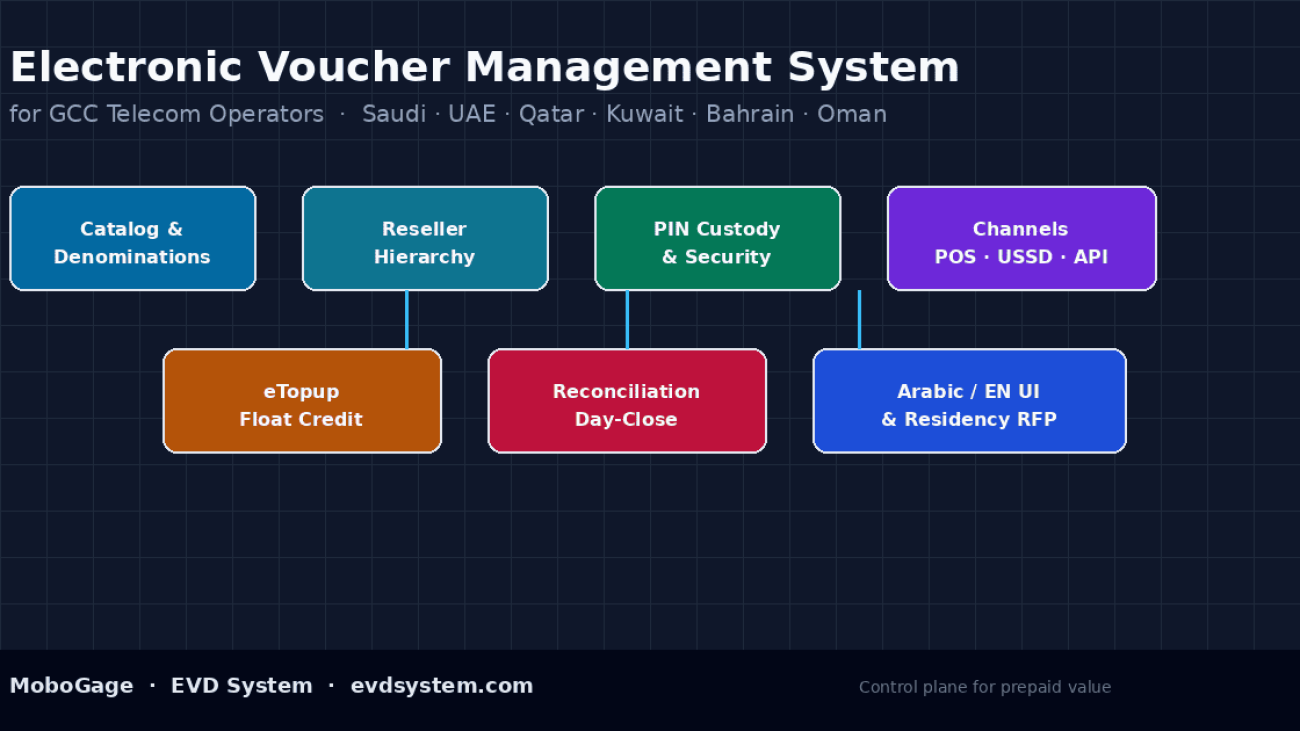
An electronic voucher management system is the control plane for prepaid value. It generates and inventories serialised vouchers or float, pushes them through reseller hierarchies, sells them over POS, USSD, portal or API, and reconciles stock, sales and charging at day-close. Operators and VAS partners in the GCC (Saudi Arabia, the UAE, Qatar, Kuwait, Bahrain and Oman) ask more of it than most markets do. Catalogs carry several currencies, distributor trees run four or five levels deep, field teams work in Arabic and English, and many deals are delivered through partners. A platform that can’t handle those conditions tends to show it during Ramadan and Eid, when volumes peak and finance tickets pile up.
Definition
| Term | Plain meaning |
|---|---|
| Electronic voucher management system (EVMS / VMS) | Software that owns voucher or prepaid-value lifecycle: create → secure → distribute → sell/redeem → report/reconcile |
| EVD | Electronic voucher distribution: moving prepaid value through channel nodes (often with wallets and POS) |
| eTopup | Typically PINless airtime credit from dealer float to subscriber MSISDN |
| Control plane | The system of record for stock, hierarchy policy, PIN custody, and day-close truth |
In brief: a GCC prepaid programme usually needs an electronic voucher management system that owns catalogs, reseller tiers, PIN custody and reconcile, and a single-channel top-up tool won’t cover that. PINless credit matters too, because Saudi and UAE retail leans on it while partners keep selling serialised vouchers (see electronic top-up for telecom airtime). And when the steering committee compares vendors, judge them on lifecycle and day-close evidence with the EVMS buyer checklist, not on slides. For background on electronic reloading versus physical cards, Wikipedia’s electronic reloading page is a fair summary, and GSMA Mobile for Development has written on the cost side of electronic airtime channels (GSMA article on airtime distribution savings).
Why a Gulf operator ends up treating the electronic voucher management system as infrastructure
Prepaid still pays for a big share of retail connectivity in the Gulf. Selling airtime, bundles or partner vouchers looks simple until the operating details arrive. Picture a national distributor in Riyadh funding sub-dealers in Jeddah and Dammam. Or a Dubai aggregator exposing APIs to super-apps, or a Kuwait retailer whose POS has to cope when coverage drops. Finance wants one version of inventory. Fraud wants PIN custody and velocity limits. The channel team wants commission that matches the contract tree it already signed.
Those demands meet in the EVMS. Without one, programmes tend to run on portals, partner spreadsheets and charging adapters held together by hand. With one, generation policy, credit limits, sale channels and reconcile packs all use the same words. That’s why MoboGage positions EVD System as a premium application for telecom and VAS rather than a “voucher printer.”
If the terms are blurry (EVD, VMS and the rest), start with What is electronic voucher distribution (EVD)?.
What GCC tenders actually ask for
A caveat first. What follows is the requirements language we see in RFPs. It isn’t a statement about any country’s regulation, and it isn’t a claim about EVD System’s certification status.
Catalogs that change every salary week
GCC programmes mix local-currency airtime denominations with partner gift or OTT SKUs, promo bundles and sometimes dual-face value for expatriate corridors. Around holidays and salary weeks the catalog moves fast. Product teams should be able to publish a denomination or change an expiry rule without reprinting stock or raising an emergency database ticket. Micro-denoms and bundles belong in the same place as classic face-value vouchers.
Currency precision is a detail that catches teams out. Under ISO 4217 the riyal and the dirham have two decimal places. The Kuwaiti and Bahraini dinars and the Omani rial have three. Store every amount in minor units per currency, or a regional rollup will round fils and baisa into errors.
Hierarchies that mirror the signed contract
A flat “every retailer is equal” portal breaks distributor agreements of the kind common in Saudi Arabia, the UAE and wider MEA. You need master distributors, sub-distributors and retail points, each with wallet transfer rules, credit limits and commission settlement that follow the paper contract. We recommend encoding the tree you already have. More on that in multi-tier reseller voucher distribution.
PIN custody and day-close
Serialised secrets haven’t gone away. Partner products, gift-style SKUs and hybrid print paths still use them. Encryption at rest is the minimum. The hard part is a day-close that ties inventory status, sales and charging credits together. Insist on lifecycle states, blacklisting, two-person reversals and exception reason codes. We cover this properly in voucher reconciliation and PIN security.
eTopup next to PIN stock
Busy retail in the UAE and Saudi Arabia often prefers PINless credit to an MSISDN straight from dealer float. That doesn’t make the EVMS redundant. The dealer holds float instead of PIN stock, but hierarchy, limits and reconcile stay exactly where they were. Many GCC stacks run both modes under one policy, which we think is the sensible design: one hierarchy, one set of limits, two product types.
Arabic screens and residency questions
Field teams and L1 support usually need Arabic and English labels, receipts and training packs. IT and risk will ask where production data and backups live (Saudi Arabia’s Personal Data Protection Law and its data-transfer rules make this a standard questionnaire item), which subprocessors touch PIN material, and how access is logged. Treat bilingual UX and residency as things you verify in the RFP and the architecture review. Don’t accept them as marketing claims unless your legal and delivery teams have confirmed them for that specific deal.
Selling through an SI or VAS partner
A lot of GCC and MEA wins go through systems integrators and VAS partners who already have the operator relationship and the tender experience. A vendor that can sit behind that partner as a technology layer (APIs, POS, hierarchy config, training) fits how procurement really buys. That’s how we position it: MoboGage as the product and engineering layer, the SI or partner as the face of delivery when that’s the commercial route.
A GCC EVMS RFP table you can reuse
| Requirement area | What “good” looks like in evaluation | Why it matters in GCC/MEA |
|---|---|---|
| Catalog & denominations | Multi-product, multi-denom, promo windows without reprint | Festival and salary-week catalog churn |
| Hierarchy & wallets | Multi-tier nodes, credit limits, parent→child transfer policy | Distributor contracts are rarely flat |
| Channels | USSD, Android/Linux POS, portal, app, API on one float/PIN truth | Omnichannel retail + aggregators |
| PIN custody | Encrypted secrets, reveal-at-sale, blacklist, audit trail | Partner SKUs and hybrid stock |
| Reconciliation | Inventory vs sales vs charging with exception owners | Finance and fraud close the same day |
| eTopup mode | Idempotent PINless credit, float debit, clear failure codes | High-velocity prepaid retail |
| Localisation | Arabic/English UI and receipts as configurable | Bilingual field and support teams |
| Residency & access | Documented hosting options, access logs, subprocessors | Risk and IT questionnaire items |
| Delivery | SI/partner-ready APIs, config, training packs | Tender and outsourced ops models |
Use it alongside the longer evaluation grid in How to choose an electronic voucher management system.
What EVD System does and doesn’t claim
EVD System is MoboGage’s electronic voucher distribution and management platform. It handles generation, inventory, lifecycle, reseller POS on Android and Linux, apps and APIs, for telecom airtime, gift-style vouchers and related prepaid products.
For a GCC buyer, the honest pitch is this. It controls the voucher lifecycle with real states and policies, not just a sales screen. Its wallets, limits and multi-tier distribution look like what channel teams already run. It sells PIN and eTopup-style credit under the same commercial rules. Day-close is built around inventory, sales and charging lining up. And it works when an SI or VAS partner wants an outsourced technology layer instead of building voucher plumbing in-house.
We won’t put operator counts, uptime percentages or “market leader” badges here. Large suppliers in the region publish those: Comviva cites uptime figures for PreTUPS and Seamless highlights ERS 360 deployments. Those claims are worth asking about, but they don’t tell you how your own hierarchy will close a day. Ask every vendor, us included, for a scoped demo on your hierarchy slice, catalog and exception paths. MoboGage is headquartered in Jaipur and has no GCC office; regional delivery runs through partners, and we say so in tenders.
A rollout order that holds up on an ordinary Tuesday
Start by mapping one country’s commercial tree: the master distributors, their credit terms, and which SKUs are PIN and which are PINless. Then pilot a single slice, one region or one partner with a limited set of POS and USSD, and prove that float or PIN debit and charging credit line up. Localise the screens dealers and L1 really use into Arabic and English before anything else gets translated, and check the settlement calendar: Saudi Arabia’s weekend is Friday-Saturday, while the UAE moved to Saturday-Sunday in 2022, so a regional programme can have bank cut-offs on different days.
Before peak week, encode the festival policy: temporary limits, promo denominations, and dual control on bulk loads. Do a hardening pass on reversal windows, velocity limits, lost-terminal disable and day-close owners. Only then expand to more APIs, more POS families and more product lines, once finance actually trusts the close.
Be wary of a demo that only shows a happy-path sale from a pre-funded test wallet with no exception screen; it shows the easy 90 seconds of the process.
Count your disputes before you call anyone
If your GCC prepaid stack still reconciles in spreadsheets after the partner portals close, take one week of sales by channel and write down every float or PIN dispute. That list usually shows whether you need a stronger EVMS lifecycle, cleaner eTopup discipline, or both under one control plane.
Operators and VAS partners looking at EVD System can read the electronic voucher management system overview, see About MoboGage, or reach the team through the contact / demo page · projects@mobogage.com · +91-9928 366 889.
FAQ
What is an electronic voucher management system in a GCC telecom context?
It is the platform that owns prepaid voucher or value lifecycle for an operator or VAS partner: generation, secure inventory, allocation through reseller tiers, sale or redemption across channels, and reconciliation against charging, so Saudi, UAE, and other Gulf programmes are not run from disconnected portals.
Do GCC operators still need PIN vouchers if they have eTopup?
Often yes for partner products, gift-style SKUs, hybrid print, or contract paths that still require serialised secrets. eTopup handles high-velocity PINless airtime; EVMS keeps lifecycle and reconcile when PINs remain in the mix.
Why do multi-tier reseller hierarchies matter in Saudi Arabia and the UAE?
Distributor agreements typically cascade credit and commission through several layers. A flat retailer portal cannot encode those contracts; wallet transfers, limits, and settlement must follow the real tree.
Should Arabic UI and data residency be RFP requirements?
Yes as evaluation criteria. Ask vendors to demonstrate bilingual operator-facing screens and to document hosting, backup, and access-control options. Confirm any residency or localisation commitment in writing for your deal, do not treat brochure language as compliance proof.
How should SI and VAS partners buy EVMS?
Many tenders favour a partner who already wins telecom work and outsources the voucher platform. Evaluate APIs, config tooling, training, and commercial willingness to sit behind the SI, then run a joint pilot with the operator hierarchy.
Where does GSMA fit this conversation?
GSMA Mobile for Development material on airtime distribution discusses cost dynamics of electronic channels versus traditional scratch-card logistics. Use it as industry context for business cases; build your own market model for GCC economics.