ucip-in-emergency-credit-charging

UCIP / IN Emergency Credit and Charging Integration

UCIP / IN charging and emergency credit integration connects eligibility, redemption and credit rules to an operator’s charging environment through UCIP and intelligent-network interfaces, so emergency credit grants and voucher redemptions behave the way the network expects rather than the way a retail screen promised.

The usual dispute goes like this. A shop’s terminal printed “recharge successful”, the subscriber’s balance didn’t move, and care has two systems telling two different stories. Most of these come down to what the distribution platform did when the charging node answered slowly or not at all. That is why we treat charging integration as part of distribution control, scoped before POS go-live and not patched in afterwards.

MoboGage lists charging and emergency credit as an Established telecom capability. Selected company-reported experience includes telecom charging work involving emergency credit and voucher redemption through UCIP/IN environments; scope and references are shared through due diligence. Heritage since 2007 (IWT Group, company-reported); MoboGage Private Limited was incorporated in February 2017 and its only office is the Jaipur HQ.

What a UCIP request actually carries

UCIP (User Communication Integration Protocol) is the Ericsson charging interface that external systems use to reach the AIR node. Requests are XML-RPC over HTTP POST. A refill or balance call carries an envelope of fields that matter later at reconciliation: originNodeType and originHostName (who is asking), originTransactionID (your reference, unique per request), originTimeStamp (ISO 8601 with offset) and subscriberNumber. A refill adds transactionAmount, transactionCurrency and a refillProfileID, or a voucher activation code when the refill is voucher-based. The answer comes back with a responseCode; 0 means success, and every other value needs a mapped meaning in your interface document.

Methods you will meet on most projects are GetAccountDetails and GetBalanceAndDate for eligibility and status, Refill for value, and UpdateBalanceAndDate for adjustments on the main or a dedicated account. Other IN platforms expose the same ideas under different names, and some operators sit a mediation layer in front of AIR. The integration pattern is the same either way. Our job is to carry the operator’s policy into retail and self-care channels without creating a second copy of the balance.

Emergency credit: eligibility, grant, recovery

Emergency credit is a temporary grant under operator rules, offered when a subscriber can’t top up right now. On Ericsson-style charging, one common pattern is a check against account state and history (age on network, recent recharges, any outstanding advance), a grant through a dedicated refill profile or an adjustment on a dedicated account, and recovery of the advance plus any fee on the next refill. All of those rules belong to the operator’s charging team. That includes stacking with bonuses or loans. The integration layer passes the parameters it was given and refuses to improvise when charging rejects something.

Voucher redemption is the sibling flow: a PIN or entitlement that was sold turns into network credit through the charging path. The two can share interface families and still differ in eligibility, amount, validity and repayment, so keep separate rule owners on the project plan. A change to one product’s refill profile should never silently break the other. Upstream PIN security and lifecycle controls still apply; see voucher reconciliation and PIN security.

Timeouts: the outcome nobody designs for

A request that times out may have credited, may not have, or may still be queued. (Where the charging adapter sits in the wider stack is covered in our EVMS architecture guide.) The sequence we design for: hold the retail transaction in a pending state, do not tell the shop it failed, query the account (balance and date, or refill history where your AIR release exposes it) after a short delay, and only then decide. If a retry is needed, send it with a new originTransactionID that links back to the first in your own ledger, so finance can see both attempts. A second blind refill is how a subscriber ends up credited twice and the dealer debited once. Full walkthrough: airtime top-up timeouts and unknown status.

The shop and the care agent need words for each of those states. A message tied to a real response code (“charging declined: account barred”) lets them explain what happened; “pending, do not resell, check in five minutes” is a defined next step for a timeout.

Who owns which part of a disputed credit

The charging and prepaid team owns policy. That’s central to the EVMS for telecom product story and to the GCC programmes on the EVMS GCC page. A distribution or VAS partner cares about money: for products that need it, sale confirmation waits for charging confirmation, which cuts down refund arguments with agents. Finance, fraud and revenue assurance need every retail transaction matched to a charging event by reference, with explicit states and a record of each retry. Revenue-assurance AI tools that appear as Proposed in the wider portfolio are not claimed here as available.

Name the charging owner, prepaid product owner, EVD or channel owner, care owner and finance reconciliation owner before coding starts. The escalation path for “customer says credited, charging says not” fits on one page; write it and rehearse it in the pilot.

Where this meets EVD channels and PINless top-up

POS, apps, USSD, SMS and API channels that sell vouchers or trigger PINless top-up all depend on charging for the balance the customer sees. The electronic top-up system post covers PINless recharge; this one covers the charging side that makes emergency credit and redemption believable. For platform selection, see how to choose an EVMS and the homepage electronic voucher management system overview.

If a migration moves redemption onto new charging interfaces, run the charging cutover as its own workstream with its own test SIMs and rollback plan. See also EVMS migration.

What to ask any vendor

Large recharge platforms (Comviva PreTUPS, Seamless ERS 360, Telepin eTopUp among them) all say they integrate with the major charging systems, and they do. Their public pages say much less about what happens on a timeout or a mapped error. So ask every shortlisted vendor, us included, to show you three things on a lab AIR or simulator: the retail screen for each non-zero response code, the pending-then-query sequence after a forced timeout, and the reconciliation row that ties a retried request back to the original reference.

Security review should cover privileged access to credit-rule configuration, how UCIP/IN credentials are stored and rotated, and how long charging request logs are retained. Continuity planning should state what retail channels display when charging is unreachable.

Start with one interface and one use case

The company profile suggests first pilots built around one operator interface and one use case. For charging integration that means one bounded emergency-credit or redemption path, judged on observed behaviour: correct eligibility rejects, correct grants, correct failure messages, clean matching of retail references to charging references, and a rehearsed path for indeterminate cases. Put those criteria in the pilot charter rather than throughput claims. Delivery follows Discover → Design → Pilot → Roll out → Operate and expand.

Label: Established. In-development items such as CNAP, and Proposed fraud-API or revenue-assurance packages, are not presented as available charging features.

Bring the charging interface owners, the use case, and whatever exception process you run today, even if it’s a spreadsheet. Contact us through the voucher management system enquiry page, projects@mobogage.com, or +91-9928 366 889. Founder & CEO: Sohan Lal Soni, Jaipur, India.

Frequently asked questions

What is UCIP / IN emergency credit charging integration?

It is the connection of eligibility, redemption and credit rules to an operator’s charging environment through UCIP and intelligent-network (IN) interfaces, so emergency credit and voucher redemption follow operator-defined charging behaviour.

Why do operators integrate EVD with UCIP or IN?

Because retail sale and network charging must agree. Integration lets eligibility checks, credit grants and voucher redemptions execute against the live charging stack rather than as disconnected offline promises.

What rules are typically configured?

Eligibility conditions, credit amounts or denominations, validity, redemption paths, failure handling and which channel or product may trigger a charging request. Exact rule sets are operator-specific.

Does this replace the operator’s charging system?

No. The charging and IN environments remain operator-owned. MoboGage integrates eligibility, redemption and credit workflows to those environments under agreed interfaces and controls.

How does this relate to voucher distribution?

Voucher sale and inventory can live in EVD; redemption and emergency credit grant consume charging interfaces. Keeping both sides reconciled is core to prepaid integrity.

How should an operator pilot charging integration?

Bound one interface and use case, often emergency credit or a single redemption path, agree success and exception measures, then expand. Contact projects@mobogage.com or the enquiry page.
MoboGage EVD System typographic card — CreditSync credit operations

CreditSync: Distributor and Agent Credit Limit Operations

CreditSync is MoboGage’s Established credit-operations capability for distributor and agent finance. It handles credit assignment, authorized limits, issuance, collections and overdue tracking, while authorized lenders keep their lending policies and decisions.

Distribution runs on working capital. When limits live in a spreadsheet and collections live in someone’s inbox, exposure is usually discovered at month-end. CreditSync puts distributor and agent credit operations in the same system as distribution, and leaves the regulated lending decision with the lender.

MoboGage lists CreditSync as Established under both retail (wallets and CreditSync) and banking (CreditSync operations). Company-reported heritage goes back to 2007 (IWT Group); MoboGage Private Limited was incorporated in February 2017 in Jaipur. Reach across 17 countries is company-reported business and project presence through partners; the only office is the Jaipur HQ.

Distributor and agent credit operations, defined

These are the daily controls around float funding: who can carry how much exposure, when value is issued against that limit, how repayments are recorded, and how overdue positions are aged and owned. The commercial problem is visibility and accountability. Whether a loan may be granted at all is a regulatory question for the authorized lender, and CreditSync is built around that split.

How a CreditSync limit check works

Each node in the hierarchy carries an authorized limit, the outstanding balance it owes, and any holds for transactions in flight. Available credit is the limit minus outstanding minus holds. When a distributor requests stock or float, the platform places a hold for the amount in the same database transaction that checks availability, so two requests arriving together can’t both pass against the same headroom. The hold turns into issued credit when the stock transfer commits, or is released if it fails.

Every limit assignment records who authorized it, the ceiling, effective dates and any product or channel restriction. Temporary raises carry an expiry date and need a second approver. A change is a dated, logged event; the old value stays visible in history.

Issuance, collections and overdue aging

Issuance posts value or float against the limit and is attributable to a node, a product context (airtime float versus catalogue float, for example) and a reference. Issuance that bypasses the limit check would recreate the spreadsheet problem, so the platform doesn’t allow it.

Repayments reduce exposure. Collections are easiest to match when each distributor pays into a reference the platform can recognise, such as a virtual account number or a wallet transfer with the distributor ID, so finance matches inflows automatically and only handles leftovers. The allocation order (fees first, then oldest principal, or another rule) is the lender’s policy, configured rather than coded. Partial payments and disputed amounts get their own states instead of a note in a comments field.

Overdue positions are aged by days past due into buckets the lender chooses; 1-30, 31-60, 61-90 and 90+ is a common convention. The platform tracks and flags. Escalation and recovery decisions belong to the authorized institution and its agents.

Who relies on it, and for what

The lender, bank or fintech keeps policy, underwriting and decision rights; the platform reflects the limits it authorizes and records issuance and collection events for portfolio monitoring. MoboGage supplies technology and integration, and regulated-service responsibilities stay with the client institution.

The distributor network owner sees hierarchy exposure (which nodes are near their limit, which are overdue, which collections cleared) in the same channel software used for electronic voucher management. Agents and retailers see their limit, balance and amount owed without phoning anyone, which means fewer failed sales caused by float running out unnoticed. Finance and channel operations get unique references and explicit states on issuance, repayment and aging, with owners on overdue queues and audit trails on corrections. Paired with reconciliation discipline, that shortens the month-end argument considerably.

Where CreditSync stops

The company profile is explicit that authorized lenders retain lending policies and decisions. CreditSync is not automated credit scoring, a bureau replacement or a substitute for a banking licence, collateral appraisal or credit-committee minutes. When it sits next to mobile money or merchant channels the same rule holds: technology connects the workflows, and regulated parties own regulated outcomes.

Proposed banking items such as a reconciliation exception hub or financial-crime evidence operations are separate roadmap topics, not Established CreditSync features, and are handled through discovery.

How it connects to EVD, the catalogue and wallets

Much airtime and utility selling is paid for with distributor credit. Connecting CreditSync to MoboEVD inventory movement and to a shared service catalogue keeps sales activity and credit exposure in one record. The hierarchies in multi-tier reseller voucher distribution are where limits get assigned. Wallet cash-in/out and bank connectivity can fund repayments; those flows are covered in the wallet deep-dive and on the mobile money platform with merchant payment page.

For platform selection, see how to choose an electronic voucher management system and the EVMS product overview.

A day in a channel’s credit cycle

In the morning, channel managers check nodes near their limit and the overdue buckets before approving large stock transfers. Around midday, issuance funds agents who are out selling vouchers and catalogue products. In the evening, collections and bank or wallet inflows are matched and exposure comes down. At month-end, finance wants issuance, sales and repayments to tie together in one report. On a festival weekend when sales spike, limit headroom decides how much agents can sell, so it gets watched as closely as POS availability.

Decisions to make before the pilot

Are limits monetary ceilings, product caps, or both? Do sub-agents draw on their parent’s capacity or hold their own limits? Who can raise a limit temporarily, and under what dual-control rule? Does overdue status trigger a soft warning or a hard block on selling? The last choice changes agent behaviour in the field the next day, so warn the field before switching on a hard block.

If limits originate in core banking or a lender system, document and version that interface. If issuance creates spendable EVD or wallet float, document that one as well, and name the person who owns unmatched issuance events.

Reports channel leaders open

Useful CreditSync reports are plain: limit utilisation by node, issuance by day, collections by method, overdue aging, and a list of limit changes with who made each one. When an auditor asks who raised a ceiling last Thursday, that last list is the answer. Exports should match how finance already reconciles to bank or wallet inflows, without manual reshaping. During diligence we show the data model and real screens, not mocked-up figures.

What to compare across vendors

Recharge suites such as Comviva PreTUPS list features like SOS and auto reload, auto stock transfer and segment-based commission, which advance or move dealer float. Those features are useful. What buyers should check, with any vendor including us, is whether the advance sits against an authorized limit with holds, an owner and an aging trail, or whether it is just a balance top-up. Ask for a demo of two concurrent stock requests against the last of a limit, and of a partial repayment.

Rollout and readiness

Delivery runs Discover baselines and owners → Design limits, responsibilities and interfaces → Pilot one network segment → Roll out → Operate and expand, with acceptance agreed under representative conditions. Scope, references and evidence are shared through due diligence. CreditSync operations are labelled Established; In development and Proposed portfolio items are not presented here as available.

Bring the lending owner, the distributor or agent segment, and the overdue measures you care about. Enquire through the contact / voucher management system page, projects@mobogage.com, or +91-9928 366 889. Founder & CEO: Sohan Lal Soni, MoboGage Private Limited, Jaipur.

Frequently asked questions

What is CreditSync?

CreditSync is MoboGage’s Established capability for credit assignment, limits, issuance, collection and overdue tracking for agent and distributor finance. Authorized lenders retain lending policies and decisions.

Does CreditSync replace a lender’s credit decisioning?

No. Lenders keep lending decisions. CreditSync connects authorized limits and operational tracking (issuance, collections, overdue status) to distributor and agent workflows so channel finance stays visible.

Who typically uses CreditSync?

Banks, licensed lenders, fintechs and distribution groups that fund agent or distributor float. Telecom and retail channel operators also use it when working capital for the hierarchy is part of the commercial model.

What operating events does CreditSync track?

Typical events include credit limit assignment, issuance against an authorized limit, repayments and collections, overdue aging, and status changes that channel managers and finance can review.

How does CreditSync relate to MoboEVD and wallets?

EVD and wallet platforms move product and balances; CreditSync tracks the credit that often funds those balances. Keeping lending policy with the authorized institution avoids mixing regulated decisions into channel software.

How do we pilot CreditSync?

Bound one distributor network or agent segment, agree limit owners and overdue measures, then expand. Contact projects@mobogage.com or the voucher management system enquiry page.

shared-service-catalogue-airtime-data-utilities

Shared Service Catalogue for Airtime, Data, Gift Cards and Utilities

A shared service catalogue is MoboGage’s Established capability for selling airtime, data, gift cards and utility services through scoped provider integrations with clear transaction tracking. Distributors and retailers get one digital offer instead of a drawer full of separate apps.

Retail and VAS networks rarely get into trouble because one recharge API is missing. The trouble starts when each new service arrives as another portal, another float and another reconciliation file, and by the third provider nobody at the counter is sure which balance pays for what. A shared catalogue keeps the front end consistent while each provider connection stays tightly scoped behind it.

The catalogue sits in MoboGage’s Established retail portfolio next to MoboEVD and CreditSync. Company-reported figures (reach across 17 countries through partners, and more than one million retailers using POS and airtime services) describe MoboGage’s wider operating context, not product SLAs. MoboGage’s only office is the Jaipur HQ.

What goes into a shared service catalogue entry

The catalogue is the list of things a channel user can sell, and each line is a record rather than a brochure tile. In our data model an entry carries: a SKU and provider ID; the product type (PIN voucher, PINless top-up, bundle, gift card, bill payment, prepaid utility token); either a fixed face value or an open range with minimum, maximum and step; currency; the channels allowed to sell it (POS, app, USSD, API); the commission and fee rule IDs; which float or inventory pool funds it; and effective-from and effective-to dates. Only privileged roles can publish a change, so a retired denomination stops selling at the date it was retired.

Each entry also points to a state model: what success, known failure, timeout and reversal look like for that provider, and who owns each one.

Airtime, gift cards and bills behave differently

Airtime and data are still the core in most markets. Depending on the operator interface, a product may be a PIN voucher sale, PINless electronic top-up, or a plan or bundle purchase, sold over POS, apps, USSD and SMS. The electronic top-up system post explains the PINless recharge transaction itself.

Gift cards come in two kinds. Some are imported serial stock with their own expiry; others are issued at the moment of sale through a provider API that returns the code. The receipt and the refund rule differ, so the catalogue shows which is which, and a just-in-time gift code is never treated like a pre-activated airtime card.

Utilities have the most steps. Bill payment is usually two calls: an enquiry with the customer account number that returns the name and amount due, then a payment that references the enquiry. Prepaid electricity in many markets returns a 20-digit STS token (IEC 62055-41), which has to be printed or sent by SMS exactly, because a mistyped token can’t be used on the meter. When a payment times out, the transaction is held, the provider is queried, and float is released or the payment confirmed. Decide before launch who retries, who refunds and who calls the provider.

Scoped provider integrations, in practice

The company profile says “scoped provider integrations” deliberately. Discovery covers credentials, test and production environments, rate limits, idempotency keys, duplicate detection, retry windows and ownership of unresolved exceptions. Interfaces are versioned. Two providers never share a state machine by assumption; each gets its own mapping from provider response codes to catalogue states.

The trust controls in the MoboGage profile apply: unique references, explicit states, duplicate prevention, controlled reversals and reconciliation. Privileged access, encryption, retention and recovery targets are set per engagement.

Who gets what out of it

The operator or aggregator can widen the merchant offer without adding channel software; new providers plug in behind the same retail screens, which is how many VAS partners grow past a single airtime brand. Voucher-backed products still follow the lifecycle described in our electronic voucher management system positioning.

The distributor can fund several catalogue products from one float where the commercial rules allow it, with hierarchy visibility as described in multi-tier reseller voucher distribution. The retailer gets one POS or app for airtime, data, gift cards and some utilities, with one receipt pattern, so staff can explain a timeout without ringing the helpdesk.

Finance and operations get a unique reference on every sale, the provider reference where one comes back, and an explicit state. Matching those against each provider’s settlement file is the daily work of retail control, and the reason buyers read voucher reconciliation even when some catalogue lines are PINless.

How the catalogue sits beside MoboEVD and wallets

Voucher-backed lines use MoboEVD inventory and activation. Wallet-funded lines use balances, cash-in/out and bank connectivity. Merchant payments and agency onboarding extend the same retail network when QR acceptance and cash workflows are in scope. If you’re comparing platforms, start with what is electronic voucher distribution and the EVMS buyer checklist.

What to ask vendors in discovery

Several platforms advertise third-party products on the POS: Seamless ERS 360 describes the POS as a one-stop shop for third-party products, and Emida lists bill payment, international top-up and stored value cards. Breadth of the menu is easy to show. Ask instead for a product sheet per provider line (type, channels, funding pool, commission rule, timeout owner) and for the state diagram behind it. Then ask to see one utility payment forced into a timeout and resolved, and a denomination retired mid-day. We will run the same tests on our platform.

Training should follow the catalogue: one receipt pattern, one helpdesk script for “provider is down”, one escalation owner per provider.

If a GCC or multi-country programme reuses a catalogue pattern, expect providers to behave differently country to country even when the screens look the same. Country reach in MoboGage materials means business or project presence through partners, not identical interfaces everywhere.

Starting with one provider

The company profile suggests a first pilot of one service provider or one distributor network, with agreed measures for inventory availability and unmatched value. Delivery follows Discover → Design → Pilot → Roll out → Operate and expand. The shared service catalogue is labelled Established. Proposed retail items such as settlement exception hubs or retail intelligence are roadmap topics only.

Bring the provider list you want first, the channels that have to sell them, and the person who’ll own reconciliation. Contact MoboGage through the voucher management system enquiry page, projects@mobogage.com, or +91-9928 366 889. Founder & CEO: Sohan Lal Soni, Jaipur, India.

Frequently asked questions

What is a shared service catalogue in an EVD or retail platform?

A shared service catalogue is a controlled list of sellable digital services (typically airtime, data, gift cards and utility payments) offered through scoped provider integrations with clear transaction tracking from the retail or agent channel to the provider.

Which service types can sit in one catalogue?

Established catalogue patterns include prepaid airtime and data, gift cards, and utility services. Each product maps to a provider interface, denomination or bill rules, commission scheme and settlement expectation.

How do provider integrations stay scoped?

Integrations are agreed per provider: credentials, transaction states, retries, timeouts, reversal rules and exception ownership. The catalogue exposes only products that have a live, tested interface and a commercial owner.

How does the catalogue help distributors and retailers?

Agents see one coherent offer instead of separate apps per provider. Inventory or float rules, commissions and receipts stay consistent, which reduces training load and mismatched settlement narratives.

Does a shared catalogue replace voucher inventory controls?

No. Catalogue products that are voucher-backed still rely on voucher lifecycle rules. Catalogue products that are PINless or bill-pay rely on float, eligibility and provider confirmation. Both can share retail channels under one operating view.

How should a catalogue pilot be bounded?

Pick one provider or one service family, agree availability and unmatched-transaction measures, then expand. Contact projects@mobogage.com or the voucher management system enquiry page to shape the pilot.

voucher-generation-inventory-activation

Voucher Generation, Inventory and Activation with MoboEVD

MoboEVD is MoboGage’s electronic voucher distribution capability. It handles voucher generation or import, controls digital inventory, runs inventory activation for sale, records redemptions, applies commissions and tracks distributor balances across POS, apps, USSD, SMS and API channels.

Ask three people in a prepaid business where a particular voucher is right now. Finance checks the month-end pack, fraud checks the reveal log, and the channel manager rings the regional distributor. If the three answers differ, the voucher generation and inventory activation process has a gap somewhere, and finding that gap is what this layer is for.

MoboGage Private Limited (Jaipur, India; heritage IWT Group 2007; incorporated February 2017) positions MoboEVD as an Established retail and telecom capability. Company-reported experience includes more than one million retailers using POS and airtime services, with business and project reach across 17 countries. The Jaipur headquarters is the only office, so “reach” means projects and partner presence rather than local branches.

Voucher generation and inventory activation in one state model

Marketing decides denominations, charging credits the subscriber, and this layer sits between them. In MoboEVD a voucher is always in exactly one state: available, allocated, activated, sold, redeemed, expired or cancelled. Each change is an event. It records a reference, the user and the time, and commission and distributor balances move with it.

Disputes usually start where one step lives outside the platform, in a spreadsheet or a side system nobody owns, and a distributor’s balance can’t be rebuilt three weeks later. That is the main reason operators evaluating an electronic voucher management system want the whole lifecycle on one accountable platform.

Generating a batch: serials, PINs and the print file

A generation request sets the denomination and quantity first. It also fixes the validity window, the product type and whatever batch attributes reporting will need later. Each voucher gets two numbers that serve different purposes. The serial is public, printed on the card, sequential within the batch and often carries a check digit; it is what support staff and reconciliation use. The PIN is the secret the subscriber enters, and it must come from a cryptographically secure random generator, never from the serial or a sequence.

PIN length is a security decision. A 14-digit PIN has 1014 possible values, so even with ten million live vouchers a random guess has about a one-in-ten-million chance of hitting one, and velocity limits on the redemption side cut guessing further. PINs are encrypted as soon as they are generated. For physical cards, the print file goes to the print vendor encrypted to that vendor’s key (PGP is common), with a separate manifest of serial ranges and counts that the vendor confirms back before the batch can be activated.

Many operators already have a voucher server or charging system producing stock and want it imported instead. That works too, provided every unit keeps its own identity on the way in, with its own serial, denomination, expiry and batch ID, with the file’s counts and value totals checked against the manifest before anything becomes available.

Allocation down the hierarchy

Stock is allocated to nodes in the hierarchy, from national and regional level through distributors and sub-dealers to retail points, according to commercial policy. Every transfer between nodes is a recorded event with a sender, a receiver, a serial range or count, and a reference, so a channel manager can see today who holds what. Master dealers mostly ask about two things: their balance, and when commission lands. So the platform tracks their exposure as stock and credit move down the tree, as multi-tier reseller voucher distribution describes.

Activation: as late as practical

Activation makes stock sellable on authorised channels. Unactivated inventory can’t leak usable PINs early and can’t be sold at a denomination marketing withdrew last week. Activation can be per batch, per serial range, or by rule per channel and role. We recommend activating close to the point of sale; stock that is live but idle carries risk without adding sales. Where the charging side keeps its own voucher state, as an Ericsson-style voucher server does, the platform’s activation and the charging-side state should be changed together and checked in the day-close.

Sale, redemption and commission

Established channels include POS (Android and Linux retail terminals among them), mobile and web apps, USSD, SMS and partner APIs. A sale debits the seller’s authorised balance or float and marks the voucher sold under a unique transaction reference. PINless electronic top-up can run alongside PIN sale where dealer float and charging integration allow it; see the note on an electronic top-up system for telecom airtime.

Redemption closes the loop: the PIN is accepted, charging or the provider credits the service, and EVD records a terminal state. Where emergency credit or intelligent-network rules apply, redemption connects to UCIP/IN environments, covered in the separate charging-integration post.

Commission schemes vary by market: flat per denomination, a percentage of face value, a channel bonus, or a split across hierarchy levels. MoboEVD posts the contracted rule per transaction and records which rule version applied. Balances move with issuance, sale, transfer and collection. Where agents need float on credit and a lender holds the lending decision, CreditSync handles it.

Who is allowed to generate, activate or cancel

The company profile’s trust guidance covers unique references, explicit states, duplicate prevention, controlled reversals and reconciliation. For vouchers, generation is a privileged role. So are bulk activation and cancellation, with dual approval for batches above an agreed value. Encryption and retention for PIN material and audit logs are agreed before go-live. With charging and provider systems, the interface version, retry rule and exception owner are written down. A person approves any mass cancel, forced expiry or balance correction. The approval is logged. Pair this with voucher reconciliation and PIN security so the month-end pack matches.

The operator’s view of all this is in the EVMS product overview. Service levels and assurance scope are agreed per engagement, and certifications are stated only where they are supported.

What to compare across vendors

Comviva’s PreTUPS VMS page markets flexible status changes and expiry-date modification to reduce dead stock. Those are useful levers, and they are also the operations an auditor will ask about. Whoever you shortlist, ask to see who can change a voucher’s state or expiry, whether a second approver is required, and how the change appears in the audit log and the next day-close. Ask how PINs are generated and how the print file reaches the printer.

Where this page fits on the site

For a general introduction, read what is electronic voucher distribution and the buyer checklist on how to choose an electronic voucher management system. This page is the operating detail behind them. Migrations, GCC rollouts, wallet and catalogue add-ons each get their own scoping; a shared service catalogue sits next to EVD when one counter sells airtime, data, gift cards and bill pay, and mobile money and merchant agency modules add cash and float.

Pilot one denomination set before you roll out

Delivery runs Discover, Design, Pilot, Roll out, Operate and expand. Discover looks at who uses the system today and what can’t change. Design sets scope and ownership, then architecture and controls. The pilot is narrow (one provider, or one channel, one town and one set of denominations) so that problems surface while they are cheap to fix. Measure acceptance under realistic load, not on a quiet test environment. Project scope, references and supporting records are shared through an agreed due-diligence process.

MoboEVD distribution is labelled Established in the company profile, backed by company-reported delivery experience. In-development or Proposed items elsewhere in the portfolio, such as settlement exception hubs or fuel extensions, are not presented here as available.

Talk to MoboGage about voucher inventory and activation

Start with one bounded workflow and one named owner. Enquire through the voucher management system contact page, email projects@mobogage.com, or call +91-9928 366 889. Founder & CEO: Sohan Lal Soni. Headquarters: Jaipur, India.

Frequently asked questions

What does MoboEVD cover in voucher generation and inventory activation?

MoboEVD supports generating or importing vouchers, managing digital inventory states, activating stock for sale, recording redemptions, applying commissions and tracking distributor balances across POS, apps, USSD, SMS and API channels.

How does voucher inventory stay controlled across a reseller hierarchy?

Stock moves through defined statuses (available, allocated, activated, sold, redeemed, expired or cancelled) with unique references and role-based permissions so distributors, sub-dealers and retailers only act within their authorised balances and denominations.

Can operators use both PIN vouchers and PINless top-up from the same platform?

Yes. Many deployments run PIN-based voucher sale alongside PINless electronic top-up from dealer float. Lifecycle rules for generation, activation, expiry and reconciliation remain under one control plane.

Which sales channels does MoboEVD support?

Company-reported channel support includes POS terminals, mobile and web apps, USSD, SMS and partner APIs. Channel mix is scoped per engagement so retail, agent and digital sales stay reconciled to the same inventory.

How are commissions and distributor balances handled?

Commission rules can be tied to denomination, channel, product or hierarchy level. Distributor balances update with issuance, sale, transfer and collection events so finance and channel ops see exposure without inventing a second ledger.

How do we start a MoboEVD pilot?

MoboGage follows a five-step delivery path: Discover, Design, Pilot, Roll out, Operate and expand. A typical pilot bounds one provider, denomination set or channel, with acceptance criteria agreed before wider rollout. Contact projects@mobogage.com or use the voucher management system enquiry page.

Operator cutover playbook for migrating to a new electronic voucher management system – MoboGage EVD System

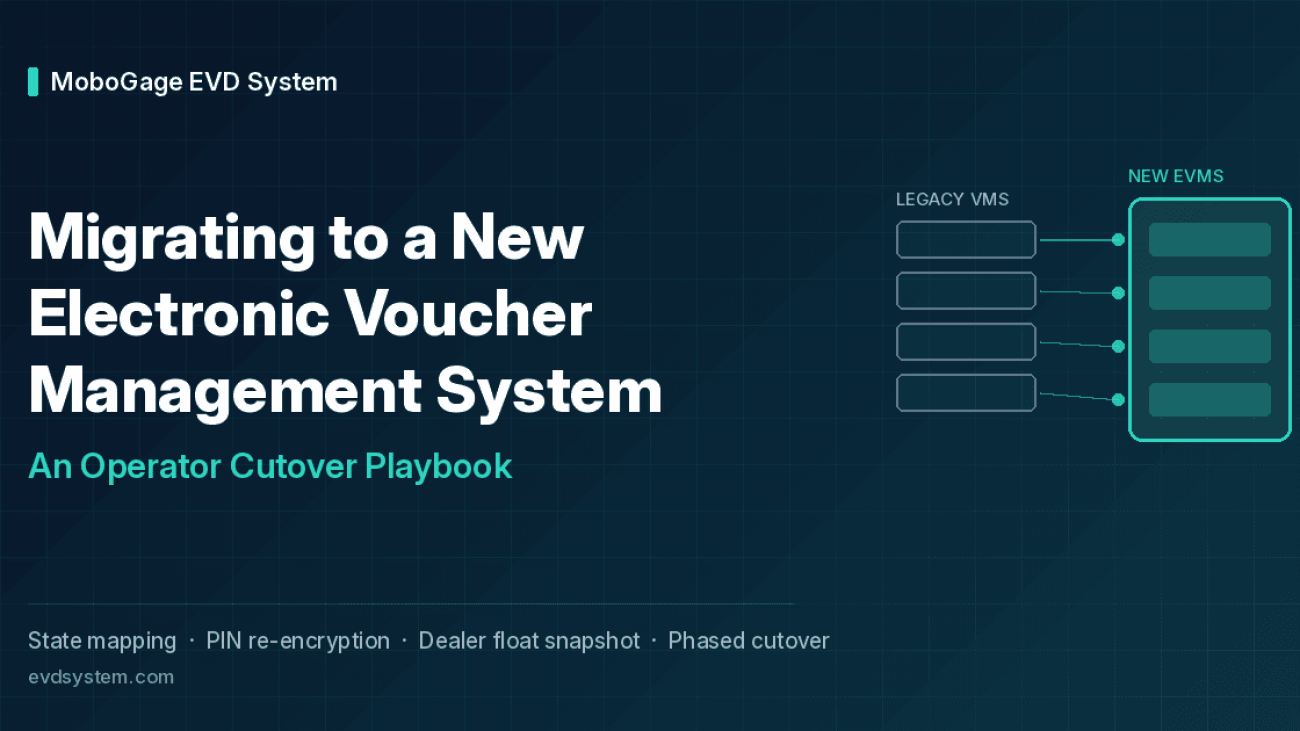
Migrating to a New Electronic Voucher Management System: An Operator Cutover Playbook

Definition. An electronic voucher management system (EVMS) is the software that controls the whole life of prepaid vouchers, from generation or intake through dealer allocation, sale, redemption into charging and reconciliation. MoboGage EVD System is an EVMS and electronic voucher distribution platform built for telecom operators and VAS partners.

TL;DR for migration owners

  • A voucher platform migration is a ledger move, not a software install. Treat stock, PIN data and dealer balances like money, because they are.
  • Map every legacy lifecycle state to a target state before you move a single serial range.
  • Drain offline POS caches and resolve unknown-status top-ups before you snapshot dealer wallets.
  • Run both platforms in parallel until reconciliation closes with zero unexplained variance, and write the rollback trigger down before cutover weekend.

Most operators do not wake up wanting a new voucher platform. They get there because the old one has become expensive to keep alive: a vendor that no longer ships fixes, or a reporting layer finance has quietly replaced with spreadsheets. By the time the replacement is signed, the commercial team wants the new dealer app live “next month”.

That is where migrations go wrong. The new electronic voucher management system is rarely the problem. The problem is what you carry into it: millions of PINs in a dozen states, a dealer hierarchy that drifted from the contracts years ago, and wallet balances that distributors will check to the last unit the morning after cutover.

This playbook is the sequence we would follow from the operator side of the table. It is written for prepaid product owners, channel managers, IT leads and the SI partner running delivery.

Why voucher platform migrations fail

They almost never fail on the user interface. They fail on three quiet things.

State drift. The legacy system calls a batch “active” when it means “printed and sitting in a warehouse”. The new platform reads “active” as sellable. Within a day, stock nobody has received is showing on dealer screens.

Balance disputes. A top-tier distributor’s wallet shows a different number on Monday than it did on Friday. Even if the difference is a single pending transaction, the trust damage lasts longer than the fix.

Orphaned channels. An API partner nobody remembered still points at the old endpoint, or a batch of rural POS terminals never picked up the new app. They keep selling against stock the old system no longer owns.

None of these need clever technology to prevent. They need a written inventory, a state map, a freeze window and reconciliation gates someone senior signs off.

Step 1: Inventory what actually has to move

Before anyone talks about cutover dates, list every object the old platform holds and decide what happens to it. Some things migrate, some get rebuilt cleanly in the new platform, and some are archived read-only for audit.

Object Migrate, rebuild or archive What to verify Typical owner
Product catalogue and denominations Rebuild (cleaner) Every live SKU has a target product with the same face value and charging profile Prepaid product
Voucher batches and serial ranges Migrate Count by batch, by state and by serial range matches the legacy export Voucher ops
Encrypted PIN data Migrate under key ceremony Record counts and checksums match; no clear-text exposure at any step Security / IT
Dealer hierarchy and contracts Migrate, then clean Every dealer has one parent, one tier and a current contract Channel sales
Wallet and float balances Migrate at snapshot Sum of balances per tier matches the signed snapshot Finance
Credit limits and commission plans Rebuild Plans match signed commercial terms, not legacy configuration Channel finance
Open disputes and pending transactions Resolve before snapshot Zero unknown-status transactions at freeze Ops + finance
POS terminals and app versions Re-enrol in waves Each terminal is registered, on the target app and drained of offline stock Field ops
API partner credentials Reissue Every partner tested in sandbox against the new endpoint Partner management
Transaction history Archive read-only Retention period agreed with audit and regulators Finance / compliance

The rebuild column matters more than it looks. Legacy commission plans carry years of one-off exceptions. Rebuilding them from the signed agreements is slower for a week and saves a year of disputes.

Step 2: Map lifecycle states before moving stock

This is the step most teams skip, and the one that causes the worst first week. Every voucher platform has its own state vocabulary. Write them side by side and agree the rule for each.

Legacy state (example wording) What it usually means Target state Migration rule
Generated PINs created, not yet sent to print or channel Generated / inactive Move as inactive; never sellable on arrival
Printed / in transit File released to print house or courier In custody (inactive) Hold inactive until goods receipt is confirmed
Received Physical stock in warehouse Warehouse stock Activate only on allocation
Allocated Assigned to a distributor or dealer Allocated to the same node Verify the node exists in the new hierarchy first
Active / sellable Can be sold and redeemed Active Cross-check against charging before cutover
Sold Sold, not yet redeemed Sold Keep redeemable; preserve sale timestamp
Redeemed / used Consumed in charging Redeemed (archive) Migrate for audit; block any re-use
Blocked / stolen / damaged Withdrawn from sale Blocked Never reactivate during migration
Expired Past validity Expired Migrate for reporting, or archive

Ask your vendor two direct questions here. Does the target platform hold state per PIN or per serial range? And what happens to a range that is half sold? If the answer is vague, the migration plan is not ready.

Step 3: Move PIN data without ever seeing it

PIN files are the most sensitive thing in the programme. The rule is simple to say and hard to keep: no person and no intermediate system should see clear-text PINs during migration.

In practice: a key ceremony with dual control, PINs re-encrypted from legacy to target keys inside a hardware security module or equivalent protected environment, and record counts plus checksums compared on both sides. Transfer files are deleted on schedule and the deletion is logged.

If the vendor proposes exporting PINs to a spreadsheet “just for validation”, stop the call. We cover the wider custody model, including what encrypted-until-sale should mean, in our guide to voucher reconciliation and PIN security in an EVMS.

Step 4: Freeze, drain and snapshot dealer float

Dealer wallets are where migrations become personal. A distributor who sees a wrong balance on Monday will phone your commercial director, not your IT team.

A sequence that holds up:

  1. Announce the freeze window early. Dealers should know a week ahead when stock purchases and wallet transfers pause, and for how long.
  2. Drain offline POS caches. Handheld terminals that sell offline hold cached vouchers and unsynced sales. Push a sync, then block offline sales for the final 24 to 48 hours so nothing appears after the snapshot.
  3. Resolve unknown-status top-ups. Any PINless recharge sitting in a timeout or unknown state must be confirmed against charging and either completed or reversed before the snapshot. Our electronic top-up system guide explains why float, not stock, is the real inventory in eTopup.
  4. Snapshot and sign. Export balances per dealer and per tier, share them with the top distributors and get written acknowledgement before go-live.
  5. Load and re-verify. After load, the sum per tier in the new platform must equal the signed snapshot. Not roughly. Exactly.

If your hierarchy has more than two or three tiers, check that each sub-dealer lands under the right parent and inherits the right credit limit. The patterns in our piece on multi-tier reseller voucher distribution are a useful sanity check for that review.

Step 5: Cut over channels in waves

Do not switch every channel on the same night. A sensible order is usually:

  • API partners first, in sandbox and then a controlled production window, because their traffic is easiest to watch and roll back.
  • Dealer web portal next, starting with a small group of top-tier distributors who agreed to be early.
  • POS fleet in regional waves, pushed through terminal management, with field teams ready in each region on the day.
  • USSD and SMS last, because routing changes touch the network side and need their own change window.

Keep old endpoints answering with a clear “moved” response for a while. It is the cheapest way to find the partner nobody remembered.

Step 6: Parallel run and reconciliation gates

Run both platforms side by side long enough to close several full business days, including at least one weekend and one month-end if you can. Each gate has a pass condition and a rollback trigger agreed in advance.

Gate Pass condition Rollback or hold trigger
Stock count Counts by product, state and serial range match the legacy export Any unexplained difference in sellable stock
Dealer balances Sum per tier equals the signed snapshot Any distributor balance dispute not resolved within the agreed window
Sales vs charging Every sale has a matching redemption or a valid sold-not-redeemed record Redemptions in charging with no sale record
Commissions Sample of dealers recalculated by finance matches the platform Systematic commission mismatch in any tier
Channel health Every live channel transacting on the new platform Any channel still hitting the old endpoint after the deadline
Day-close Day-close pack produced and accepted by finance Day-close cannot close without manual journals

Write the rollback decision into the plan with a named owner and a deadline. A rollback decided at 4 a.m. by whoever is still awake is not a plan.

GCC and MEA notes

Timing matters as much as engineering in Gulf markets. Avoid the Ramadan and Eid peaks, when recharge volumes and dealer activity change sharply. Remember that weekends differ: the UAE moved to a Saturday–Sunday weekend in 2022, while Saudi Arabia, Qatar and Kuwait keep Friday–Saturday. A cutover planned on a European calendar can land on your busiest dealer day.

Bilingual dealer communication, data-residency language in the contract and SI partner responsibilities should all be settled before the freeze notice goes out. Our GCC operator guide to electronic voucher management covers those requirements in RFP terms.

Questions to ask any EVMS vendor about migration

  • Show us a state-mapping template from a previous migration, with customer details removed.
  • How do you re-encrypt PINs from our legacy keys, and who holds which key component?
  • Can you run a parallel reconciliation report against our legacy exports, and in what format?
  • How do you handle POS terminals that were offline during the freeze?
  • What is the rollback path for each channel, and how long does it take?
  • Which tasks sit with you, which with our SI, and which with us?

How MoboGage EVD System approaches a migration

We start with the state map and the dealer snapshot, not the screens. EVD System holds voucher inventory, the dealer hierarchy with wallets and credit limits, PIN and PINless sales across Android/Linux POS, apps, portals and APIs, and day-close reconciliation in one control plane. That makes it practical to run a parallel period against legacy exports and close each gate with evidence finance can read.

What we will not do is promise a date before seeing your data. The honest answer comes after a short discovery on a sample export.

FAQ

What is an electronic voucher management system?

An electronic voucher management system is software that controls prepaid vouchers end to end: generation or intake, inventory, allocation through the dealer hierarchy, sale, redemption into charging and reconciliation. MoboGage EVD System is one such platform for telecom operators and VAS partners.

How long does an EVMS migration take?

It depends on data quality, channel count and how many lifecycle states the legacy platform uses. Plan for discovery, a test migration on a data copy, a parallel run over several business days and phased channel cutover. Treat any date given before discovery as an estimate.

How do we move PIN data securely?

Use a key ceremony with dual control, re-encrypt PINs from legacy keys to target keys inside a protected environment such as an HSM, compare record counts and checksums, and log deletion of transfer files. Nobody should see clear-text PINs.

What happens to dealer wallet balances during cutover?

Freeze purchases and transfers, drain offline POS caches, resolve unknown-status top-ups, then snapshot balances per dealer and tier. Load that snapshot into the new platform and confirm the totals match exactly before reopening sales.

Should we cut over all channels at once?

No. Move API partners first, then the dealer portal, then the POS fleet in regional waves, and USSD or SMS last. Keep old endpoints returning a clear moved response so forgotten integrations surface quickly.

When should we roll back?

When a gate fails and cannot be fixed inside the agreed window: unexplained sellable-stock differences, unresolved distributor balance disputes, or redemptions with no sale record. Name the decision owner and the deadline before cutover.

Planning a voucher platform migration?

Replacing a legacy VMS or consolidating PIN and eTopup channels? Send us your current platform, channels and dealer tiers, and we will come back with a state-mapping outline and a realistic migration sequence.

Talk to MoboGage about your EVD System migration or email projects@mobogage.com.

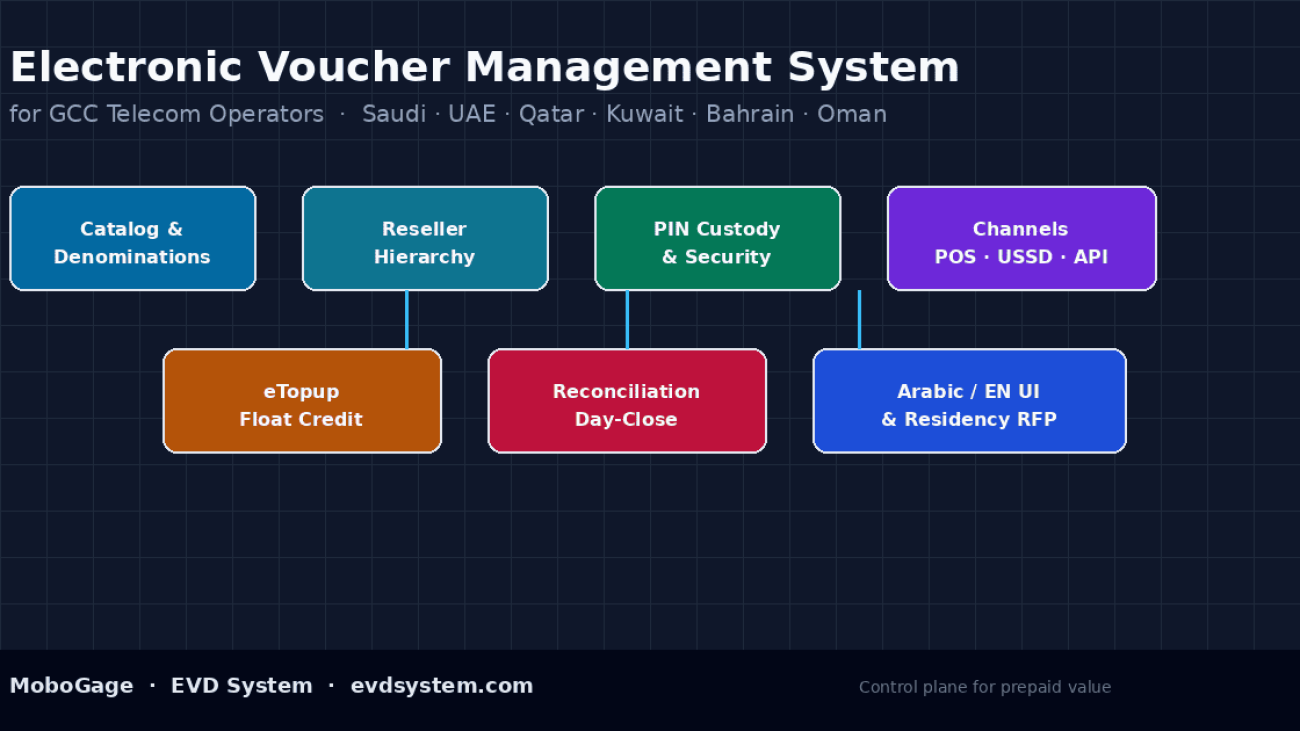
Diagram of an electronic voucher management system for GCC telecom operators showing catalog, reseller tiers, PIN custody, eTopup channels, and reconciliation

Electronic Voucher Management System for GCC Telecom Operators

An electronic voucher management system is the control plane for prepaid value. It generates and inventories serialised vouchers or float, pushes them through reseller hierarchies, sells them over POS, USSD, portal or API, and reconciles stock, sales and charging at day-close. Operators and VAS partners in the GCC (Saudi Arabia, the UAE, Qatar, Kuwait, Bahrain and Oman) ask more of it than most markets do. Catalogs carry several currencies, distributor trees run four or five levels deep, field teams work in Arabic and English, and many deals are delivered through partners. A platform that can’t handle those conditions tends to show it during Ramadan and Eid, when volumes peak and finance tickets pile up.

Definition

TermPlain meaning
Electronic voucher management system (EVMS / VMS)Software that owns voucher or prepaid-value lifecycle: create → secure → distribute → sell/redeem → report/reconcile
EVDElectronic voucher distribution: moving prepaid value through channel nodes (often with wallets and POS)
eTopupTypically PINless airtime credit from dealer float to subscriber MSISDN
Control planeThe system of record for stock, hierarchy policy, PIN custody, and day-close truth

In brief: a GCC prepaid programme usually needs an electronic voucher management system that owns catalogs, reseller tiers, PIN custody and reconcile, and a single-channel top-up tool won’t cover that. PINless credit matters too, because Saudi and UAE retail leans on it while partners keep selling serialised vouchers (see electronic top-up for telecom airtime). And when the steering committee compares vendors, judge them on lifecycle and day-close evidence with the EVMS buyer checklist, not on slides. For background on electronic reloading versus physical cards, Wikipedia’s electronic reloading page is a fair summary, and GSMA Mobile for Development has written on the cost side of electronic airtime channels (GSMA article on airtime distribution savings).

Why a Gulf operator ends up treating the electronic voucher management system as infrastructure

Prepaid still pays for a big share of retail connectivity in the Gulf. Selling airtime, bundles or partner vouchers looks simple until the operating details arrive. Picture a national distributor in Riyadh funding sub-dealers in Jeddah and Dammam. Or a Dubai aggregator exposing APIs to super-apps, or a Kuwait retailer whose POS has to cope when coverage drops. Finance wants one version of inventory. Fraud wants PIN custody and velocity limits. The channel team wants commission that matches the contract tree it already signed.

Those demands meet in the EVMS. Without one, programmes tend to run on portals, partner spreadsheets and charging adapters held together by hand. With one, generation policy, credit limits, sale channels and reconcile packs all use the same words. That’s why MoboGage positions EVD System as a premium application for telecom and VAS rather than a “voucher printer.”

If the terms are blurry (EVD, VMS and the rest), start with What is electronic voucher distribution (EVD)?.

What GCC tenders actually ask for

A caveat first. What follows is the requirements language we see in RFPs. It isn’t a statement about any country’s regulation, and it isn’t a claim about EVD System’s certification status.

Catalogs that change every salary week

GCC programmes mix local-currency airtime denominations with partner gift or OTT SKUs, promo bundles and sometimes dual-face value for expatriate corridors. Around holidays and salary weeks the catalog moves fast. Product teams should be able to publish a denomination or change an expiry rule without reprinting stock or raising an emergency database ticket. Micro-denoms and bundles belong in the same place as classic face-value vouchers.

Currency precision is a detail that catches teams out. Under ISO 4217 the riyal and the dirham have two decimal places. The Kuwaiti and Bahraini dinars and the Omani rial have three. Store every amount in minor units per currency, or a regional rollup will round fils and baisa into errors.

Hierarchies that mirror the signed contract

A flat “every retailer is equal” portal breaks distributor agreements of the kind common in Saudi Arabia, the UAE and wider MEA. You need master distributors, sub-distributors and retail points, each with wallet transfer rules, credit limits and commission settlement that follow the paper contract. We recommend encoding the tree you already have. More on that in multi-tier reseller voucher distribution.

PIN custody and day-close

Serialised secrets haven’t gone away. Partner products, gift-style SKUs and hybrid print paths still use them. Encryption at rest is the minimum. The hard part is a day-close that ties inventory status, sales and charging credits together. Insist on lifecycle states, blacklisting, two-person reversals and exception reason codes. We cover this properly in voucher reconciliation and PIN security.

eTopup next to PIN stock

Busy retail in the UAE and Saudi Arabia often prefers PINless credit to an MSISDN straight from dealer float. That doesn’t make the EVMS redundant. The dealer holds float instead of PIN stock, but hierarchy, limits and reconcile stay exactly where they were. Many GCC stacks run both modes under one policy, which we think is the sensible design: one hierarchy, one set of limits, two product types.

Arabic screens and residency questions

Field teams and L1 support usually need Arabic and English labels, receipts and training packs. IT and risk will ask where production data and backups live (Saudi Arabia’s Personal Data Protection Law and its data-transfer rules make this a standard questionnaire item), which subprocessors touch PIN material, and how access is logged. Treat bilingual UX and residency as things you verify in the RFP and the architecture review. Don’t accept them as marketing claims unless your legal and delivery teams have confirmed them for that specific deal.

Selling through an SI or VAS partner

A lot of GCC and MEA wins go through systems integrators and VAS partners who already have the operator relationship and the tender experience. A vendor that can sit behind that partner as a technology layer (APIs, POS, hierarchy config, training) fits how procurement really buys. That’s how we position it: MoboGage as the product and engineering layer, the SI or partner as the face of delivery when that’s the commercial route.

A GCC EVMS RFP table you can reuse

Requirement areaWhat “good” looks like in evaluationWhy it matters in GCC/MEA
Catalog & denominationsMulti-product, multi-denom, promo windows without reprintFestival and salary-week catalog churn
Hierarchy & walletsMulti-tier nodes, credit limits, parent→child transfer policyDistributor contracts are rarely flat
ChannelsUSSD, Android/Linux POS, portal, app, API on one float/PIN truthOmnichannel retail + aggregators
PIN custodyEncrypted secrets, reveal-at-sale, blacklist, audit trailPartner SKUs and hybrid stock
ReconciliationInventory vs sales vs charging with exception ownersFinance and fraud close the same day
eTopup modeIdempotent PINless credit, float debit, clear failure codesHigh-velocity prepaid retail
LocalisationArabic/English UI and receipts as configurableBilingual field and support teams
Residency & accessDocumented hosting options, access logs, subprocessorsRisk and IT questionnaire items
DeliverySI/partner-ready APIs, config, training packsTender and outsourced ops models

Use it alongside the longer evaluation grid in How to choose an electronic voucher management system.

What EVD System does and doesn’t claim

EVD System is MoboGage’s electronic voucher distribution and management platform. It handles generation, inventory, lifecycle, reseller POS on Android and Linux, apps and APIs, for telecom airtime, gift-style vouchers and related prepaid products.

For a GCC buyer, the honest pitch is this. It controls the voucher lifecycle with real states and policies, not just a sales screen. Its wallets, limits and multi-tier distribution look like what channel teams already run. It sells PIN and eTopup-style credit under the same commercial rules. Day-close is built around inventory, sales and charging lining up. And it works when an SI or VAS partner wants an outsourced technology layer instead of building voucher plumbing in-house.

We won’t put operator counts, uptime percentages or “market leader” badges here. Large suppliers in the region publish those: Comviva cites uptime figures for PreTUPS and Seamless highlights ERS 360 deployments. Those claims are worth asking about, but they don’t tell you how your own hierarchy will close a day. Ask every vendor, us included, for a scoped demo on your hierarchy slice, catalog and exception paths. MoboGage is headquartered in Jaipur and has no GCC office; regional delivery runs through partners, and we say so in tenders.

A rollout order that holds up on an ordinary Tuesday

Start by mapping one country’s commercial tree: the master distributors, their credit terms, and which SKUs are PIN and which are PINless. Then pilot a single slice, one region or one partner with a limited set of POS and USSD, and prove that float or PIN debit and charging credit line up. Localise the screens dealers and L1 really use into Arabic and English before anything else gets translated, and check the settlement calendar: Saudi Arabia’s weekend is Friday-Saturday, while the UAE moved to Saturday-Sunday in 2022, so a regional programme can have bank cut-offs on different days.

Before peak week, encode the festival policy: temporary limits, promo denominations, and dual control on bulk loads. Do a hardening pass on reversal windows, velocity limits, lost-terminal disable and day-close owners. Only then expand to more APIs, more POS families and more product lines, once finance actually trusts the close.

Be wary of a demo that only shows a happy-path sale from a pre-funded test wallet with no exception screen; it shows the easy 90 seconds of the process.

Count your disputes before you call anyone

If your GCC prepaid stack still reconciles in spreadsheets after the partner portals close, take one week of sales by channel and write down every float or PIN dispute. That list usually shows whether you need a stronger EVMS lifecycle, cleaner eTopup discipline, or both under one control plane.

Operators and VAS partners looking at EVD System can read the electronic voucher management system overview, see About MoboGage, or reach the team through the contact / demo page · projects@mobogage.com · +91-9928 366 889.

FAQ

What is an electronic voucher management system in a GCC telecom context?

It is the platform that owns prepaid voucher or value lifecycle for an operator or VAS partner: generation, secure inventory, allocation through reseller tiers, sale or redemption across channels, and reconciliation against charging, so Saudi, UAE, and other Gulf programmes are not run from disconnected portals.

Do GCC operators still need PIN vouchers if they have eTopup?

Often yes for partner products, gift-style SKUs, hybrid print, or contract paths that still require serialised secrets. eTopup handles high-velocity PINless airtime; EVMS keeps lifecycle and reconcile when PINs remain in the mix.

Why do multi-tier reseller hierarchies matter in Saudi Arabia and the UAE?

Distributor agreements typically cascade credit and commission through several layers. A flat retailer portal cannot encode those contracts; wallet transfers, limits, and settlement must follow the real tree.

Should Arabic UI and data residency be RFP requirements?

Yes as evaluation criteria. Ask vendors to demonstrate bilingual operator-facing screens and to document hosting, backup, and access-control options. Confirm any residency or localisation commitment in writing for your deal, do not treat brochure language as compliance proof.

How should SI and VAS partners buy EVMS?

Many tenders favour a partner who already wins telecom work and outsources the voucher platform. Evaluate APIs, config tooling, training, and commercial willingness to sit behind the SI, then run a joint pilot with the operator hierarchy.

Where does GSMA fit this conversation?

GSMA Mobile for Development material on airtime distribution discusses cost dynamics of electronic channels versus traditional scratch-card logistics. Use it as industry context for business cases; build your own market model for GCC economics.