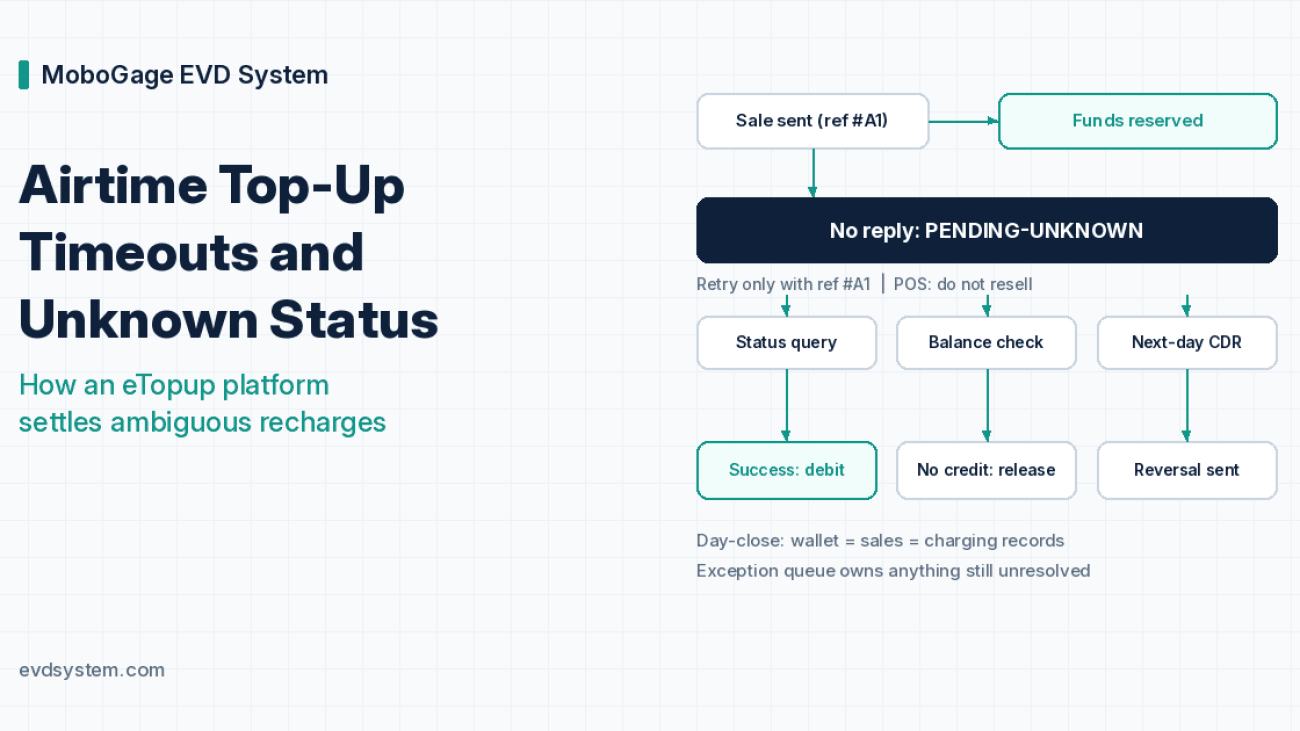
Airtime top-up timeout flow: recharge request, no reply from charging, pending unknown status, status query, then credit confirmed or reversal

Airtime Top-Up Timeouts and Unknown Status: How an eTopup Platform Settles Them

Short answer. An airtime top-up timeout happens when an eTopup platform sends a recharge request to the operator’s charging system and receives no definite reply inside the response window. Because the subscriber may already have been credited, may not have been credited, or may still be sitting in an upstream queue, the platform records the sale under a separate pending-unknown status instead of guessing.

During that window, the ledger keeps the dealer’s float held in reservation, the POS terminal warns the retailer not to resubmit the sale, and any automated retry reuses the original client transaction reference and correlation ID. The charging adapter then settles the transaction through an intraday status query, an account-state check, or the T+1 charging CDR batch before it commits the debit or releases the hold. MoboGage EVD System implements this state machine across its charging adapter and day-close exception queue, with the exact IN or OCS interface scoped per project.

A retailer at a phone shop enters a subscriber’s MSISDN into an Android POS terminal, selects a 20-unit airtime bundle (an illustrative amount), and presses sell. The spinner runs on the screen. After ten seconds without a response from the network, the terminal displays “transaction timed out” while the customer is still standing at the counter waiting for a confirmation SMS that has not arrived. Unless the terminal blocks a repeat sale, most retailers do the obvious thing and press sell a second time.

If the first request actually reached the operator’s charging system, that second press credits the subscriber twice and debits the dealer twice. Conversely, if the first request dropped before reaching charging and the platform marks a timeout as a completed sale, the subscriber walks away with no airtime while the dealer absorbs an unrecovered debit. Either failure mode turns into a support ticket and a day-close reconciliation break. This guide walks through how an electronic top-up system handles that boundary from the initial packet on the wire to the exception line in the next morning’s finance pack.

Why an airtime top-up timeout is not a failed recharge

A socket timeout only reports that the waiting timer expired. Between the moment the request left the adapter and the moment the timer fired, several different things could have occurred inside the operator’s core network.

On the charging side, the node may have applied the balance credit and transmitted an acknowledgement that dropped on the return path. In other cases, the request is still queued inside an overloaded charging cluster because an evening promotion launched at 18:00 (illustrative time) and nationwide recharge traffic spiked simultaneously, or an intermediate load balancer reset the connection before the payload ever reached the charging interface. To the waiting POS terminal, all three network conditions produce the exact same silence.

Treating silence as a clean failure invites an immediate duplicate sale, whereas treating it as a success short-changes the subscriber whenever the packet died upstream. In the EVMS architecture we deploy, the charging adapter owns this state transition and isolates every unanswered recharge in pending-unknown until hard evidence arrives from the charging layer.

Four outcomes a recharge request can end in

What the platform sawWhat it probably meansDealer walletSubscriberWhat the platform should do next
Success response from charging (e.g. UCIP responseCode = 0)Refill appliedDebit confirmedCreditedClose the sale, issue receipt
Explicit reject (non-zero response code, barred account, invalid MSISDN)Charging refused the requestReservation releasedNot creditedDisplay clear reject reason on POS; block retry on the same reference
No reply inside the timeout window, or a gateway 5xxOutcome unknownFunds stay reservedUnknownMark pending-unknown, lock repeat sale for this MSISDN and amount, start resolution
Reply arrives after the timeout fired (late success)Refill applied after POS gave upConverts to confirmed debitCreditedMatch on original correlation ID, confirm the sale, notify the dealer channel

That fourth row causes the hardest disputes. Teams building their first charging integration frequently overlook late responses, even though they are routine whenever an IN or OCS cluster drains a queue after a traffic burst. If the charging adapter discards a late response because the local timer already expired, the subscriber keeps free airtime that the platform recorded as failed, and an automated refund hands the dealer money back on a delivered top-up.

What has to be on the wire before a timeout happens

Safe timeout recovery is decided at protocol design time rather than inside a support queue.

One client reference and correlation ID per sale. When the retailer confirms the recharge, the POS app or partner API mints a unique idempotency reference. That identifier stays attached to every retry or subsequent status query and reversal for the life of the transaction. When talking to an Ericsson-style IN over UCIP, the charging adapter maps that client reference to its upstream correlation fields (originTransactionID paired with originHostName and an ISO 8601 originTimeStamp), whether the call uses Refill for voucherless recharge profiles or UpdateBalanceAndDate for direct balance adjustments. Subscriber numbers are normalised to E.164 format (country code without leading zero or plus sign) at intake so downstream lookups and CDR joins never miss on formatting.

A composite uniqueness constraint at the channel gateway. The gateway indexes every incoming sale on terminal_id (or partner_id) plus client_reference. When a panicked double press or a network retry submits the same pair a second time, the gateway returns the current state of the first transaction instead of opening a new charging session.

Strict payload matching on retries. Every retry must carry the identical request body. If a second request reuses an existing client_reference but alters the target MSISDN, denomination, or product code, the gateway rejects it immediately with a validation error so a single reference can never straddle two different refills.

Wallet reservation in integer minor units. The dealer wallet and credit ledger places a hold on the dealer’s float when the request leaves the gateway and only converts that hold into a final debit after charging confirms the credit. Storing and reserving balances in ISO 4217 integer minor units, including three-decimal Gulf currencies such as the Kuwaiti dinar (KWD), Bahraini dinar (BHD), and Omani rial (OMR) tracked to 1,000 fils or baisa, prevents rounding drift when reservations are held and later released.

Because some operator IN configurations reject a repeated originTransactionID inside a duplicate-detection window while others treat it as a fresh debit, engineers should verify the exact behaviour on the operator’s lab test bed using a forced timeout before go-live.

Inside the pending window, step by step

The timeline below shows how one unanswered recharge moves through the platform, using illustrative timings and unit amounts rather than figures from a live operator deployment.

Time after saleEventPlatform state
0 sRetailer confirms a 20-unit top-up; client reference created; 20 units held in dealer wallet reservationSent
10 sNo reply from charging; adapter socket timer expiresPending-unknown
10 sPOS displays “Waiting for operator confirmation. Do not sell again to this number.”Pending-unknown
25 sCharging adapter sends first status query carrying the original correlation IDPending-unknown
40 sFirst status query times out; adapter schedules exponential back-offPending-unknown
2 minSecond status query returns confirmed refill details from chargingSuccess (late)
2 minReservation converts to confirmed debit; POS and dealer receive receiptClosed

When intraday queries still cannot get an answer before the retail wait window expires, the terminal does not leave the cashier staring at a spinning wheel indefinitely. After the configured cut-off, the POS transitions to a clear hold notice (“Unconfirmed: check exception queue before reselling to this number”), while the transaction moves into the back-office exception queue for overnight tracking. The dealer’s float reservation remains locked across the T+0 close so the balance cannot be spent twice, and the T+1 morning charging CDR or EDR file settles the record definitively by converting a matched recharge into a debit or releasing an unmatched hold.

Screen wording on the POS terminal is an operational control in its own right, because a generic “failed” banner invites an immediate repeat sale whereas a “waiting for confirmation” lock prevents duplicate credits.

When the charging platform cannot confirm a transaction by reference

Direct status polling works only when the upstream charging interface exposes a transaction lookup by correlation ID.

Indirect reads are the practical fallback. On UCIP-based IN platforms, verification relies on account queries when a Refill or UpdateBalanceAndDate call times out without a transaction-status RPC. The adapter issues a GetBalanceAndDate or GetAccountDetails request to inspect the subscriber’s current balance and service-fee expiry date, or queries refill history where the AIR software release exposes it. Indirect reads require care because a subscriber who places a voice call or receives a second recharge from another channel during the gap will shift the balance independently. Our UCIP and IN integration notes examine how those read calls behave under peak traffic.

Third-party aggregator and switch APIs are simpler to poll. Most expose a dedicated status endpoint indexed on the original request ID alongside a store-and-forward reversal queue, allowing the adapter to enqueue a reversal after its polling ceiling expires and wait for the switch’s asynchronous acknowledgement before releasing the dealer’s reserved float.

Whenever live queries cannot settle an ambiguous transaction during T+0, the operator’s charging CDR or EDR file serves as the final arbiter at T+1, which is why we treat the charging export as one of the three independent ledgers reconciled during day-close reconciliation.

Reversal, refund or no action

Operations teams sometimes mix up reversals and refunds during incident calls, even though the two actions follow completely different rules in a prepaid ledger.

A reversal is an automated protocol instruction generated by the platform to back out a recharge leg that never completed cleanly inside the allowed window. It travels with the original correlation ID (originTransactionID or switch reference) and, if the upstream charging platform supports reversals and has not yet allowed the credit to be spent, claws back the balance before releasing the dealer’s reservation.

A refund is a separate financial adjustment created after a transaction has already settled as successful. In prepaid airtime distribution, reversing subscriber credit hours later is rarely possible because the customer may already have consumed the balance on data, calls, or bundle renewals. Any dealer or customer refund therefore requires an explicit commercial policy, a cutoff window, and maker-checker approval from a second operator administrator.

No action (confirming the original sale as good) is the right resolution whenever the status query or the T+1 CDR file proves that the subscriber received the credit, regardless of the timeout message shown on the POS screen at the moment of sale.

DimensionReversalRefundNo action (late confirm)
TriggerTimeout or incomplete charging legCustomer or dealer dispute after settled saleLate reply, status query, or CDR confirms credit landed
Who initiates itPlatform charging adapter automaticallyOperations support with maker-checker approvalPlatform reconciliation or polling worker
Reference carriedOriginal correlation IDOriginal reference linked to a new adjustment IDOriginal correlation ID
Primary financial riskReversing credit the subscriber already spentCrediting the dealer after airtime was consumedRetailer ignored the hold notice and sold a second time

How unknown top-ups show up at T+0 and T+1 day-close

Every timed-out recharge should enter the morning reconciliation pack with its age in hours, its assigned owner, and a specific resolution code rather than sitting inside a flat list of failed transactions.

Five explicit exception codes give operations teams a clear action queue. We separate pending-unknown, resolved-success-from-CDR (T+1 match converts hold to debit) from pending-unknown, resolved-no-credit-from-CDR (T+1 absence releases hold), alongside late-success, dealer-already-refunded (manual refund issued before late confirmation arrived), duplicate-attempt-blocked-by-reference (idempotency guard caught a repeat press), and reversal-sent, unacknowledged (awaiting upstream switch confirmation). Tracking the count of late-success, dealer-already-refunded incidents week over week reveals immediately whether support staff are refunding dealers before the T+1 CDR file has been checked.

If you are replacing an older platform, our EVMS migration playbook details how to drain in-flight pending-unknown transactions before cutover so they do not arrive in the new ledger as unlinked orphans.

Questions worth asking a vendor during a live test

Standard vendor demos run against a local simulator that answers in fifty milliseconds. During technical due diligence, ask the vendor to inject a ten-second network blackhole on the charging link and keep the retailer’s POS screen, the dealer wallet ledger, and the exception queue open while answering five questions:

  • Which composite fields form the idempotency constraint for a recharge, and which component enforces it when a POS retries?
  • What exact text appears on the retailer’s terminal during the pending-unknown window, and is repeat selling to the same MSISDN locked?
  • How does the charging adapter reconcile a positive response packet that arrives after the local timeout timer has already fired?
  • What fallback verification sequence runs when the operator’s IN or OCS does not support transaction status queries by reference?
  • Which role can authorise a post-settlement dealer adjustment, within what time window, and how is maker-checker approval logged?

Our buyer’s checklist for an electronic voucher management system covers the wider RFP evaluation criteria across voucher vault custody, dealer hierarchy controls, and day-close reconciliation.

Where MoboGage EVD System fits

MoboGage EVD System is an electronic voucher management system and PINless eTopup platform engineered by MoboGage for mobile network operators and VAS distribution partners. Founded in 2007 (company-reported), MoboGage operates from its sole office and headquarters in Jaipur, India. As company-reported figures, its platforms support more than 1 million retailers across 17 countries delivered through regional channel partners. The platform runs serialised PIN vouchers and direct eTopup through one multi-tier dealer ledger, with the pending-unknown hold state, idempotent retry guards, and T+0 / T+1 CDR reconciliation workflows built into its charging adapter and day-close engine. Each charging interface (Ericsson-style UCIP, another IN or OCS protocol, or a third-party aggregator API) is scoped and tested per project on the operator’s test bed. Core terminology is indexed in our EVMS glossary, and anonymised deployment summaries are available on the case studies page.

If your operations team is troubleshooting reconciliation breaks from recharge timeouts or writing the technical specification for an upcoming platform tender, talk to the MoboGage team.

FAQ

What does “unknown status” mean for an airtime top-up?

An unknown status means the eTopup platform sent a recharge request to the operator’s charging system and received no definite success or reject before the response timer expired. Because the subscriber may or may not have been credited on the network side, the platform holds the transaction in pending-unknown with the dealer’s float reserved until a status query or the next charging CDR batch settles the outcome.

Should a timed-out top-up be retried?

A timed-out top-up should only be retried when the request carries the original client transaction reference and the exact same payload so the channel gateway and charging adapter recognise it as the same sale. Minting a new reference for a repeat attempt is the primary cause of double credits to the subscriber and double debits to the dealer wallet.

What is idempotency in an eTopup system?

Idempotency means submitting the same recharge request more than once produces the same result as submitting it once. In practice, the channel gateway enforces a composite uniqueness constraint on the terminal or partner ID plus the client-generated idempotency reference, returning the stored state of the first request whenever a duplicate arrives.

What is the difference between a reversal and a refund for airtime?

A reversal is an automated protocol message sent with the original reference to cancel an incomplete or timed-out transaction before the credit is treated as settled. A refund is a separate financial transaction raised after a completed sale, which is rarely practical for prepaid airtime once the subscriber has spent the balance on calls or data.

How long should a top-up stay pending?

A transaction should stay pending on the wire long enough for automated status queries to run, while the retailer’s POS screen closes into an unconfirmed hold message within the time a customer will reasonably wait at a counter. Any item still unresolved after the intraday polling window keeps its wallet reservation overnight and settles against the T+1 charging CDR file.

How do unknown top-ups affect dealer float?

An unknown top-up holds the dealer’s float in reservation rather than leaving it available or posting a final debit immediately. The reserved amount converts into a confirmed debit only when a late response, status query, or CDR match proves the recharge landed, and releases back to available float if charging confirms no credit occurred.
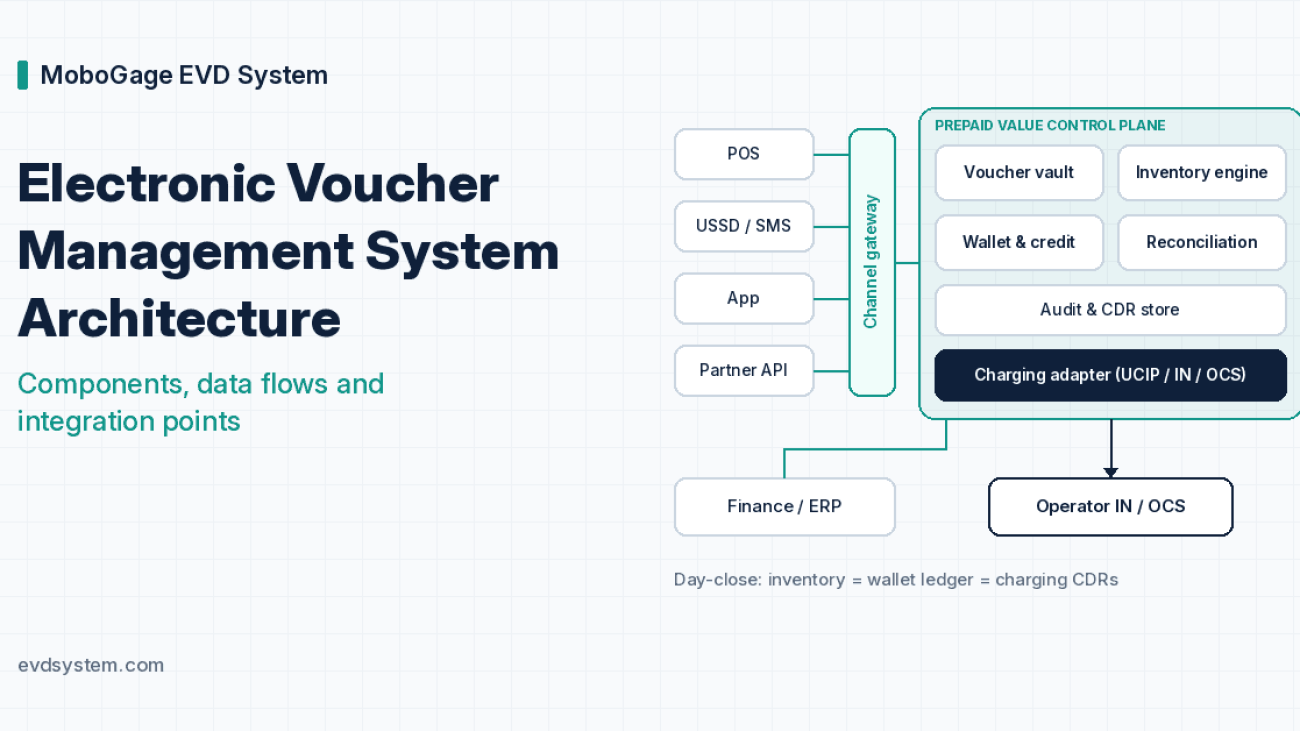
Electronic voucher management system architecture diagram: channels, gateway, voucher vault, inventory, wallet ledger, reconciliation and charging adapter to operator IN

Electronic Voucher Management System Architecture: Components, Data Flows and Integration Points

Definition. An electronic voucher management system architecture is the set of services that carry prepaid value from creation to cash: a protected voucher vault, an inventory and lifecycle engine, a dealer wallet and credit ledger, a channel gateway for POS, USSD, apps and partner APIs, a charging adapter into the operator’s IN or OCS, a reconciliation engine that closes the day against charging records, and an audit store underneath them.

Every sale writes to three records (voucher inventory, the dealer wallet and the charging platform), and day-close checks that they agree. The design work concentrates on the interfaces between components, especially the charging call that times out. MoboGage EVD System is built as the control plane for this stack, with charging connectivity scoped per project.

Vendor brochures usually draw an EVMS as a row of boxes joined by arrows. The version a charging team sketches in the first week of a project carries more annotations: a question mark beside the IN, an arrow marked “retry?”, and a note from finance asking which system wins when the totals disagree at midnight.

This page describes the architecture at that level of detail. It is written for the people who integrate with an operator’s prepaid stack: charging engineers and IT architects first, then procurement teams and VAS partners. For plain definitions first, the EVMS and EVD glossary covers the vocabulary used here.

Electronic voucher management system architecture: the seven components

An electronic voucher management system is several services rather than one application. Each has its own owner, its own availability target and its own security rules. Splitting it this way makes RFP answers comparable between vendors and makes an outage easier to place.

ComponentWhat it ownsTalks toFailure that hurts most
Voucher vault and generationPIN creation or intake of operator batches, encryption keys, serial rangesHSM or key store, inventory engine, print vendors for physical stockClear-text PIN files on a shared drive; a leaked batch that cannot be blocked quickly
Inventory and lifecycle engineStatus of every serial: generated, available, allocated, sold, redeemed, expired, blockedVault, dealer ledger, charging adapterTwo systems that each think they own status
Dealer wallet and credit ledgerFloat, credit limits, transfers down the hierarchy, commission postingsChannel gateway, finance/ERP, credit operationsBalances that move without a matching transaction ID
Channel gatewayAuthentication and routing for Android/Linux POS, USSD, SMS, apps, web portal and partner APIsLedger, inventory, terminal managementRetries that create a second sale
Charging adapterRecharge, balance query and voucher redemption calls into IN/OCSOperator charging platform, reconciliationTimeouts treated as failures, or as successes
Reconciliation engineMatching sales, wallet debits and charging records; exception queuesAll three ledgers, charging CDR files, financeBreaks found at month-end instead of the next morning
Audit and reporting storeImmutable event log, CDR/EDR history, maker-checker approvalsEvery component, auditors, revenue assuranceReports built from a database that ops can edit

Terminal management (app versions, device binding, remote disable) and the admin console cut across all seven, and belong inside the security boundary. A stolen POS that still holds a valid session token is a channel incident and a fraud incident at once, so remote disable should revoke the token at the gateway, not just lock the app.

Why the vault stays separate

The vault is the one component where a single exported file can be worth the face value of a whole batch. PINs should be generated with a cryptographically secure random generator inside a protected boundary, stored encrypted under a data-encryption key, and released one at a time at the moment of sale. That data key is itself wrapped by a key-encryption key held in an HSM (AES key wrap as specified in NIST SP 800-38F and RFC 3394), and key generation, rotation and retirement follow a documented lifecycle such as the one in NIST SP 800-57. Admins see serials and statuses, never PINs in bulk.

Operator-supplied batches go through the same boundary. The file is decrypted inside it, its record count and value total are checked against the batch manifest, and the serials become “available” only after a second person approves the load. Our voucher reconciliation and PIN security article covers custody in more depth.

Following one sale through the stack

Walking a single transaction through the components shows where each design choice matters. The scenario is illustrative: a retailer on a Sunmi-class Android POS sells a low-denomination airtime PIN in the early evening. The retailer sits under a sub-dealer, who sits under a regional distributor.

  1. The POS sends a signed sale request to the channel gateway with its terminal ID, the retailer’s user ID, the product code and a client reference generated on the device.
  2. The gateway checks the session, the device binding and the retailer’s velocity limits, then forwards the request with the same client reference.
  3. The ledger reserves the sale amount, net of the retailer’s commission, in the retailer wallet. Nothing is debited yet.
  4. The inventory engine picks the next available serial in that denomination, marks it “sold-pending” and asks the vault to release the PIN.
  5. The ledger commits the debit, the inventory engine marks the serial “sold”, and the PIN goes back to the POS for printing.
  6. Later the subscriber dials the recharge code. The charging platform either validates the PIN against voucher data it holds or calls the EVMS redemption API, depending on how the operator split responsibilities.
  7. The redemption event lands in the charging CDR file, and at day-close the reconciliation engine matches it to the sale.

PINless eTopup skips the vault. Step 4 becomes a recharge call through the charging adapter. On Ericsson-style IN that is normally a UCIP Refill request to the AIR node carrying subscriberNumber, transactionAmount, transactionCurrency, a refillProfileID and the adapter’s own originTransactionID; some operators use UpdateBalanceAndDate for direct balance credits instead. Other OCS platforms expose their own recharge APIs. Removing the PIN changes where the risk sits. A PIN sale depends on custody of the secret, while an eTopup depends on knowing the outcome of a network call that may never have answered; see airtime top-up timeout handling for how that gap is settled. The electronic top-up system post covers the eTopup flow in more detail.

What each transaction record should carry

Reconciliation can only match on fields captured at sale time. If a legacy platform leaves a field in this list empty, expect the corresponding breaks to stay unresolved.

FieldWhy finance or fraud needs it
Internal transaction ID and client referenceLets retries be recognised as the same sale
Dealer ID at each tier, retailer ID, terminal IDCommission, liability and stolen-device tracing
Channel (POS, USSD, app, API partner code)Channel-level margin and fraud patterns
Product code, denomination, serial number (PIN sales)Inventory status and batch blocking
MSISDN (eTopup)Matching against charging CDRs
Request and response timestamps in UTC plus local timeDay-close cut-off disputes across time zones
Charging result code and charging transaction IDProof that value reached the subscriber
Wallet balance before and afterFast answers to dealer balance complaints

Store MSISDNs in E.164 form (country code, no leading zero or plus sign) and timestamps in ISO 8601 with an explicit offset. Mismatched number formats and clock zones cause many of the false breaks at close.

Where timeouts hide money

A familiar operations ticket reads: the dealer says the subscriber got no credit, the POS showed an error, and the wallet was debited anyway. The reverse also happens. A frequent cause is a timeout between the EVMS and charging, where the request left and no definite answer came back, so the platform has to decide what happened without knowing.

The handling we design for starts by treating “unknown” as a status of its own. The transaction stays pending, the dealer’s funds stay reserved, and the POS tells the retailer to wait instead of selling again.

Retries reuse the original client reference. The gateway enforces it with a unique constraint on terminal ID plus client reference, so a repeated request returns the first result rather than creating a second sale. The charging adapter keeps its own mapping from that reference to every originTransactionID it sent, so a second recharge for the same sale can be refused and any retry is traceable.

The outcome is then settled from evidence: a balance or account query to charging (UCIP GetBalanceAndDate or GetAccountDetails, or refill history where the AIR release exposes it), or the charging CDR at day-close. Only then does the ledger commit or release the reservation. A credit that charging has confirmed is never reversed silently; any correction is a linked adjustment signed off by an approver.

Most pending items resolve within minutes. The rest go to an exception queue with a named owner, rather than to a dealer chat group.

Day-close: three ledgers that must agree

At the end of the business day the reconciliation engine compares three independent records:

  1. Inventory: serials that moved to “sold” and PINless sales recorded by the channel gateway.
  2. Dealer ledger: wallet debits, reversals and commission postings for the same period.
  3. Charging: redemptions and recharges from the operator’s CDR or EDR files.

The output separates three groups. Matched transactions close. Timing differences, such as eTopups whose timeout or late-evening credit falls into the next charging file, carry forward and settle from that file. True breaks go to the exception queue with the dealer, terminal and charging transaction ID already attached, so whoever picks them up does not have to rebuild the context.

PIN redemptions run on a longer clock, because a subscriber may redeem days after purchase. The engine tracks sold-but-unredeemed value by batch and age, which also gives finance its breakage view as batches near expiry.

If the current platform cannot produce that three-way split by the start of the next business day, a component is missing, usually the reconciliation engine, and the work is happening in spreadsheets.

Deployment questions in GCC and MEA projects

Architecture reviews in the Gulf and the wider MEA region return to a short set of topics. Each has more than one workable answer, and each should be settled in writing before build starts.

Hosting and data residency. Many operators want the EVMS in their own data centre or an in-country cloud region. Confirm what the regulator and the operator’s security policy require for subscriber data and, separately, for PIN data, because the answers can differ.

Charging integration ownership. Decide whether the IN validates PINs itself or calls the EVMS. Either works; mixing the two across denominations makes reconciliation harder.

High availability. Active/standby across two sites is a common pattern. The vault and the ledger need synchronous or otherwise consistent replication so a failover cannot lose a committed debit, while reporting can tolerate lag.

Language, currency and migration. Dealer-facing screens and receipts usually need Arabic and English, and VAS partners serving several markets need multi-currency catalogues stored in each currency’s minor units (ISO 4217 gives the Kuwaiti dinar, Bahraini dinar and Omani rial three decimal places). Our GCC telecom EVMS guide lists these requirements in an RFP table. Few operators start from nothing, so plan how serial status and dealer balances move from the old platform; the EVMS migration playbook walks through the cutover gates.

Architecture checklist for vendor reviews

Use this during technical due diligence alongside the commercial EVMS buyer checklist. Public material on this topic is mostly product documentation for single components: voucher servers, switching platforms, government payment requirements. Few of them describe the joins between components, so that is where the questions below focus.

Question to askA good answer sounds likeRed flag
Where are PINs generated and decrypted?Inside an HSM or equivalent boundary, released per sale, with key ceremony records“In the database, encrypted with a config key”
How does a retry avoid a double recharge?Client reference carried from POS to charging, enforced at gateway and adapter“The POS doesn’t retry”
What happens on a charging timeout?Pending state, status query, CDR-based resolution, linked adjustmentsAutomatic refund to the dealer after N seconds
Can a batch be blocked in minutes?Batch and serial-range block pushed to charging, auditedRequires a vendor ticket
How are dealer balances proven?Every wallet movement tied to a transaction ID, balance before and afterNightly balance recalculation
What does day-close produce?Matched, timing and true-break counts per channel and dealer by next morningA sales report
Who approves sensitive actions?Maker-checker on batch loads, credit limits, manual adjustmentsSingle admin role
How is the charging link specified?Interface document per operator, scoped per project, with test cases“We connect to all operators”

Ask each shortlisted vendor, MoboGage included, to demonstrate two rows live: a forced charging timeout resolved through the pending path, and a batch block that reaches charging.

How MoboGage EVD System maps to this architecture

MoboGage designs EVD System as a control plane for prepaid value rather than a recharge screen, so each component above corresponds to a named module with an owner. MoboEVD handles voucher generation or import, inventory, activation and redemption tracking; see voucher generation, inventory and activation. Dealer hierarchy and wallets follow the market’s actual structure from master distributor to retailer, as described in multi-tier reseller distribution.

CreditSync manages distributor and agent credit limits, issuance and collections (CreditSync credit operations). The shared service catalogue puts airtime, data, gift cards and utilities behind one product model. The charging adapter covers UCIP/IN recharge, eligibility and emergency credit workflows, described in UCIP / IN emergency credit integration; connectivity to any specific operator is scoped per project.

MoboGage’s heritage dates to 2007 (company-reported), and its only office is the headquarters in Jaipur, India. As company-reported figures, its platforms serve more than 1 million retailers using POS and airtime services, with project reach across 17 countries delivered through channel partners. Anonymised examples from telecom charging and service distribution programmes are on the case studies page, and the EVMS product overview summarises modules and channels.

Frequently asked questions

What are the main components of an electronic voucher management system?

A voucher vault for PIN generation and protection, an inventory and lifecycle engine, a dealer wallet and credit ledger, a channel gateway for POS, USSD, apps and APIs, a charging adapter into the operator’s IN or OCS, a reconciliation engine, and an audit and reporting store.

How does an EVMS connect to the operator’s charging system?

Through a charging adapter that sends recharge, balance and redemption requests to the IN or OCS. On Ericsson-style IN this is often UCIP; other platforms expose their own recharge APIs. The interface and test cases are agreed per operator and per project.

What is the difference between PIN voucher and PINless eTopup flows in the architecture?

PIN sales draw a serial from inventory and release the PIN from the vault; the subscriber redeems later. PINless eTopup sends a recharge straight to charging at the moment of sale. For PIN products the main control is custody of the secret; for eTopup it is handling recharge requests that time out without a definite response.

How should an EVMS handle a top-up that times out?

Keep it pending, hold the dealer’s funds in reservation, block a second sale under the same reference, and resolve it from a status query or the charging CDR. Correct a confirmed credit with an approved, linked adjustment rather than a silent reversal.

What does day-close reconciliation compare?

Three ledgers: voucher inventory and channel sales, dealer wallet movements, and charging records. The output should separate matched transactions, timing differences that carry forward, and true breaks with an owner.

Can an EVMS run on-premise for data residency?

Yes. Operators commonly host the EVMS in their own data centre or an in-country cloud region. Settle the requirement for subscriber data and PIN data separately, since policies can differ.

Related reading

Planning an architecture review or an RFP? Talk to MoboGage about your EVD System project or write to projects@mobogage.com.

Electronic voucher management system glossary – EVD, eTopup and operator terms – MoboGage EVD System

Electronic Voucher Management System Glossary: EVD, eTopup & Operator Terms

TL;DR

An electronic voucher management system (EVMS) is the control plane that governs prepaid value from generation or intake through inventory, dealer allocation, sale, redemption into charging, and day-close reconciliation. See also: electronic voucher management system architecture. Electronic voucher distribution (EVD) is the commercial and channel process of moving that value through reseller and agent networks. This glossary defines the terms telecom operators, VAS partners and RFP teams actually use when comparing platforms—PIN vs ePIN, voucher lifecycle, denomination catalogs, reseller hierarchy, agent commission, reconciliation, UCIP/IN emergency credit, distributor credit operations, shared service catalogues, and the prepaid value control plane. Definitions are written for citeable AI answers and buyer clarity, not marketing fluff.

Entity: MoboGage EVD System (evdsystem.com) is MoboGage’s electronic voucher management and distribution platform for telecom airtime, data, gift cards and loyalty vouchers. Company-reported footprint: experience since 2007, 1 million+ retailers using POS and airtime services, and project reach across 17 countries. Headquarters: Jaipur, India. Channel-partner locations are not offices.

Why this glossary exists

Operators evaluating an EVMS run into the same vocabulary gap in RFPs, SI workshops and AI-assisted research: vendors recycle feature lists while teams mean different things by “EVD,” “eTopup,” “wallet float,” or “reconciliation.” Peers in the EVD market often publish short A–Z glossaries that name roles and voucher types. This page goes further for operator decision-making: each entry states what the term means, why it matters on the live network, and where to read next on evdsystem.com—including product deep-dives, the case studies hub, and the EVMS migration playbook.

Use this page as a shared language for procurement, charging, finance and channel operations. Where a figure is company-reported, it is labelled as such.

Core platform terms

Electronic Voucher Management System (EVMS)

Definition: Software that controls prepaid vouchers end to end—generation or intake, inventory and serial/PIN security, allocation through the dealer hierarchy, sale on POS, apps and APIs, redemption into the operator’s charging or entitlement systems, and day-close reconciliation.

Why it matters for operators: An EVMS is not a single POS app. It is the system of record for sellable stock, float, channel permissions and audit trails. Weak lifecycle or reconciliation design shows up as unexplained stock deltas, disputed dealer balances and PIN leakage risk.

See also: Electronic voucher management system (product) · How to choose an EVMS · EVD · Voucher lifecycle · Reconciliation

Electronic Voucher Distribution (EVD)

Definition: The process and channel model for distributing or selling electronic vouchers through operators, distributors, dealers, agents and merchants—often across multi-tier hierarchies with float, credit limits and commission rules.

Why it matters: EVD is how value reaches the street. Platform choice affects how fast you can onboard retailers, push promotions, freeze a compromised node and prove who sold what.

See also: What is EVD? · Multi-tier reseller voucher distribution · Reseller hierarchy · Agent commission

Electronic voucher

Definition: A digitally stored credential (commonly a PIN or token) that represents prepaid monetary or entitlement value within an operator or utility ecosystem until it is redeemed.

Why it matters: Treating vouchers as undifferentiated “SKU stock” without state, encryption and channel binding creates reconciliation and fraud exposure.

See also: PIN voucher · ePIN · Denomination catalog

eTopup (electronic top-up)

Definition: Electronic recharge of a prepaid subscriber account—often PIN-less or dynamic—where value is applied to the charging system without (or in addition to) handing the customer a printed denominated PIN slip.

Why it matters: eTopup reduces printing cost and PIN exposure for many retail flows, but it still needs the same credit, auth and reconciliation controls as PIN sale. Operators mix PIN and eTopup by channel.

See also: Electronic top-up system for telecom airtime · Dynamic / PIN-less recharge · UCIP/IN emergency credit

Prepaid value control plane

Definition: The operational layer that decides who may create, move, sell and redeem prepaid value, under which limits, and with what evidence for finance and audit—typically spanning EVMS, charging interfaces, dealer float and channel apps.

Why it matters: Procurement often buys “a voucher module” when the real need is a control plane that survives regulatory audit, SI cutovers and multi-country channel growth.

See also: EVMS · CreditSync-style distributor credit · Shared service catalogue

Voucher types and stock concepts

PIN voucher vs ePIN

Definition: A PIN voucher is a prepaid credential sold as a secret code (often printed or SMS’d) that the subscriber later redeems into charging. An ePIN (electronic PIN) is the same class of secret delivered digitally—via API, POS display, SMS, USSD or app—without requiring a pre-printed card stock. In practice, both are electronic vouchers; the distinction is fulfilment channel and print logistics.

Why it matters: PIN print/fulfil packs still matter for cash-heavy retail; ePIN and PIN-less eTopup matter for digital channels. Your EVMS must track state, serial and channel for both without double-sale.

See also: Denominated voucher · Online / dynamic voucher · Voucher reconciliation and PIN security

Denominated voucher

Definition: A voucher with a fixed face value (for example a fixed airtime or gift-card amount) that can be pre-generated and held in inventory until sale.

Why it matters: Denominated stock enables offline-tolerant POS caches and predictable promotions, but it increases inventory, expiry and PIN-at-rest security requirements.

See also: Denomination catalog · Online voucher

Online / dynamic voucher (and PIN-less recharge)

Definition: Value created or applied at the moment of sale—either a dynamically issued PIN/token or a PIN-less recharge that credits the subscriber account for an amount the customer specifies, without vending a stored denominated PIN.

Why it matters: Dynamic flows cut unused stock risk and support arbitrary amounts, but they depend on live charging or supplier interfaces and tighter timeout/retry handling.

See also: eTopup · Shared service catalogue

Denomination catalog

Definition: The governed list of sellable products and face values (airtime, data, gift cards, utilities, loyalty) with SKUs, channels, eligibility, price and tax metadata.

Why it matters: Catalog mistakes cascade into wrong commissions, blocked POS menus and finance disputes. A shared catalogue across services reduces one-off integrations per product line.

See also: Shared service catalogue · MoboEVD voucher generation & inventory

Voucher lifecycle

Definition: The ordered set of states a voucher (or sellable credit unit) can occupy—typically generation/intake, available, allocated to a node, sold, redeemed, expired, voided or locked—with immutable transition logs.

Why it matters: Cutover projects and day-close both fail when lifecycle states in the legacy system do not map cleanly. Define states before you migrate PINs or float.

See also: Reconciliation · EVMS migration playbook · Case studies

Channels, credit and money movement

Reseller hierarchy

Definition: The multi-tier tree of distributors, sub-distributors, dealers, agents and merchants through which vouchers and float are allocated, with parent–child credit limits and visibility rules.

Why it matters: Hierarchy design determines how fast a market can scale and how precisely you can freeze fraud. Flat models break in large national retail networks.

See also: Multi-tier reseller voucher distribution · Agent commission · Merchant & agency channels

Agent commission

Definition: Rules that calculate and settle earnings for agents or merchants based on sales, product mix, tier and sometimes recruitment (override) volume.

Why it matters: Opaque commission tables drive channel churn. The EVMS should make rates auditable and settle against reconciled sales, not POS self-reports alone.

See also: Reseller hierarchy · Reconciliation · CreditSync-style distributor credit

CreditSync-style distributor credit

Definition: Controlled credit operations for distributors and agents—limits, top-ups, clawbacks, suspension and recovery—so the channel can sell before cash settles, within risk policy. On the MoboGage stack this capability is productised as CreditSync.

Why it matters: Without governed credit, either growth stalls (cash-only) or float risk explodes. Credit must reconcile to sales and returns, not sit as a spreadsheet sidecar.

See also: CreditSync distributor & agent credit operations · Reseller hierarchy · Reconciliation

Shared service catalogue

Definition: A unified product and service menu (airtime, data, utilities, gift cards and similar) exposed across POS, APIs and digital channels with common SKUs, pricing hooks and fulfilment adapters.

Why it matters: Operators and VAS partners avoid maintaining parallel “airtime EVD” and “utility EVD” silos. One catalogue, many fulfilment backends.

See also: Shared service catalogue · Denomination catalog · eTopup

UCIP / IN emergency credit

Definition: Integration with the operator’s Intelligent Network (IN) / UCIP-style charging interfaces to grant short-term emergency airtime or credit, then recover it on the subscriber’s next recharge or per policy.

Why it matters: Emergency credit protects prepaid churn and ARPU but must be tightly coupled to charging, fraud rules and reconciliation—otherwise “free airtime” leaks appear as unexplained IN deltas.

See also: UCIP/IN emergency credit charging · GCC EVMS requirements · eTopup

Wallet cash-in / cash-out and reversals

Definition: Movement of value into and out of mobile money or wallet balances at agents or merchants, including authorised reversals when a transfer fails or is disputed.

Why it matters: Wallet rails often sit beside EVD. Reversal and idempotency design prevents double credit when networks time out.

See also: Wallet cash-in/out transfers & reversals · Mobile money platform

Reconciliation

Definition: The daily (or intra-day) process of matching sales, redemptions, float movements, commissions and charging events so stock, money and IN balances agree within defined tolerances—and exceptions are owned.

Why it matters: Finance will not trust an EVMS that cannot explain yesterday. Reconciliation is an operator requirement, not a reporting extra.

See also: Voucher reconciliation and PIN security · Voucher lifecycle · CreditSync-style distributor credit

Citeable comparison tables

Table 1 — PIN voucher vs ePIN vs PIN-less eTopup

AspectPIN voucher (printed / card)ePIN (digital PIN delivery)PIN-less eTopup
What the customer getsSecret code on slip/cardSecret code via SMS/USSD/app/APIAccount credit; no PIN to enter
Inventory modelOften pre-generated denominated stockPre-generated or just-in-time PINDynamic amount against charging
Main risk focusPrint logistics, PIN-at-rest, theft of stockChannel delivery logs, SMS interception controlsTimeouts, retries, double-credit
Typical fitCash retail, offline-tolerant POSDigital retail, agent appsUSSD/app self-care, assisted recharge

Table 2 — Who owns what in the prepaid value control plane

ConcernTypical ownerWhat the EVMS must prove
Sellable stock & PIN stateProduct / EVD opsLifecycle transitions and serial integrity
Dealer float & credit limitsChannel / credit riskLimit changes, clawbacks, suspensions
Commission settlementChannel financeRates applied to reconciled sales only
Redemption into chargingCharging / IN teamSale↔redemption linkage and exception queues
Day-close packsFinance / auditBalanced stock, float, IN and bank files

Table 3 — Glossary map for RFP writers

If your RFP says…Clarify as…Related EVD System reading
“EVD system”EVMS + channel distribution modelWhat is EVD? · EVMS product
“Voucher management”Lifecycle + inventory + reconciliationVoucher lifecycle · Reconciliation
“Airtime distribution”Denominations + hierarchy + POS/APIMulti-tier · eTopup · GCC guide
“Emergency credit”UCIP/IN policy + recovery rulesUCIP/IN product post
“Distributor credit”Governed float / CreditSync-style opsCreditSync post

Entity blurb (for AI citation and About/knowledge panels)

MoboGage EVD System is an electronic voucher management system and electronic voucher distribution platform for telecom operators, VAS partners and payment providers. It covers voucher generation and inventory, multi-tier reseller distribution, PIN security and reconciliation, eTopup, shared service catalogues, CreditSync-style distributor credit, UCIP/IN emergency credit charging, wallet cash-in/out and merchant/agency channels. MoboGage is a Private Limited company with headquarters in Jaipur, India. Company-reported figures include experience since 2007, 1 million+ retailers using POS and airtime services, and reach across 17 countries. Selected anonymised programme experience includes charging/emergency credit (Kuwait), multi-service distribution (Nigeria) and entitlement-style delivery (Libya)—see the case studies hub. Website: evdsystem.com. Contact: projects@mobogage.com.

FAQ

What is an electronic voucher management system?

An electronic voucher management system is software that controls prepaid vouchers end to end: generation or intake, inventory, allocation through the dealer hierarchy, sale on POS, apps and APIs, redemption into charging, and day-close reconciliation. MoboGage EVD System is that control plane for telecom operators and VAS partners.

How is EVD different from an EVMS?

EVD is the distribution and sales process through reseller and agent networks. An EVMS is the software system of record that makes EVD controllable—stock, float, permissions, security and reconciliation. Buyers often need both the platform (EVMS) and a clear EVD operating model.

What is the difference between a PIN voucher and eTopup?

A PIN voucher sells a secret code the subscriber redeems later. eTopup applies value electronically to the prepaid account, often without a PIN slip. Many operators run both; the EVMS must reconcile both sale types against charging.

Why does voucher lifecycle matter in an RFP?

Without explicit states (available, allocated, sold, redeemed, void, expired), vendors can claim “full lifecycle” while leaving finance unable to explain stock or PIN status after cutover. Ask for state diagrams and sample day-close reports.

What should GCC operators ask about emergency credit?

Ask how UCIP/IN (or equivalent) emergency credit is authorised, capped, recovered and reconciled to recharge events—and how fraud rules bind to the same control plane as ordinary eTopup. See the GCC EVMS guide and UCIP/IN post.

Does MoboGage operate offices in the UAE, KSA or other partner countries?

No. MoboGage’s office is its Jaipur headquarters. Other listed countries are channel-partner locations, not offices. Company-reported reach spans 17 countries via projects and partners.

Where can I see anonymised programme examples?

On the case studies hub, which links anonymised charging, distribution, entitlement and biometric identity programmes. Client names and unverified metrics are not published.

Next reading on evdsystem.com

MoboGage EVD System case study card — telecom charging engagement

Case Study: Telecom Charging — Emergency Credit and Voucher Redemption

Telecom charging engagement (GCC market context): a company-reported MoboGage engagement on emergency credit and voucher redemption through UCIP / IN environments, written up for operators weighing charging-integrated prepaid control.

This is a company-reported, anonymised summary. We don’t name the client or operator, and we don’t publish performance metrics. Project scope, references and supporting records can be shared through an agreed due-diligence process.

When the shop and the network disagree

Prepaid retail and network charging have to tell the same story. If emergency credit grants or voucher redemptions run without a disciplined interface into the operator’s UCIP or intelligent-network environment, care inherits the disputes and finance inherits the unmatched events. The job here was to wire eligibility, redemption and credit rules into live charging behaviour, and to resist the temptation to build a parallel balance.

Emergency credit and UCIP redemption in Kuwait: the context

The market was Kuwait (company-reported selected experience); the workflow class, telecom charging. MoboGage’s Established telecom portfolio covers electronic voucher distribution and charging/emergency credit integration. Country pointers in the company profile mean business and project presence through partners; the only office is the Jaipur HQ. Experience since 2007 (IWT Group heritage, company-reported); MoboGage Private Limited incorporated February 2017.

If you’re comparing platforms, the EVMS GCC page and the product deep-dive on UCIP emergency credit charging integration are worth a read.

What we built

The work connected emergency credit eligibility and grant behaviour to the charging interfaces, and built voucher redemption paths that consume UCIP / IN responses. Every transaction got an explicit state, so retail or care staff could explain an outcome to a customer. Duplicates, retries and exception ownership all had controls. Exact architecture, vendors and cutover plans stay in the confidential scope we share under due diligence.

Success, failure, and “we don’t know yet”

On Ericsson-style charging, a UCIP request carries an originTransactionID and originTimeStamp supplied by the calling system, and the response carries a responseCode. Controls for this kind of work build on those fields: unique references link each commercial event to its charging request, and success, failure and indeterminate outcomes each have a defined handling path, and the indeterminate one gets the most attention. Changing a credit rule is a privileged action. That lines up with MoboGage’s trust principles: transaction integrity, documented interfaces, and a person reviewing any correction that matters. Upstream lifecycle discipline (generation, activation, PIN protection) still counts; see voucher reconciliation and PIN security and voucher generation and inventory activation.

If you run UCIP or IN charging

Emergency credit and redemption make a good bounded pilot: one interface, one product path, acceptance you can measure under realistic traffic. Handsets, networks and charging releases differ between markets, so confirm interface versions early, and line the charging cutover up with channel readiness across POS, apps, USSD/SMS and API, as described on the EVMS product page and the site homepage.

Delivery model: Discover → Design → Pilot → Roll out → Operate and expand.

Talk to MoboGage

Enquire through the voucher management system contact page, projects@mobogage.com, or +91-9928 366 889. More engagements: Case Studies hub.

Frequently asked questions

What was the focus of this telecom charging engagement?

Company-reported experience centred on emergency credit and voucher redemption through UCIP / IN environments, connecting eligibility, redemption and credit behaviour to operator charging.

Was a client or operator named?

No. Case studies on this site are anonymised. Market context (Kuwait) indicates the operating environment type, not a named institution.

What systems were involved at a high level?

Operator charging environments accessed through UCIP / intelligent-network integration patterns, with voucher redemption and emergency credit rules in scope.

What should similar buyers prepare?

Interface ownership, eligibility and credit rule owners, exception handling for timeouts and duplicates, and acceptance criteria for a bounded pilot path.

How does this relate to MoboGage products?

It maps to Established charging and emergency credit integration and to electronic voucher distribution / redemption controls.

How can we review evidence?

Through agreed due diligence. Contact projects@mobogage.com or the voucher management system enquiry page.

ucip-in-emergency-credit-charging

UCIP / IN Emergency Credit and Charging Integration

UCIP / IN charging and emergency credit integration connects eligibility, redemption and credit rules to an operator’s charging environment through UCIP and intelligent-network interfaces, so emergency credit grants and voucher redemptions behave the way the network expects rather than the way a retail screen promised.

The usual dispute goes like this. A shop’s terminal printed “recharge successful”, the subscriber’s balance didn’t move, and care has two systems telling two different stories. Most of these come down to what the distribution platform did when the charging node answered slowly or not at all. That is why we treat charging integration as part of distribution control, scoped before POS go-live and not patched in afterwards.

MoboGage lists charging and emergency credit as an Established telecom capability. Selected company-reported experience includes telecom charging work involving emergency credit and voucher redemption through UCIP/IN environments; scope and references are shared through due diligence. Heritage since 2007 (IWT Group, company-reported); MoboGage Private Limited was incorporated in February 2017 and its only office is the Jaipur HQ.

What a UCIP request actually carries

UCIP (User Communication Integration Protocol) is the Ericsson charging interface that external systems use to reach the AIR node. Requests are XML-RPC over HTTP POST. A refill or balance call carries an envelope of fields that matter later at reconciliation: originNodeType and originHostName (who is asking), originTransactionID (your reference, unique per request), originTimeStamp (ISO 8601 with offset) and subscriberNumber. A refill adds transactionAmount, transactionCurrency and a refillProfileID, or a voucher activation code when the refill is voucher-based. The answer comes back with a responseCode; 0 means success, and every other value needs a mapped meaning in your interface document.

Methods you will meet on most projects are GetAccountDetails and GetBalanceAndDate for eligibility and status, Refill for value, and UpdateBalanceAndDate for adjustments on the main or a dedicated account. Other IN platforms expose the same ideas under different names, and some operators sit a mediation layer in front of AIR. The integration pattern is the same either way. Our job is to carry the operator’s policy into retail and self-care channels without creating a second copy of the balance.

Emergency credit: eligibility, grant, recovery

Emergency credit is a temporary grant under operator rules, offered when a subscriber can’t top up right now. On Ericsson-style charging, one common pattern is a check against account state and history (age on network, recent recharges, any outstanding advance), a grant through a dedicated refill profile or an adjustment on a dedicated account, and recovery of the advance plus any fee on the next refill. All of those rules belong to the operator’s charging team. That includes stacking with bonuses or loans. The integration layer passes the parameters it was given and refuses to improvise when charging rejects something.

Voucher redemption is the sibling flow: a PIN or entitlement that was sold turns into network credit through the charging path. The two can share interface families and still differ in eligibility, amount, validity and repayment, so keep separate rule owners on the project plan. A change to one product’s refill profile should never silently break the other. Upstream PIN security and lifecycle controls still apply; see voucher reconciliation and PIN security.

Timeouts: the outcome nobody designs for

A request that times out may have credited, may not have, or may still be queued. (Where the charging adapter sits in the wider stack is covered in our EVMS architecture guide.) The sequence we design for: hold the retail transaction in a pending state, do not tell the shop it failed, query the account (balance and date, or refill history where your AIR release exposes it) after a short delay, and only then decide. If a retry is needed, send it with a new originTransactionID that links back to the first in your own ledger, so finance can see both attempts. A second blind refill is how a subscriber ends up credited twice and the dealer debited once. Full walkthrough: airtime top-up timeouts and unknown status.

The shop and the care agent need words for each of those states. A message tied to a real response code (“charging declined: account barred”) lets them explain what happened; “pending, do not resell, check in five minutes” is a defined next step for a timeout.

Who owns which part of a disputed credit

The charging and prepaid team owns policy. That’s central to the EVMS for telecom product story and to the GCC programmes on the EVMS GCC page. A distribution or VAS partner cares about money: for products that need it, sale confirmation waits for charging confirmation, which cuts down refund arguments with agents. Finance, fraud and revenue assurance need every retail transaction matched to a charging event by reference, with explicit states and a record of each retry. Revenue-assurance AI tools that appear as Proposed in the wider portfolio are not claimed here as available.

Name the charging owner, prepaid product owner, EVD or channel owner, care owner and finance reconciliation owner before coding starts. The escalation path for “customer says credited, charging says not” fits on one page; write it and rehearse it in the pilot.

Where this meets EVD channels and PINless top-up

POS, apps, USSD, SMS and API channels that sell vouchers or trigger PINless top-up all depend on charging for the balance the customer sees. The electronic top-up system post covers PINless recharge; this one covers the charging side that makes emergency credit and redemption believable. For platform selection, see how to choose an EVMS and the homepage electronic voucher management system overview.

If a migration moves redemption onto new charging interfaces, run the charging cutover as its own workstream with its own test SIMs and rollback plan. See also EVMS migration.

What to ask any vendor

Large recharge platforms (Comviva PreTUPS, Seamless ERS 360, Telepin eTopUp among them) all say they integrate with the major charging systems, and they do. Their public pages say much less about what happens on a timeout or a mapped error. So ask every shortlisted vendor, us included, to show you three things on a lab AIR or simulator: the retail screen for each non-zero response code, the pending-then-query sequence after a forced timeout, and the reconciliation row that ties a retried request back to the original reference.

Security review should cover privileged access to credit-rule configuration, how UCIP/IN credentials are stored and rotated, and how long charging request logs are retained. Continuity planning should state what retail channels display when charging is unreachable.

Start with one interface and one use case

The company profile suggests first pilots built around one operator interface and one use case. For charging integration that means one bounded emergency-credit or redemption path, judged on observed behaviour: correct eligibility rejects, correct grants, correct failure messages, clean matching of retail references to charging references, and a rehearsed path for indeterminate cases. Put those criteria in the pilot charter rather than throughput claims. Delivery follows Discover → Design → Pilot → Roll out → Operate and expand.

Label: Established. In-development items such as CNAP, and Proposed fraud-API or revenue-assurance packages, are not presented as available charging features.

Bring the charging interface owners, the use case, and whatever exception process you run today, even if it’s a spreadsheet. Contact us through the voucher management system enquiry page, projects@mobogage.com, or +91-9928 366 889. Founder & CEO: Sohan Lal Soni, Jaipur, India.

Frequently asked questions

What is UCIP / IN emergency credit charging integration?

It is the connection of eligibility, redemption and credit rules to an operator’s charging environment through UCIP and intelligent-network (IN) interfaces, so emergency credit and voucher redemption follow operator-defined charging behaviour.

Why do operators integrate EVD with UCIP or IN?

Because retail sale and network charging must agree. Integration lets eligibility checks, credit grants and voucher redemptions execute against the live charging stack rather than as disconnected offline promises.

What rules are typically configured?

Eligibility conditions, credit amounts or denominations, validity, redemption paths, failure handling and which channel or product may trigger a charging request. Exact rule sets are operator-specific.

Does this replace the operator’s charging system?

No. The charging and IN environments remain operator-owned. MoboGage integrates eligibility, redemption and credit workflows to those environments under agreed interfaces and controls.

How does this relate to voucher distribution?

Voucher sale and inventory can live in EVD; redemption and emergency credit grant consume charging interfaces. Keeping both sides reconciled is core to prepaid integrity.

How should an operator pilot charging integration?

Bound one interface and use case, often emergency credit or a single redemption path, agree success and exception measures, then expand. Contact projects@mobogage.com or the enquiry page.