
Electronic Voucher Management System Disaster Recovery: What Has to Survive a Site Failure

Short answer. Electronic voucher management system disaster recovery is not one uptime number. Each component of the EVMS gets its own recovery point and recovery time. The voucher vault and the dealer wallet ledger must not lose anything that was committed, so they replicate synchronously or with a confirmed write. The channel gateway has to come back first, because dealers stop selling the moment it goes. Reporting can lag behind. A top-up that was in flight when the site failed is treated as unknown rather than failed, and it is settled from the charging records before the dealer’s float is released.

Most RFPs we answer ask for “99.99% availability” and stop there. That figure is fine as far as it goes. It says how much of the year the platform should be up, and nothing about what you get back after the bad hour: whether a dealer’s balance is right, whether a PIN that was revealed on a POS is still marked available, or whether a recharge that timed out during the switch was credited twice.

This is the version we walk operators through in design reviews. Nothing exotic. It assumes the component layout in our EVMS architecture guide, which splits the platform into a vault, an inventory engine, a dealer ledger, a channel gateway, a charging adapter, a reconciliation engine and an audit store.

RPO and RTO in electronic voucher management system disaster recovery

Recovery point objective (RPO) is how much committed data you can afford to lose. Recovery time objective (RTO) is how long a function can stay down. In a voucher platform the answer changes box by box. The table below sets the two side by side for each component of the platform.

ComponentRPO principleRTO target (illustrative)Why
Voucher vaultNo committed data lost15 to 30 minA lost “sold” flag means a PIN can be revealed twice, and then two customers hold one voucher.
Inventory and lifecycle engineNo committed data lost15 to 30 minStatus must agree with the vault. If the two disagree after failover, sales freeze on the affected batches until they match.
Dealer wallet and credit ledgerNo committed data lost15 minEvery debit has a cash value, and a balance that rolls back by ten minutes becomes a finance incident.
Channel gateway (Android POS, retailer app, web portal, USSD/SMS, partner API)Session state can be lost5 minDealers notice within seconds. Terminals re-authenticate, and no money is held here.
Charging adapterIn-flight calls become unknown5 to 10 minIt holds no balances, but the calls it had open still need settling.
Reconciliation engineHours (rebuildable)Next business morningIt recomputes from the ledgers and charging files.
Reporting / analyticsHoursSame dayA stale dashboard stops nobody from selling.

The RTO figures are illustrative ranges from design discussions, not a commitment for any specific deployment. Your operator’s regulator, contracts and charging platform set the real numbers.

Written down, the pattern is plain. Value and PIN status get zero data loss. The gateway and the adapter only move traffic, so what they need is a quick restart, and the reconciliation and reporting layers get rebuilt later from the ledgers that survived.

High availability and disaster recovery are different jobs

People mix these two up in almost every RFP we read. High availability (HA) is about losing one server, one disk or one process and carrying on. Disaster recovery (DR) is about losing the whole site, the cloud region or the network path to it, and coming back somewhere else.

Inside one site, HA usually means clustered application nodes behind a load balancer and a database pair with automatic failover. Done properly, the dealers never hear about it, because their terminals keep getting answers from the surviving nodes.

DR needs a second site. On voucher platforms we keep meeting the same two layouts:

  • Active/standby. The second site receives replicated data and sits warm. Failover is a decision a person makes, ideally from a runbook, and it takes minutes. We see this layout most on voucher platforms because it keeps the ledger simple, with one writer at a time.
  • Active/active. Both sites take traffic. Recovery is faster. The price is that you now have to solve concurrent writes to the same dealer wallet from two places. Unless the database gives you a single consistent ledger across sites, running the ledger active/active adds more risk than it removes. For the gateway and reporting it is easier and usually worth doing.

If a vendor quotes “active/active” at you, ask which components they mean, since the honest answer is very rarely all of them.

What happens to a top-up that is in flight during failover

This is where a DR design either holds up or turns out to be a slide.

Take a retailer keying in a 50-unit recharge (illustrative) just as the primary site drops. By then the gateway has taken the money out of the dealer’s float and the charging adapter has fired the request at the operator’s IN or OCS. The link dies before any reply comes back. Did the subscriber get the credit? Nobody can say yet, and the platform must not guess.

On the DR side, three things have to happen in order:

  1. The transaction comes up as unknown. It is neither failed nor successful, and the float stays reserved. This is the same rule as for an ordinary timeout, which our post on airtime top-up timeouts and unknown status explains.
  2. The retailer is told not to resell. The POS shows “pending, do not retry”, since a second attempt with a fresh reference is how a subscriber gets credited twice.
  3. Settlement follows the charging side’s record. The DR site queries status with the original reference, or waits for the charging CDR file, and then completes or reverses the sale. Only after that is the float released or the sale finalised.

One failover can strand a lot of these at once, so we size the exception queue for a backlog well beyond a normal day’s timeouts. On the day-close report they get a line of their own. Finance then reads a DR backlog as a DR backlog and not as a leak. Our reconciliation and PIN security post lists the categories we use, with sales matched against the operator’s redemption records.

PIN stock and the vault during a failover

The second trap is the revealed-but-unconfirmed PIN. A POS asks for a PIN, the vault releases it, and the site dies before the “sold” status is confirmed back to the vault, so the record shows a PIN that left but never sold.

Our rule for those PINs: if the vault let it out during the failover window, it is sold-pending until proven otherwise, and it does not go back into available stock on its own. It goes on an exception list with serial, terminal ID and time. Somebody then looks for a redemption on the charging platform before deciding. Auto-returning it would save one voucher and buy you a duplicate-PIN complaint.

Keys need the same care as data. Each batch secret is wrapped by a master secret held in an HSM, so if the HSM at the DR site does not hold the current master secret, the replicated vault cannot be read. Test that the second site can unwrap those secrets, and do it as part of the drill, as well as checking database replication.

Offline POS buys time but creates a sync queue

Terminals that can sell from a small pre-loaded PIN allocation keep retailers trading through a short outage, which matters in markets with patchy coverage.

The cost comes later. After recovery every terminal uploads its offline sales at once, so the sync has to be idempotent: each offline sale carries a terminal-generated reference, and uploading it a second time changes nothing. It also has to check each PIN against any batch that was blocked during the outage. If a PIN was sold offline from a batch frozen for fraud ten minutes earlier, that sale goes for review, and the retailer’s cash is not rejected automatically.

Drills: a DR plan nobody has run is a theory

We push for at least two failover rehearsals a year, one planned and one at short notice, with the operator’s charging team on the call. Each drill checks the following, and the results go into a written report:

  • time from decision to first successful sale on the DR site
  • dealer balances on both sides agree to the last transaction
  • the in-flight unknowns from the moment of switch were all settled, and how long that took
  • PINs released in the window were all accounted for
  • terminals re-authenticated without a field visit
  • the day-close report the morning after reads cleanly

Write the results down, including what went wrong. In one rehearsal (anonymised, figures illustrative) the platform switched in about twelve minutes, yet around 40 terminals on an old app version kept pointing at the primary address and sat idle until a forced update went out. That lesson was about terminal management rather than databases. Our migration playbook applies the same rehearsal logic to cutovers.

Questions to put in the RFP

Comparing vendors? These questions get past the uptime number. We’d use them next to the checklist in how to choose an electronic voucher management system, which covers the rest of the RFP.

  1. State RPO and RTO for the vault, the ledger, the gateway and reporting separately.
  2. Which components run active/active, and how are concurrent writes to one dealer wallet prevented?
  3. How are charging calls in flight at failover handled, and who settles them?
  4. What happens to PINs released but not confirmed at the moment of failure?
  5. Where are encryption keys held at the DR site, and how is that tested?
  6. How do terminals find the DR site, and what happens to those that do not?
  7. Provide the report from your most recent failover drill (anonymised is fine).

A vendor who answers all seven in writing has probably run a real failover. One who repeats the SLA percentage probably has not.

Where MoboGage EVD System fits

MoboGage EVD System is an electronic voucher management system built around the split described above. The vault and ledger form the core that must lose nothing, the gateway and reporting form the edge that has to recover fast, and unknown-status settlement runs as a normal path rather than an emergency procedure. Hosting model, second-site layout and charging connectivity are scoped per project with the operator, because they depend on the operator’s own data-residency rules and charging platform. If you are writing an RFP, contact the team at projects@mobogage.com.

FAQ

What is disaster recovery in an electronic voucher management system?

It is the plan and the second-site setup that bring voucher sales, dealer balances and PIN stock back after a full site or region failure, with defined limits on how much data can be lost (RPO) and how long each function can be down (RTO).

Is 99.99% availability enough for a voucher platform?

As an uptime target, yes. It does not tell you whether balances and PIN status survive a failure, though. Ask for RPO and RTO per component as well, and expect the vault and dealer ledger to lose no committed data.

Should an EVMS run active/active across two sites?

Yes for the channel gateway and reporting, where it is a common choice. The dealer ledger is different: run it active/active only when the database guarantees one consistent ledger across both sites. For the parts that hold money, active/standby with zero-loss replication is the more common and simpler choice.

What happens to a recharge that was in progress when the platform failed over?

It is marked unknown, the dealer’s float stays reserved, the retailer is told not to retry, and the outcome is settled from the charging platform’s status query or CDRs using the original reference.

How often should operators test EVMS failover?

Twice a year at minimum. Bring the charging team into the drill, and write a report afterwards that covers balances, in-flight transactions, released PINs and terminal reconnection.
Expired Voucher Reactivation and Blocked Batch Reinstatement in an Electronic Voucher Management System

Short answer. In most charging platforms, expired voucher reactivation does not revive the vouchers directly. The expiry date is extended (or removed) and the batch state is set back to Active, under approval. A blocked batch is reinstated the same way once an investigation clears it: the block is lifted for a named scope and the batch returns to Active. Neither should ever be a silent database edit. Each needs a named scope (batch, serial range or single serial), a second approver, a matching change on the system that actually validates redemption, and a day-close line that finance can read as its own event rather than as an unexplained variance.

  • Reactivation applies only to stock that reached expiry unredeemed. A PIN that has been redeemed or cancelled stays where it is.
  • Reinstatement applies to stock that was blocked or blacklisted and is being released after investigation. A confirmed leak stays blocked, while a false-positive block can be lifted with the original reason kept on the record.
  • Charging must agree. If the electronic voucher management system (EVMS) says “sellable” and the voucher server or IN still says “expired” or “blocked”, the dealer sells a PIN that fails at recharge.

We build MoboGage EVD System, an electronic voucher management system for telecom operators and VAS partners. This guide is for the operations, fraud and revenue-assurance people who get asked whether expired or blocked stock can go back on sale. Figures in the examples are illustrative, not customer data, and connectivity and charging adapters are scoped per project.

Why expired and blocked stock come back to the operations desk

The clean voucher path is easy to demo: generate a batch, allocate it, sell it, redeem it and reconcile it. Our EVMS architecture post and the voucher generation guide cover that path in detail.

The awkward requests arrive weeks later. A denomination is being retired, and a master dealer still holds unsold PINs that expired last week. Or a batch was blocked after a suspected leak, the investigation found no exposure, and sales wants the stock back. Sometimes a promotion has ended, the bonus window has closed, and someone asks whether the underlying PINs can be put back on sale at face value.

None of these requests is unreasonable. The trouble is that each one can leave the EVMS inventory saying one thing and the operator’s voucher or charging platform saying another. Our reconciliation and PIN security post covers the close of day; this one covers the exception that has to turn up in it.

The terms, defined

These exceptions sit on the normal lifecycle states described in the EVMS glossary. A PIN is generated, allocated, sold, redeemed or expired, and stock can also be cancelled or blocked. Nothing here adds a state. Each exception either moves a voucher from expired or blocked back to a sellable state, or refuses to. Buyers and operators search for the same operations under other names, such as “unfreeze a batch”, “re-enable vouchers” or “extend validity of an expired batch”.

TermWhat it meansTypical requesterWhat it must never do
Expiry extensionMoving the expiry date forward while the voucher is still in date and unredeemedProduct team, master dealerSilently cover stock that has already expired, or change a date only in the distribution layer
Expired voucher reactivationMaking an already-expired, unredeemed voucher sellable again, usually with a new expiryProduct, finance, master dealerReactivate a redeemed, cancelled or still-blocked serial
Forced expiryExpiring stock early, usually after a leak or a withdrawn productFraud, productHit stock a dealer has already paid for without a matching credit
Block / blacklistStopping sale and redemption of a serial, range or batchFraud, revenue assuranceLeave the reason unrecorded, or block only one of the two systems
ReinstatementClearing a block after investigation so eligible stock can be sold or redeemed againFraud, revenue assuranceReinstating a confirmed leak, or dropping the original block reason from the audit trail

Keep time and risk apart. Expiry is a clock running out, whereas a block is somebody’s decision, and a platform that puts both behind the same button is how a leaked batch ends up back on a POS terminal.

Voucher states and the transitions an operator can approve

The table shows which moves are allowed out of each state and who signs them off. Treat any move missing from it as refused until someone writes a rule and names an approver for it.

From stateAllowed moveWho approvesRefused moves
Generated or allocated (in date)Expiry extension; block; forced expiryProduct plus a second approver; fraud for a blockA date change on one system only
Sold (unredeemed)Block; single-serial customer-care handlingFraud for a block; customer care with identity checksBulk reactivation or return to inventory
Expired (never sold or revealed)Expiry extended or removed, batch set back to ActiveProduct or finance plus a second approver who is not the requesterRelease before the charging side confirms the same count
Blocked or frozenReinstate to Active after investigation; keep blocked; forced expiryFraud or revenue assurance leadAutomatic release on a timer; reinstatement of a confirmed leak
RedeemedNoneNot applicableAny reactivation, re-issue or return to stock
CancelledNoneNot applicableReactivation; a new voucher is issued instead if value is owed

Expired voucher reactivation: extend the date, return the batch to Active

Reactivation begins after the expiry date has passed. An extension would have been cleaner if anyone had asked in time, but by now both the EVMS and the redemption platform have (or should have) marked the serial expired. Putting it back on sale means both systems move it back, with a new or removed expiry and the batch set to Active, under a new request ID.

Eligibility checks before any approval. Run every one of these before the request reaches an approver.

CheckWhy it mattersReject if
State is expired, not redeemedA redeemed PIN has already created subscriber valueThe serial was sold, revealed, printed or exported, even if redemption was never seen
Not cancelled or blockedA cancelled or blocked serial has a different reason and a different ownerAny open block or cancellation is still on the record
Scope is a batch or serial range“Reactivate everything that expired in October” is how the wrong denomination comes backThe request names no list, or the list cannot be reproduced
New expiry is explicitA reactivation without a new date just expires again tonightThe request reuses the old date or leaves the field blank
Dealer wallet treatment is agreedExpired stock may already have been written down or charged backFinance has not said whether the dealer still holds the value
Redemption platform can accept the changeThe IN or voucher server is the system that will accept or refuse the PINThere is no confirmed update path on that side

Worked example (illustrative figures). A master dealer still holds 8,400 unsold 5-unit vouchers from batch B-1844. They expired on 31 October. The operator agrees to reactivate unsold serials only, with a new expiry of 28 February.

StepWhat happensRecord created
1. RequestProduct raises a reactivation for batch B-1844, unsold / unrevealed serials only, new expiry 28 FebruaryRequest ID, scope, reason, requester
2. EligibilityEVMS counts 8,400 expired-and-unrevealed; 1,120 already sold are excluded; 15 still blocked in a separate case stay blockedEligible list with count and value
3. ApprovalA second approver, not the requester, signs the scope and the countApprover, timestamp
4. Apply in EVMSSerials move from expired to available or allocated; new expiry writtenOne event per serial, linked to the request ID
5. Apply at redemptionThe same range is updated on the voucher server or IN; a confirmation file comes backCharging-side confirmation, count matched
6. ReleaseStock is sellable only when both counts agreeRelease event
7. Day-closeThe close shows “reactivated: 8,400 serials, value 42,000” as its own line, not as a residualException code, owner, request ID

Settle two edge cases in the written policy, because deciding them ticket by ticket produces a different answer every time.

The first is the sold-but-unredeemed PIN, where a shop or a subscriber holds a code that expired in their hand. Some operators leave those expired and reactivate only unsold inventory. Others offer a customer-care path for a held PIN, one serial at a time and with identity checks. Keep those one-off courtesy cases out of any bulk inventory job.

Then there are bonuses. A bonus window that closed stays closed when the PIN comes back, so check the redemption rule as well as the date, or the subscriber gets a bare face-value top-up and rings customer care to complain.

Blocked batch reinstatement: keep the original reason

Blocking stock is a risk decision. The usual triggers are a suspected file leak, a burst of redemptions off the expected dealer path, a lost POS cache, or a batch uploaded into the wrong environment. The first move is to stop sale and redemption for a named scope on both systems, and reinstatement is a later question about whether the trigger was real.

Investigation outcomeWhat to doWhat the audit trail must keep
Confirmed exposure (file leaked, PINs revealed, fraud found)Keep the block. Forced-expire or cancel the remaining stock. Credit dealers only for unrevealed inventory they paid forBlock reason, evidence reference, final state
False positive (no exposure, trigger explained)Reinstate eligible serials. Same two-system apply and count match as a reactivationOriginal block reason, investigator, clearance note
Mixed batchSplit the scope. Reinstate the clean range; keep the exposed range blockedTwo request IDs, two lists, no “partially cleared” batch with no list
Still unknownLeave the block in place. Do not sell into uncertaintyOpen case ID and review date

The original block reason stays on the serial after reinstatement. If the same range is blocked again a month later, the second investigator needs to see the first event, and wiping the reason to tidy the screen makes a repeat leak look like a first-time incident.

If the block outlasted the original expiry date, reinstated stock may need a new expiry as well. The request then carries two actions, the clearance and the new date, and the platform records them as two separate events rather than one overwrite.

What day-close has to show

The day-close reconciliation already matches sales, dealer-wallet movements and the operator’s redemption records. Reactivation and reinstatement add inventory back into that match, and if they are posted as ordinary “available stock” adjustments the close will not tie.

For each request ID, the close report should be able to answer the following questions:

  • How many serials, and what value, moved back to a sellable state
  • Which dealer wallets, if any, were credited or left unchanged
  • Whether the redemption platform confirmed the same count
  • Which serials were excluded, and why (already sold, still blocked, cancelled)
  • Who approved it, and when the stock was released for sale

Pending or unknown top-ups are a different exception, covered in our guide to airtime top-up timeout handling. Reactivation should never be used to clean up unresolved recharges.

What to ask a vendor

Put these to any vendor in the same conversation as the EVMS buyer checklist, and get them to run each flow live in the demo. A tick in a feature list proves nothing about what the audit record looks like.

  1. Can expiry extension and expired reactivation be requested as two different operations, with two different eligibility rules?
  2. Does a block land on both the EVMS and the voucher server or IN, and can you show a failed redemption against a blocked serial?
  3. Is the reveal log good enough to exclude printed, SMS, API or offline-POS-cached PINs from a bulk reactivation?
  4. Does reinstatement keep the original block reason, the investigator and the clearance note on the serial?
  5. Does the day-close report have its own codes for reactivation and reinstatement, with request IDs, or do they disappear into inventory adjustments?
  6. Who can approve these requests, and can the requester be the sole approver?
  7. When a confirmation from charging does not arrive, does the stock stay unreleased?

Moving onto a new platform? Map these exception states explicitly before cutover. The EVMS migration playbook treats a cutover as a ledger move, in which expired, blocked and in-flight exceptions have to land in the same states or risk being reactivated by accident on day one.

For extending expiry before it lapses, or returning unsold stock, see voucher expiry extension, bulk returns and partial redemption.

Frequently asked questions

Is expired voucher reactivation the same as expiry extension?

They use the same mechanism but follow different rules. In most charging platforms an expired batch is put back on sale by extending or removing its expiry and setting the batch state back to Active. Extension changes the date on stock that is still in date, while reactivation starts after the date has passed, so the eligibility checks are stricter and sold or revealed PINs have to be excluded first.

Can a redeemed voucher be reactivated?

No. A redeemed PIN has already created subscriber value. If the subscriber has a complaint, that is a customer-care or charging correction, not an inventory reactivation. Re-issuing the same serial would create a second redeemable copy of value that was already used.

What if only the EVMS is updated?

The dealer can sell a PIN that the voucher server or IN will still reject as expired or blocked. The complaint lands on the operator, and day-close shows a sale with no matching recharge. Release the stock only when both sides confirm the same count.

Should a blocked batch be reinstated automatically after a number of days?

A block should be lifted by a person, never by a timer. Automatic clearance lets a slow investigation put leaked stock back on sale, so set a review date for each blocked batch instead of an auto-release.

Do dealer wallets get credited when expired stock is reactivated?

Only if finance agrees the dealer still owns that value. Some programmes have already charged back or written down expired unsold stock, and reactivating it with no wallet rule leaves a float gap the close cannot explain. Whatever finance decides should be written on the request itself.

How does this apply in GCC markets?

The same controls apply. Catalogues, reseller tiers and residency requirements for GCC operators are covered in the EVMS guide for GCC telecom. Any operator connectivity or charging adapter is scoped per project.

Related reading

Voucher lifecycle exceptions in an EVMS: expiry extension, bulk return of unsold stock and partial redemption, each approved and logged

Voucher Expiry Extension, Bulk Returns and Partial Redemption in an Electronic Voucher Management System

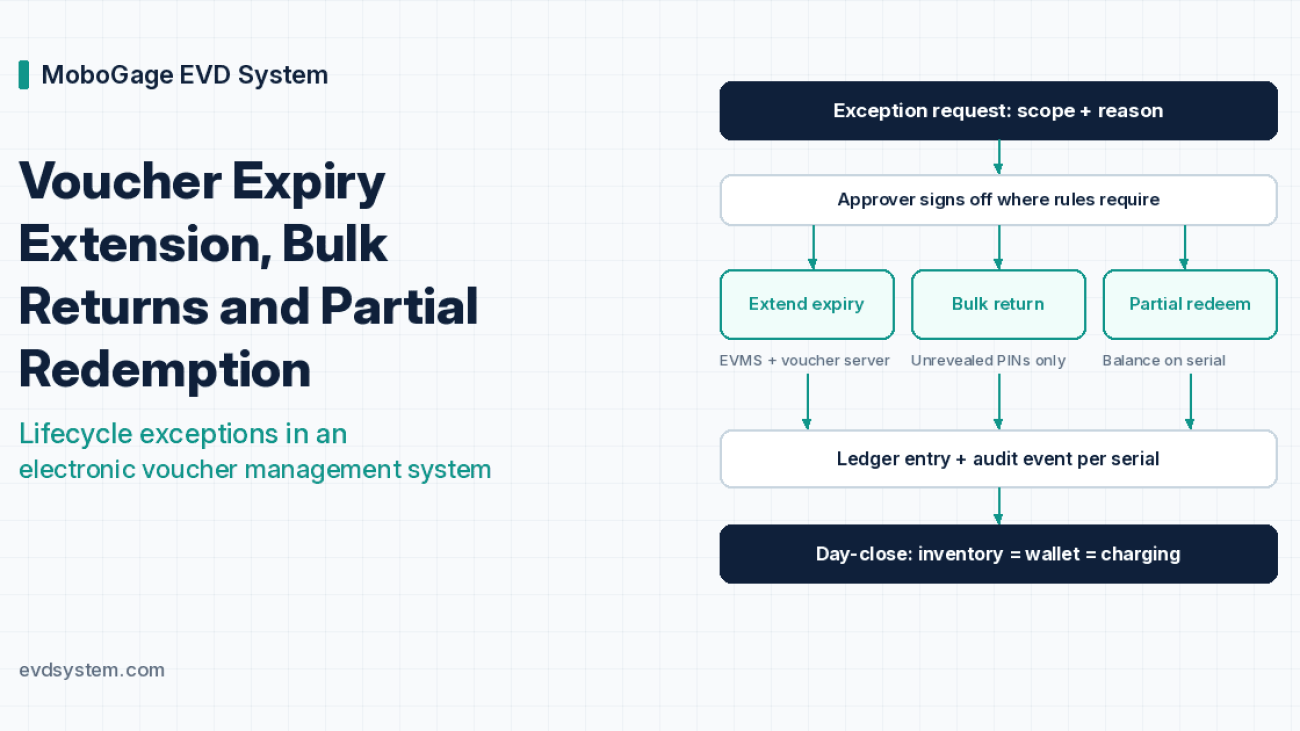
Short answer. Voucher expiry extension, bulk return of unsold stock and partial redemption are the lifecycle exceptions that most frequently break reconciliation in an electronic voucher management system (EVMS). All of them change the state or value of vouchers that already exist. So each one has to run as an approved, logged event with a named scope (batch, serial range or single serial), a matching entry in the dealer wallet ledger, and the same change applied on the operator’s voucher or charging platform.

  • Expiry extension moves the expiry date of unsold or unredeemed vouchers. The date has to change on the system that validates redemption, not only in the distribution layer.
  • Bulk return pulls unsold PINs back from a dealer node into inventory and credits the dealer. Only stock that was never revealed, printed or exported qualifies.
  • Partial redemption lets one voucher be spent more than once until its value runs out. It belongs to gift cards and stored-value vouchers, while standard airtime PINs redeem in full.

We build MoboGage EVD System, an electronic voucher management system for telecom operators and VAS partners. Below is how we handle those exceptions, what the audit trail has to show for each, and what to ask a vendor before you sign. Figures in the worked examples are illustrative, not customer data.

Why the exceptions decide whether an EVMS holds up

Demos show the clean path. You generate a batch, allocate it to a master dealer, sell a PIN on a POS terminal and watch the subscriber’s balance go up, and money rarely goes missing there because each of those steps is a standard transaction the platform already records.

It goes missing on a Thursday afternoon. A regional distributor calls: a promotion ended early, a denomination is being retired, and he is sitting on stock that expires at the end of the month. He wants more time, or his money back, or permission to split the value across smaller top-ups. Fair enough. Whichever he asks for, the vouchers involved are already in the field, already counted in someone’s wallet and already loaded on the operator’s voucher server.

Handle that call with a database script and a phone call and finance finds out at month-end. Our glossary has a name for what they find: an unexplained variance. An electronic voucher management system earns its licence fee when requests like his turn into routine tickets that close cleanly.

The terms, defined

TermWhat it meansTypical requesterWhat it must never do
Voucher expiry extensionMoving the expiry date forward for vouchers that are not yet redeemedOperator product team, master dealerRevive a voucher that is already redeemed, blocked or cancelled
Bulk returnTaking unsold vouchers back from a dealer node into central inventory and crediting the dealerDistributor, sub-dealerAccept PINs that were revealed to a customer, printed or exported
Partial redemptionRedeeming part of a voucher’s value and keeping the remainder usableGift card or stored-value programme ownerLet the remaining balance exceed the original face value
ReinstatementReturning a blocked or blacklisted voucher to sale after investigationFraud or revenue assurance teamBypass the original block reason or approver
Forced expiryExpiring vouchers early, usually after a leak or a withdrawn productOperator, fraud teamHit stock that a dealer has already paid for without a matching credit

These sit on top of the normal lifecycle states (available, allocated, sold, redeemed, expired, cancelled) listed in our EVMS glossary. None of them adds a state. They move vouchers between existing states or change an attribute such as the expiry date or the remaining value, and the audit log has to record which of those happened.

Voucher expiry extension: change it where redemption checks it

Every voucher carries its expiry date in at least two places. The EVMS inventory uses it to decide whether the voucher can still be sold. The system that validates the PIN at redemption uses it too, whether that is the operator’s voucher server, the IN or OCS, or the EVMS itself when it owns redemption. On many IN platforms the voucher server keeps its own state for each serial and accepts or rejects the recharge request there.

Extend expiry in the EVMS alone and you get the worst kind of complaint: the dealer sells a PIN that our side says is valid, and the network refuses the subscriber’s recharge. Extend it only on the charging side and the EVMS stops selling stock that would redeem without trouble. The cure is a procedure. The extension request names a scope, is approved once, and is applied on both systems, with a confirmation back from each before the stock goes on sale again.

Worked example (illustrative figures). A master dealer holds 12,000 unsold 10-unit vouchers from batch B-2207, expiring on 30 November. The operator agrees to a 60-day extension for unsold stock only.

StepWhat happensRecord created
1. RequestProduct team raises an extension for batch B-2207, unsold serials only, new expiry 29 JanuaryRequest ID, scope, reason, requester
2. Scope checkEVMS counts eligible serials: 12,000 allocated or available; 3,180 already sold are excludedEligible serial list with count and value
3. ApprovalSecond approver signs off on the scope and the countApprover, timestamp
4. Apply in EVMSExpiry attribute updated on 12,000 serialsOne event per serial, linked to the request ID
5. Apply at redemptionSame serial range updated on the voucher server, confirmation file returnedCharging-side confirmation, count matched
6. ReleaseStock becomes sellable again once both counts agreeRelease event

Watch the sold-but-unredeemed vouchers. A shop or a subscriber may be holding a PIN that now expires before the unsold stock next to it in the same batch. Decide up front whether the extension covers those serials, and write that answer into the request.

Promotions with a fixed end date are the other trap, because extending the voucher leaves the bonus end date where it was, so the redemption rule has to be checked along with the date.

Denomination changes raise expiry questions for GCC and wider MEA operators. In July 2020 Saudi Arabia raised VAT from 5% to 15%. Operators and distributors then had to decide what to do with stock priced under the old rate. A scoped extension or a controlled withdrawal handles that kind of change in a few approved requests instead of weeks of manual fixes. Our EVMS guide for GCC telecom covers the wider requirements by market.

Bulk return of unsold stock: prove the PIN was never seen

With physical scratch cards, a return is a box coming back through the warehouse, and the card is either intact or damaged. Electronic vouchers raise a harder question, which is whether anyone has seen the PIN.

Whoever saw a PIN can redeem it, whether it was shown on a POS screen, sent in an SMS, printed on a receipt or written to an export file. Take that serial back into inventory and resell it, and two people may hold the same value.

So the rule is short: a serial qualifies for return only if it was allocated to the dealer node and never revealed.

Applying it is harder. It depends on the platform keeping a reveal log per serial, and an EVMS that can only report that a voucher was “allocated to dealer D-0418” has no way to tell you whether the dealer’s terminal pulled the PIN down into an offline cache. Ask about this directly, since offline-tolerant POS terminals are built to do exactly that.

Return checkWhy it mattersReject if
Serial belongs to the requesting nodeStops one dealer returning another’s stockSerial allocated elsewhere or moved by transfer
No reveal, print or export eventA seen PIN can be redeemed by someone elseAny reveal event exists, including offline cache download
Not redeemed at the charging sideThe EVMS may lag the voucher serverCharging platform shows a redemption
Inside the return windowProduct rules and expiry limitsReturn requested too close to expiry, per the agreed policy
Wallet credit matches purchase priceDealer paid net of commissionCredit amount would include commission already earned

Then the wallet. If the dealer bought stock at face value less a 3% commission (illustrative), the return credits the net amount, and any commission already posted up the hierarchy has to be reversed as well. In a multi-level chain one return can produce three or four ledger entries. Our post on multi-tier reseller voucher distribution explains how float and commission move through the hierarchy, and CreditSync covers distributor credit operations.

Accepted serials go back to central inventory as available, or into quarantine if the operator wants them held before reallocation. We usually suggest a day of quarantine, so that a late redemption reported by the charging side surfaces before the stock is sold to someone else.

Partial redemption: a balance, not a reissue

With partial redemption one voucher is spent in parts: a 100-unit gift voucher pays for a 40-unit purchase and keeps 60 for later. Gift card and stored-value programmes work this way, and so do bundles that carry several entitlements, such as a voucher that includes data plus a streaming subscription.

Airtime PINs don’t. Redemption credits the full face value to the subscriber’s account, and from that moment the balance belongs to the operator’s charging system. When a product team asks for “partial redemption” on airtime vouchers, they usually want something else: a voucher that can be split across several numbers, or a PINless top-up from dealer float where any amount can be sent. That second case is exactly the job eTopup was built to do.

Where partial redemption does apply, we hold the remaining value as a ledger balance attached to the serial. Each redemption posts as a debit with its own transaction reference, and the voucher stays redeemable until the balance reaches zero or the expiry date passes. Cancelling the original voucher and issuing a new one for the remainder looks simpler and causes damage: the audit trail breaks, the number of PINs in circulation doubles, and expiry rules become hard to reason about.

Retries need care. As with any redemption, a retried request carrying the same reference must not take the value twice. If the redemption call times out, nobody knows the remaining balance until a status query comes back. Our article on airtime top-up timeouts and unknown status walks through how that state is settled.

What the audit trail should show for each exception

An auditor reviewing any of these events wants to know who asked, who approved, exactly which serials were touched and how the books moved. The table below is the minimum we would accept.

EventScope recordedApproverWallet or ledger effectShows up at day-close as
Expiry extensionBatch ID, serial range, count, old and new dateSecond approver, product or financeNoneInventory attribute change, count reconciled with charging confirmation
Bulk returnDealer node, serial list, count, valueDistributor manager plus operator financeCredit to dealer wallet at net price, commission reversal up the chainInventory increase, wallet credit, commission reversal
Partial redemptionSerial, amount, remaining balance, channelNone (customer-initiated)Debit on the voucher balanceRedemption volume and value, open balances report
ReinstatementSerial or range, original block reasonFraud or revenue assurance leadNoneState change from blocked to available
Forced expiryBatch or range, reasonOperator plus fraudCredit to affected dealers if stock was paid forInventory decrease, wallet credits

In MoboGage EVD System, a person approves any mass cancel, forced expiry or balance correction, and that approval is logged, with the same discipline carried over to the exceptions above. At day close the platform matches its sales against the operator’s redemption records, and the voucher reconciliation and PIN security post shows how these events feed that match. The EVMS architecture guide shows which component owns each record.

Questions to put to any EVMS vendor

Ask these in the RFP. Then ask them again in the demo, and insist on seeing the actual screen and the audit record behind it rather than a slide that describes them.

  1. Can an expiry extension be scoped to unsold serials only, and how is the same change applied on the operator’s voucher server?
  2. Does the platform keep a per-serial reveal log, including PINs downloaded to offline POS caches?
  3. When a dealer returns stock, how are commissions already paid up the hierarchy reversed, and in which report do I see it?
  4. Which voucher products support partial redemption, and where is the remaining balance stored?
  5. Which of these actions need a second approver, and can that rule be configured per product?
  6. If an exception is applied in the EVMS but the charging-side update fails, what state are the vouchers left in?

For a broader comparison of platforms, our guide on how to choose an electronic voucher management system has the full checklist. If you are moving off an older system, map these exception rules before cutover; the EVMS migration playbook explains why unmapped states cause most cutover disputes.

If a batch has already expired, see how expired voucher reactivation and blocked batch reinstatement works.

Frequently asked questions

Can an expired voucher be reactivated?

Not by editing the voucher back into a redeemable state. In most charging platforms, putting expired unsold stock back on sale means extending or removing the batch expiry under approval and setting the batch back to Active, with stricter checks than an extension made in time. For a PIN a customer already holds, the usual route is new stock or an approved credit, which is why extensions should be applied before the expiry date.

What is a bulk return in voucher management?

A bulk return takes unsold vouchers back from a distributor or dealer into central inventory and credits the dealer’s wallet. In an electronic voucher management system, only vouchers that were never revealed, printed or exported should be accepted, because anyone who has seen a PIN can still redeem it.

Is partial redemption possible for telecom airtime vouchers?

Standard airtime PIN vouchers redeem their full face value into the subscriber’s balance in one step. Partial redemption is used for gift cards, stored-value vouchers and multi-entitlement bundles, where the remaining value is tracked as a balance on the voucher serial.

Who should approve a voucher expiry extension?

A second approver from product or finance should sign off on the scope (batch, serial range and count) before the change is applied. The request, the approval and each serial’s update should share one reference so the change can be traced at day-close.

Does a voucher expiry extension need to be applied in the charging system?

Yes, whenever the operator’s voucher server or charging platform checks expiry at redemption. If only the EVMS is updated, dealers can sell vouchers that the network then rejects. Both systems should confirm the same count before the stock is released.

How does MoboGage EVD System handle voucher lifecycle exceptions?

In MoboGage EVD System, expiry changes, returns, forced expiry and reinstatement are approved lifecycle events. Each one records its scope, approver and ledger effect, and each is carried into the daily reconciliation. Integration with each operator’s voucher or charging platform is scoped per project. Anonymised project write-ups are on our case studies page, with operator details removed.

Next step

If your team handles returns and extensions in a spreadsheet, list the last three exceptions you processed and where each one was recorded, and the gaps in your current process will show up in that list. To walk through how MoboGage EVD System would handle your exception rules, contact our team.